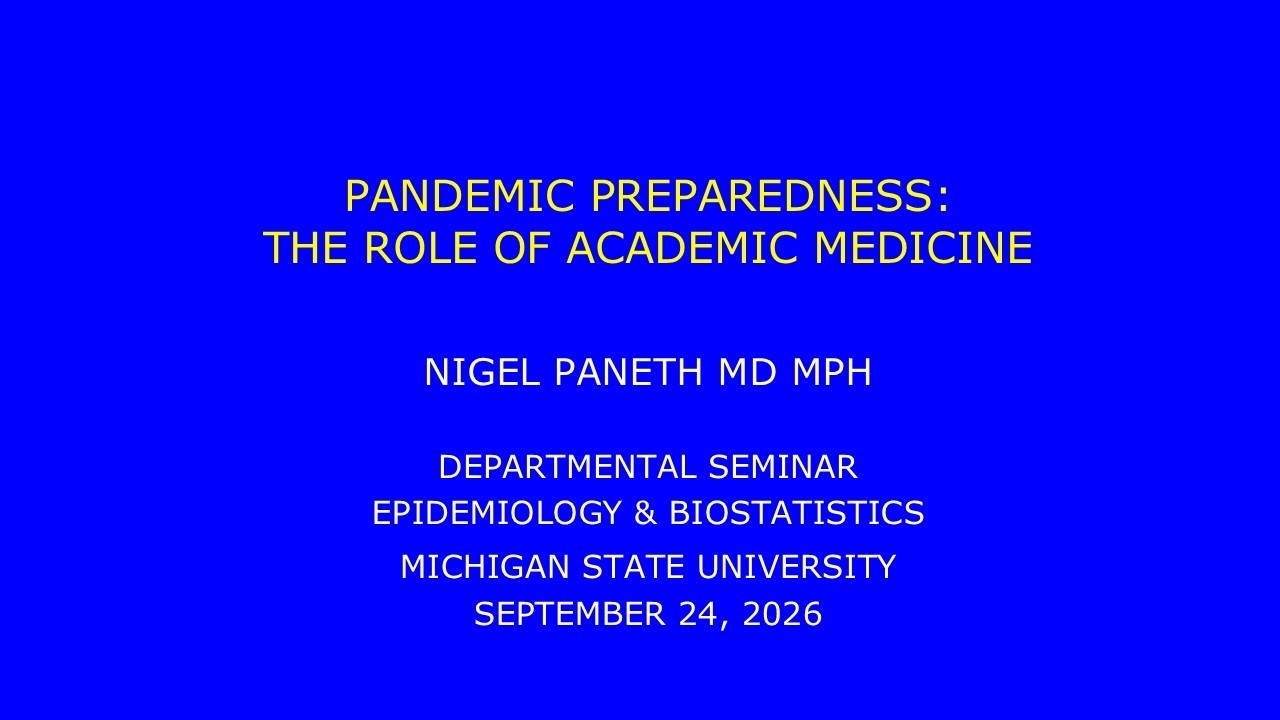
Seminar SERIES - Dr. Nigel Paneth, MD, MPH
Keywords
Summary
157 words
Critical Evaluation
Value of the Information & Strength of the Argument
The talk offers substantial value by synthesizing a broad range of pandemic preparedness issues into a coherent framework. The speaker’s argument is structured and persuasive, moving from the inevitability of pandemics to specific planning components and institutional roles. He effectively uses historical examples (cholera, 1918 influenza, HIV) to contextualize current threats and highlights the fragility of just-in-time supply chains with the Baxter IV fluid example. The argument for academic medicine’s unique role in evaluating interventions is well-supported by the COVID-19 convalescent plasma case, where he contends that evaluation was flawed and that alternative methodologies should be embraced. However, the argumentation occasionally relies on personal anecdote and rhetorical asides (e.g., comments about NIH, mirror bacteria) that, while engaging, are not fully substantiated. The call to ‘use all available information’ is sound but lacks detailed operational guidance. Overall, the reasoning is clear and logically progressive, though some claims would benefit from more rigorous evidential support.
Scientific Rigor, Source Quality, Title Accuracy
Scientific rigor is moderate: the speaker is a credible expert, but the seminar format allows for informal claims without citations. No specific studies or data sources are cited in the transcript, except for a passing mention of a Science paper on mirror bacteria co-authored by MSU researchers (Rich Lensky and Jim Fiji) and a paper by Dr. Gomez Morial on antimicrobial resistance. The title is generic and does not reflect the content, though the description clarifies the topic. The talk is explicitly framed as work in progress, inviting feedback, which suggests a degree of intellectual honesty but also indicates that the material is not fully polished or peer-reviewed. The lack of a reference list or slides in the transcript limits the ability to verify specific assertions.
294 words
Title / Content Match
The title 'Seminar SERIES - Dr. Nigel Paneth, MD, MPH' accurately reflects the format (a seminar) and speaker, but is generic and does not convey the specific topic of pandemic preparedness. The description provides the actual subject matter.
Quality & Reliability
7/10
The speaker is a credentialed epidemiologist (MD, MPH) presenting a structured expert synthesis on pandemic preparedness. The content is logically organized around seven planning components and draws on historical and contemporary examples. However, the talk is explicitly described as 'work in progress' and relies heavily on the speaker's personal experience and selected case studies rather than systematic evidence review. No formal citations are provided in the transcript, and some claims (e.g., about mirror bacteria, NIH) are anecdotal or rhetorical. The absence of a full reference list limits verifiability.
Key Moments
Markers derived by PSI from the transcript: the creator did not define chapters.
- Introduction: speaker's background and the surprising lack of attention to pandemic preparedness in epidemiology.
- Definition of pandemic and overview of the seven components of pandemic planning.
- Discussion of 21st-century pandemics: H1N1, SARS, COVID-19, monkeypox, Ebola, Zika, MERS, and antimicrobial resistance.
- Detection systems: vital data, sentinel practices, electronic medical records, wastewater surveillance, genomic surveillance.
- Mitigation strategies: non-pharmaceutical interventions, masking, school closures, and economic considerations.
- Prevention and treatment: vaccines, universal influenza vaccine efforts, passive antibody therapy, convalescent plasma.
- Non-governmental stakeholders: pharmaceutical companies, manufacturers, medical facilities, blood banks, media, academic medicine.
- Case study: improper evaluation of convalescent plasma during COVID-19 and lessons for academic medicine.
- Conclusion: Michigan state-level planning efforts and the need for stockpiles and supply-chain resilience.
Contribution & Novelties
The talk’s original contribution lies in its comprehensive, stakeholder-oriented framework for pandemic preparedness, emphasizing the often-overlooked role of non-governmental institutions, particularly academic medicine, in evaluating interventions. It provides a critical retrospective on the evaluation of convalescent plasma during COVID-19, arguing that academic medicine failed to use all available evidence and that alternative methodologies (propensity matching, time trends, dose-response) should be systematically employed. The speaker also introduces the concept of mirror bacteria as a speculative but emerging threat, and highlights the fragility of just-in-time supply chains with a concrete example (Baxter IV fluid plant). The call for statewide stockpiles and incentives for manufacturers adds a practical policy dimension.
Pour aller plus loin :
- Convalescent plasma — Wikipedia article on the history and use of convalescent plasma, relevant to the case study.
- Pandemic preparedness — Wikipedia overview of pandemic planning frameworks and components.
- Passive antibody therapy — Wikipedia article on passive immunity, including convalescent plasma and monoclonal antibodies.
- Mirror life — Wikipedia article on mirror life, a speculative concept mentioned by the speaker.
- Antimicrobial resistance — Wikipedia article on AMR, cited as a silent pandemic threat.
184 words
Radar Profile
The radar profile shows a balanced emphasis on information quantity and quality, with slightly lower technical depth due to the seminar's broad scope. Reliability is solid, reflecting the speaker's expertise, but not maximal due to the informal, work-in-progress nature of the talk. The profile suggests a well-rounded, credible overview suitable for a professional audience.