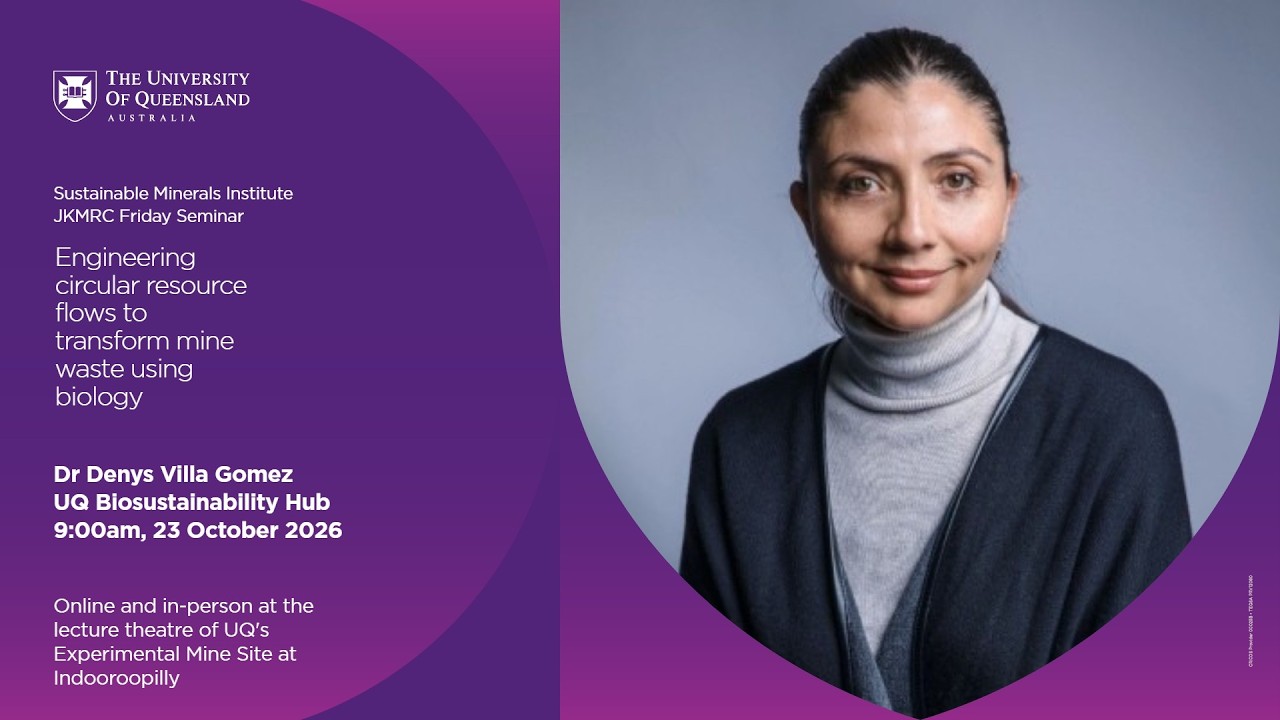
JKMRC Friday Seminars 2026 Engineering circular resource flows to transform mine waste using biology
Title history
- JKMRC Friday Seminars 2026 Engineering circular resource flows to transform mine waste using biology — observed on 20261028-0748 UTC (YouTube)
Keywords
Summary
150 words
Critical Evaluation
Value of the Information & Strength of the Argument
The value of this seminar lies in its comprehensive overview of applying biotechnology to mining waste, presenting concrete examples with preliminary results. The argumentation is solid, grounded in experimental data from the speaker’s lab, and acknowledges both advantages and current limitations of biological methods. The speaker compares biological approaches to conventional chemical methods, highlighting trade-offs in kinetics and scale-up, but counters with the potential for selectivity and reduced environmental impact. The presentation is well-structured, logically flowing from principles to applications.
Scientific Rigor, Source Quality, Title Accuracy
The seminar references peer-reviewed research and collaborations, but the video itself does not provide detailed citations except a link to the SMI webinar archive. The speaker mentions a recent report by Novonesis on bio-solutions, but no URL is given. The title accurately matches the content, and the presentation is scientifically rigorous in its methodology, though it remains a seminar rather than a formal peer-reviewed publication. The discussion of adaptive laboratory evolution and proteomics indicates high technical rigor.
172 words
Title / Content Match
The title accurately reflects the content, focusing on using biology to transform mine waste into resource flows.
Quality & Reliability
8/10
Presentation by a senior lecturer with published research, but primarily a seminar with limited peer review in the video itself.
Key Moments
Markers derived by PSI from the transcript: the creator did not define chapters.
- Introduction and acknowledgments
- Red mud processing with fungi: organic acids for critical metal recovery
- Metal-binding proteins and peptides for selective rare earth recovery
- Biological sulfur reduction and oxidation for elemental sulfur recovery
- Methane mitigation with methanotrophs and cyanobacteria for carbon sequestration
Cited Sources
- SMI Webinars — List of past webinars, including this seminar.
Contribution & Novelties
The seminar provides an original perspective by showcasing a diverse range of biotechnological applications for mine waste valorization, integrating omics, synthetic biology, and bioprocess engineering. The ‘SynBiomining’ framework is introduced as a systematic approach to translate biological capabilities into mining applications, offering a novel pathway for circular economy and decarbonisation in the minerals sector.
Pour aller plus loin :
- Biomining — Overview of microbial processes for metal extraction from ores and waste.
- Synthetic biology — Engineering of biological systems for industrial applications, relevant to the speaker’s approach.
- Bioleaching — Specific technique using microbes to dissolve metals, closely related to the seminar’s examples.
102 words
Radar Profile
The scores indicate high information quality and reliability, but slightly lower technical depth, suggesting an accessible yet authoritative presentation.