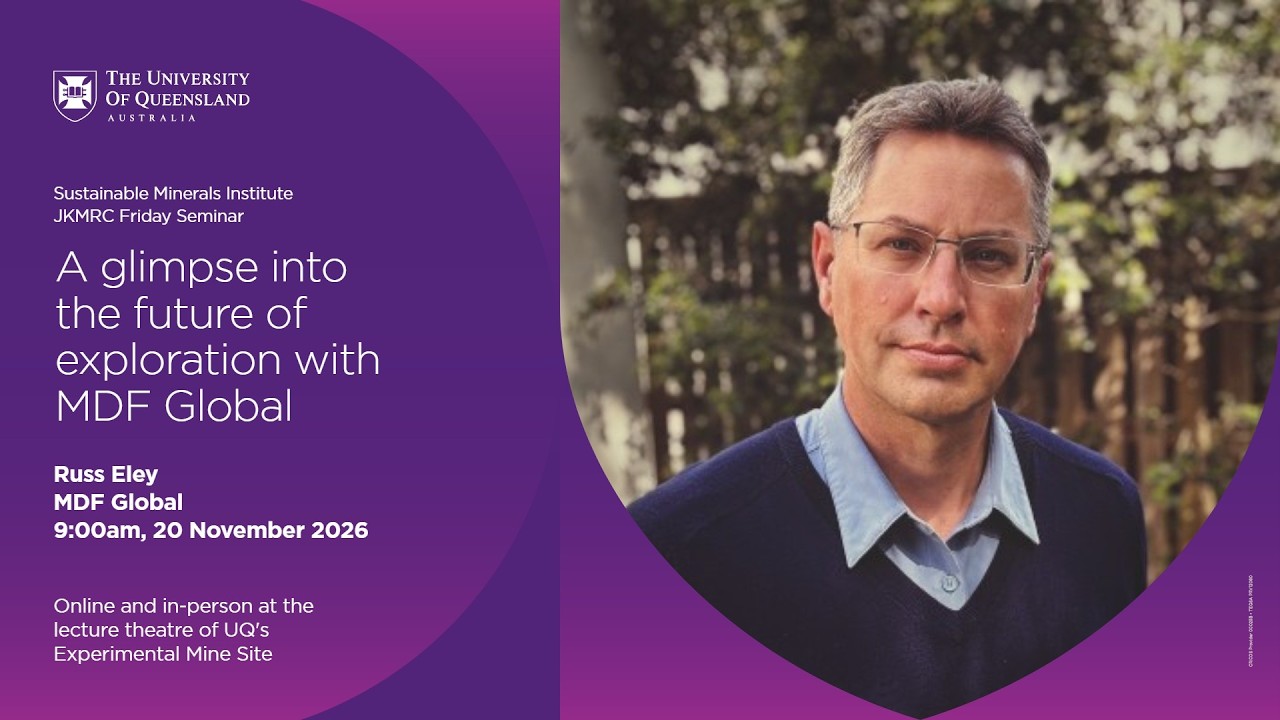
JKMRC Friday Seminar 2026: A glimpse into the future of exploration with MDF Global
Keywords
Summary
257 words
Critical Evaluation
Value of the Information & Strength of the Argument
The informational value lies in the industrial and operational picture rather than in scientific results. The speaker gives a coherent, if familiar, diagnosis of the supply side of the metals story: demand growth driven by electrification and data centres, a large endowment of known metal that is difficult to convert into reserves for technical, depth or grade reasons, decades-long lead times between discovery and production, and a discovery success rate he puts at about one in a thousand, which makes exploration look comparatively attractive against drug development or new consumer technology. The argument is structured as a chain - rising demand, poor conversion, high-risk exploration, land and capital competition, social and environmental constraints - leading to a single conclusion: the priority is not more discoveries but better ones, in jurisdictions and settings where a mine could actually be permitted and built. That reframing of the problem is the most defensible and interesting part of the talk. The second half shifts from argument to product demonstration, where the reasoning becomes thinner: the value of the platform is asserted through screenshots (hexagonal prospectivity maps, commodity toggles, decision-tree scores, a pipeline funnel, benchmarking charts) rather than evidenced by outcomes. Key quantities that would justify the claims - cost, accuracy of the automated scores against known deposits, false-positive rates, time or money saved per target tested - are withheld or absent, and the speaker explicitly declines to disclose development cost. Evidence for project quality is impressionistic (‘awesome signs’, ‘remarkable’ grades) and the talk was cut off before any results or caveats about the tool could be presented. The most substantive argumentative move is the insistence that above-ground risk is screened first, before geological potential, which is a genuine methodological choice with real economic consequences, but it is not tested against alternatives anywhere in the recording.
Scientific Rigor, Source Quality, Title Accuracy
No external sources are cited anywhere in the talk. Statistics are attributed vaguely (‘I’m quoting Rio Tinto there’ for the one-in-a-thousand odds, an approximate 70% share of significant discoveries by juniors) with no report, year or dataset identified, and the numbers are not shown on screen in the transcript. The only documentary trail is the description’s link to the Sustainable Minerals Institute webinar archive, plus a reference to the speaker’s own earlier seminar in the same series, which is presented as background rather than as evidence. Claims about the software’s capabilities rest entirely on the presenter’s authority and on partial screen captures; no validation, benchmark or independent assessment is offered, and the presenter himself flags that not all company data is yet loaded and that he avoided live demonstration. Commercial framing is explicit throughout - the platform is proprietary, the projects are proprietary or pre-IPO, and the seminar functions in part as exposure for the company - which is legitimate in this format but limits the credibility that can be granted to performance claims. On title fit: the talk does provide a company-based glimpse of exploration technology as announced, though the opening career narrative and the abrupt ending leave the final quarter of the promised content unrecorded. No audience comments were supplied, so no assessment of public reception is made.
536 words
Title / Content Match
The talk does deliver what the title promises: a company case study plus a first look at MDF Global's 'Mineralize' platform, framed as a glimpse of exploration's future. A long autobiographical opening and a truncated ending dilute the fit somewhat but do not contradict it.
Quality & Reliability
5/10
First-hand industry testimony from a senior exploration geologist with 30 years of experience, with concrete detail on company structure, projects and software architecture. However, the seminar is largely a corporate showcase: no external citations, no published data, several statistics quoted from memory (one-in-a-thousand discovery odds attributed to Rio Tinto, 70% of discoveries made by juniors), and all claims about the in-house platform's performance are self-reported and unverifiable from the transcript. Transparent about limitations in places (data not fully loaded, no live demo), which slightly improves credibility.
Key Moments
Markers derived by PSI from the transcript: the creator did not define chapters.
- Opening of the talk proper: exploration is framed as a people problem first, with tools meant to help 'the best geologists get onto the right rocks'.
- Career narrative: Liverpool, Great Gable in the Lake District, Earth Sciences at Leeds, and the brutal Rio Tinto graduate interview that redirected him.
- Professional trajectory: gold in Kenya, diamonds in Angola, BHP and Rio Tinto global generative teams, Rio's Americas team, then MDF Global.
- Recall of his 2023 seminar: the world is not running out of metal; the challenge is making 'better' discoveries, not more of them.
- The case for innovation: copper demand and record prices, data centres and EVs, slow conversion of resources into reserves, one-in-a-thousand discovery odds.
- Competition for prospective land, for investment dollars against AI-themed listings, and the need to 'tread lightly' on undisturbed land.
- Presentation of MDF Global: founded 2020, systematic strategy, Alaska Native corporation partnerships, patient private capital, portfolio of entities.
- Introduction of 'Mineralize', built in-house in about four months, positioned as one integrated decision-support platform instead of many niche tools.
- Global prospectivity map built on ~50 x 50 km hexagons, with the gaming-inspired 'beacon' interface idea borrowed from Zelda.
- Above-ground development risk layer: protected areas, roads, rail, ports, climate and terrain scored first to narrow the search space.
- Human-in-the-loop scoring: interrogable decision trees, manual overrides recorded with author and timestamp, peer thumbs-up/thumbs-down QA/QC.
- Exploration pipeline funnel from automatically ranked global cells to advanced projects such as the Treasure Creek antimony-gold system.
Cited Sources
- Sustainable Minerals Institute — JKMRC Friday Seminars webinar archive — Only link given in the video description; host page for this seminar series and past recordings, including the speaker's earlier talk referenced in the presentation.
- Speaker's earlier JKMRC seminar on global metal endowment and exploration myths (approx. 2023) — Referenced verbally as the predecessor to this talk; no URL supplied, viewed on the SMI webinar archive.
- Rio Tinto exploration success-rate statistic (one discovery per thousand targets) — Quoted from memory during the talk as coming from Rio Tinto; no report, year or document identified.
Concurring Sources
- USGS Mineral Commodity Summaries — Independent baseline for copper and critical-mineral supply, demand and reserve statistics.
- IEA — The Role of Critical Minerals in Clean Energy Transitions — Corroborates the demand-growth argument for copper and battery minerals.
- Porphyry copper deposit (Wikipedia) — Technical grounding for the deposit types central to the company's portfolio.
Dissenting Sources
- Peak minerals (Wikipedia) — Presents the depletion and declining-ore-grade perspective that the speaker's 'we are not running out of metal' framing sets aside without discussion.
Contribution & Novelties
The genuinely novel element is the demonstration that a small exploration company can build its own integrated decision-support platform in roughly four months rather than subscribing to generic GIS suites or many single-purpose tools. Two design choices stand out: scoring the entire planet in ~50 x 50 km hexagonal cells with above-ground development risk applied before geological potential, so that capital is not spent on targets that could never be permitted; and a transparent, human-overridable scoring system where every manual adjustment is attributed, timestamped and peer-reviewed, which addresses the usual opacity objection to algorithmic targeting. The talk also contributes a concrete instance of an equitable exploration model in Alaska, where Native corporations own the mineral rights, invest directly and act as partners. What is not demonstrated is whether any of this improves discovery outcomes.
Pour aller plus loin :
- Mineral exploration — Overview of targeting methods and the exploration workflow that the platform seeks to unify.
- Porphyry copper deposit — Deposit model behind the Copper Bay and Wiseman Metals projects discussed.
- The Role of Critical Minerals in Clean Energy Transitions (IEA) — Reference framing for the demand-side argument used to justify the need for new discoveries.
- Alaska Native corporation — Institutional background for the land-and-mineral-rights partnership model praised in the talk.
- Mineral prospectivity mapping and weights-of-evidence / decision-tree scoring — standard geoscientific approach that the ‘Mineralize’ scorecards effectively operationalise at global scale; no single canonical URL cited here.
238 words
Radar Profile
The profile is that of an applied industry seminar: moderate to good informational density and technical level, since it combines market context, portfolio strategy and software architecture for a specialist audience, but middling on quality and reliability because almost every performance claim is self-reported and unsourced. Information quantity is limited by the truncated recording, which cuts off before the platform demonstration and any results could be assessed.