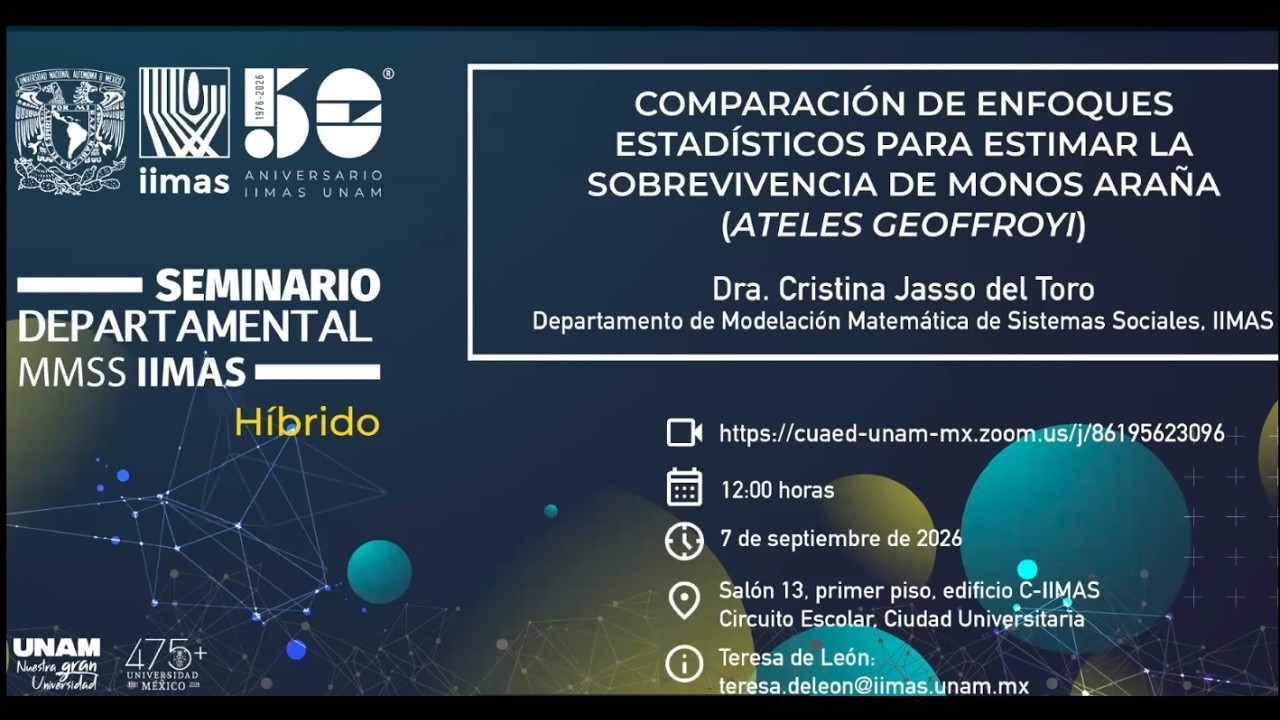
Comparación de enfoques estadísticos para estimar la sobrevivencia de monos araña (Ateles geoffroyi)
Comparison of statistical approaches to estimate the survival of spider monkeys (Ateles geoffroyi)
Keywords
Summary
179 words
Critical Evaluation
Value of the Information & Strength of the Argument
The talk delivers strong empirical value through a unique, long-term dataset (24 years) on a vulnerable species. The argumentation is clear and well-structured, logically moving from the description of the data and inherent challenges (censoring, dispersal) to the methodological rationale for comparing frequentist and Bayesian approaches. The specific contribution lies in explicitly integrating expert elicitation to handle the ‘disappeared individuals’ uncertainty, a practical and often overlooked problem in field ecology. The presenter convincingly explains why the Kaplan-Meier estimator fails to provide comparable metrics for males and how Bayesian methods can incorporate external knowledge to fill these gaps. The presentation is grounded in the speaker’s own doctoral and postdoctoral research, adding authority to the discussion and offering a replicable framework for other studies facing similar data limitations.
Scientific Rigor, Source Quality, Title Accuracy
The scientific rigor is high, evidenced by the use of established statistical techniques (Kaplan-Meier, Cox models, Bayesian survival models) and a carefully designed expert questionnaire. The research benefits from collaborations with statisticians and ecologists from IIMAS-UNAM and other institutions, as mentioned by the presenter. The speaker references her own previous publications on social structure and survival, indicating an ongoing line of rigorous research. The title is perfectly matched to the content; the presentation does precisely what it promises: it compares statistical approaches for estimating survival. The structure of the seminar, with clear objectives and preliminary results, maintains scientific integrity. Methods are explained sufficiently to allow replication by other researchers in the field.
253 words
Title / Content Match
The title accurately describes the content, which systematically compares frequentist and Bayesian approaches to estimate spider monkey survival.
Quality & Reliability
8/10
The presentation is based on 24 years of longitudinal field data (1997-2020) on a spider monkey group, involving 127 individuals. It uses standard frequentist (Kaplan-Meier) and Bayesian parametric survival models, and integrates expert elicitation to handle censored individuals. The speaker is a postdoctoral researcher with relevant publications. Results are preliminary but methodologically sound.
Key Moments
Markers derived by PSI from the transcript: the creator did not define chapters.
- Introduction and logistical announcements for the departmental seminar series.
- Formal introduction of speaker Cristina Jasso del Toro and her academic background.
- Definition of survival analysis and its key components (time-to-event, censoring).
- Comparison of frequentist and Bayesian statistical interpretations and methodologies.
- Discussion of specific challenges in estimating survival for wild animals (small samples, rare deaths).
- Presentation of the study species (spider monkeys) and the 24-year dataset (127 individuals, 49 males, 78 females).
- Presentation of Kaplan-Meier survival curves, showing limitations for male survival estimation.
- Explanation of the expert elicitation process using a 12-scenario questionnaire for disappeared individuals.
- Integration of expert opinion as prior information into Bayesian survival models.
- Presentation of preliminary Bayesian model results and comparison with frequentist outputs.
Contribution & Novelties
The original contribution lies in the pragmatic application of Bayesian survival analysis combined with formal expert elicitation to a data-scarce but ecologically critical species. By directly addressing the uncertainty of ‘disappeared’ individuals through structured expert opinions, the work offers a replicable framework for conservation biology when longitudinal data is incomplete. The comparison between frequentist and Bayesian approaches on the same dataset provides a valuable methodological reference for ecologists facing similar challenges.
Pour aller plus loin :
- Survival analysis — Core methodological foundation of the talk.
- Bayesian inference — The statistical framework used for the alternative models.
- Expert elicitation — The technique used to gather prior information for the Bayesian models.
- Geoffroy’s spider monkey — The specific species studied, highlighting its conservation status.
122 words
Radar Profile
The radar shows a balanced profile with high scores across quantity, quality, technique, and reliability. This reflects a well-rounded scientific presentation that combines robust empirical data (24 years) with advanced statistical modeling and a thoughtful engagement with methodological uncertainty.