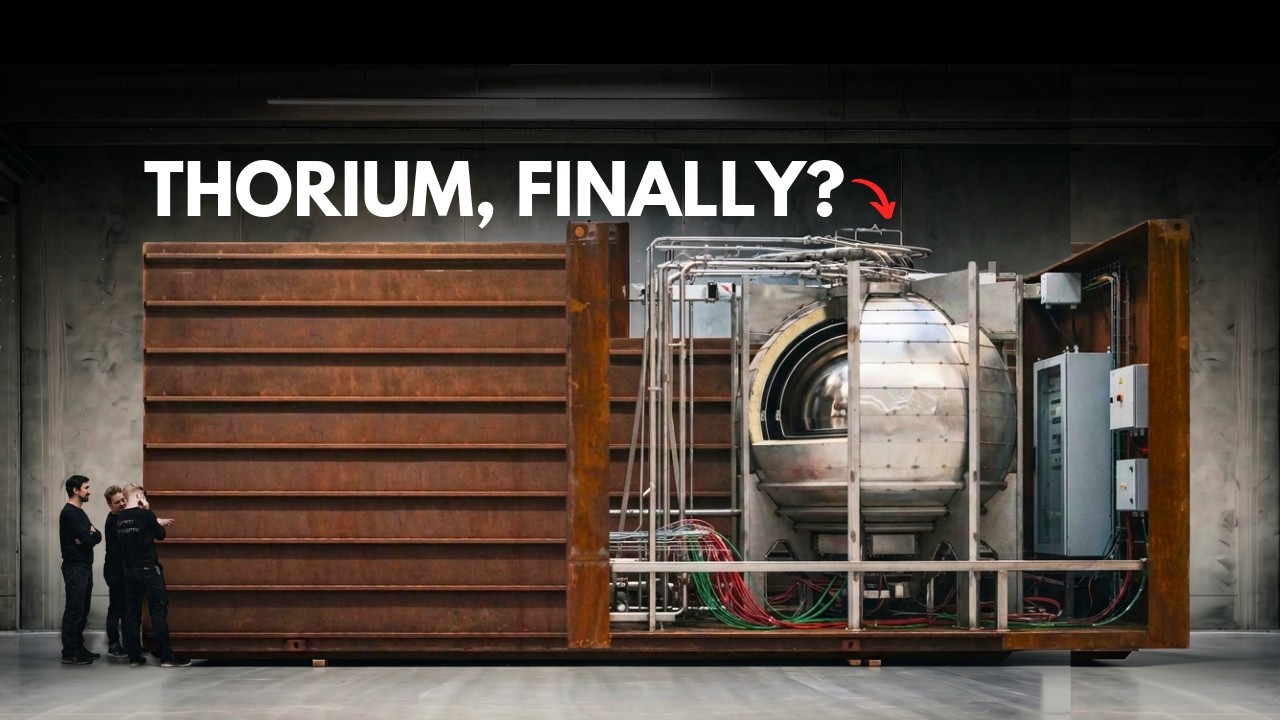
This Nuclear Reactor Runs on Thorium and Could Be Cheaper Than Coal?
Title history
- This Nuclear Reactor Runs on Thorium and Could Be Cheaper Than Coal? — observed on 20261117-0044 UTC (YouTube)
Keywords
Summary
169 words
Critical Evaluation
Value of the Information & Strength of the Argument
The video provides substantial value by translating complex reactor physics and materials science into accessible explanations, illustrated with interviews and laboratory tours. The argumentation is logically structured: it starts with the fundamental neutron economy, then systematically addresses each challenge (corrosion, lithium-6 poisoning, geometry) and presents Copenhagen Atomics’ solutions. The company’s approach—emphasizing salt purification over exotic alloys—is convincingly backed by comparative experimental data and published results. However, the narrative is inherently promotional, and some claims (e.g., cost competitiveness with coal) are presented without independent economic analysis. The video acknowledges uncertainties, such as the proprietary lithium enrichment process, and offers a transparent look at ongoing tests, which strengthens its credibility.
Scientific Rigor, Source Quality, Title Accuracy
The video cites peer-reviewed literature (Journal of Nuclear Materials) and historical ORNL reports on materials, demonstrating scientific grounding. The IAEA reference on thorium fuel cycle adds authority. The title matches the content well, as the reactor’s viability and cost are central themes. The video maintains rigor by distinguishing between verified test results and speculative design projections, though the company’s commercial interest is transparent. No external or discordant sources are presented, limiting an independent critique, but the inclusion of historical pitfalls (e.g., Hastelloy N’s cost) shows a balanced perspective.
211 words
Title / Content Match
The title accurately reflects the content, which explores thorium-based molten salt reactor design and its potential for cheaper nuclear power.
Quality & Reliability
7/10
The video presents detailed technical explanations from a company's perspective, backed by peer-reviewed sources and internal tests, though potential commercial bias and limited independent verification temper the score.
Chapters
Cited Sources
- Copenhagen Atomics Official Website — Company site providing background on their thorium reactor development and mission.
- Salt purity and 316L stainless steel corrosion (Journal of Nuclear Materials) — Peer-reviewed study on salt purification and corrosion resistance, co-authored with University of Liverpool and Copenhagen Atomics.
- Status of Materials Development for Molten Salt Reactors (ORNL/TM-5920, 1978) — Historical ORNL report detailing early molten salt reactor material challenges and Hastelloy N development.
- Materials Development for Molten-Salt Breeder Reactors (ORNL-TM-1854, 1967) — Earlier ORNL report on materials science for molten salt breeders, referenced for corrosion data.
- Thorium Fuel Cycle: Potential Benefits and Challenges (IAEA-TECDOC-1450) — IAEA technical document discussing the thorium fuel cycle, cited for its geological and economic context.
External References
Contribution & Novelties
The video offers an inside look at a private company’s iterative engineering approach to thorium reactors, distinguishing itself from academic or government projects by emphasizing cost-effective solutions—notably using purified salts with standard stainless steel rather than expensive nickel alloys. It provides a realistic assessment of the technical hurdles and the multi-decade effort required, while also highlighting the potential synergy of lithium-6 production for fusion. The presentation of the ‘Onion’ geometry and its neutron economy is an original contribution in popularizing a specific design.
Pour aller plus loin :
- Molten salt reactor — A general overview of MSR technology and its variants.
- Thorium fuel cycle — Detailed description of thorium breeding and comparison with uranium.
- Hastelloy N — The nickel alloy referenced in historical MSR development.
- Lithium-7 — Isotopic properties critical for neutron economy in this reactor design.
137 words
Radar Profile
The radar profile shows high scores across all metrics, with a slight dip in global reliability due to the for-profit context and limited peer review of some claims. The strong technical depth and transparency in testing balance the promotional aspects, yielding a robust overall assessment.