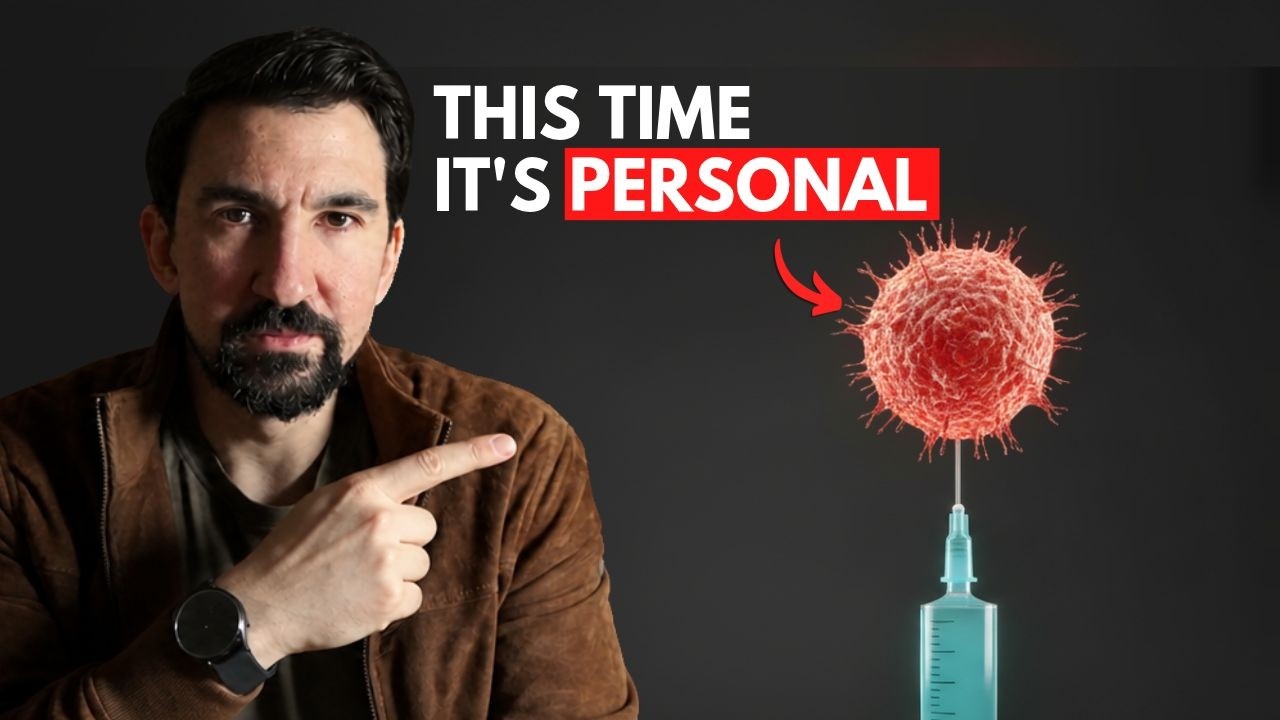
This Vaccine Stops Cancer, and It’s About to Enter Mass Production
Keywords
Summary
309 words
Critical Evaluation
Value of the Information & Strength of the Argument
The informational value is high and unusually well structured for the format. Rather than announcing a result and padding it, the presenter spends the first third of the runtime constructing the mechanism the result depends on — antigen processing, MHC display, T-cell receptor specificity, memory formation — so that the later therapeutic claims land on understood ground. Each abstract idea is converted into a concrete number or image: the proteasome as a barrel cutting a fragment, tens of millions of distinct T-cell receptors, a cubic-millimetre tumour sample, a 1,192-versus-11 mutation comparison. The argumentative spine is explicit and honest in its ordering: cancer is invisible to the immune system, neoantigens make it partially visible, PD-L1 blinds the response, checkpoint blockade removes the blindfold but only works for a minority, and personalisation supplies the missing targeting information. This is a genuine causal chain, not a list of findings, and the presenter uses the failed shared-antigen vaccine era as the counterfactual that motivates the individualised design — a strong rhetorical move that also happens to be the actual scientific rationale. Quantitative claims are handled carefully in the key place: the observation that the survival curves are nearly identical for the first six months and separate only once dosing ends is presented as evidence of mechanism rather than as a curiosity, and the distinction between recurrence-free survival and overall survival is stated rather than glossed over, as is the fact that a placebo-controlled arm was required to prove the vaccine adds anything to pembrolizumab alone. Weaknesses are of the ordinary science-communication kind. Some mechanisms are compressed into single clauses, and the segment describing pembrolizumab response rates is delivered loosely enough that the figures do not fully parse. The cost section leans on an analogy to genome sequencing, which is suggestive rather than demonstrative — sequencing scales differently from per-patient GMP manufacturing, and the video’s own description of a ‘factory for 100,000 different drugs a year’ undercuts the smooth cost-curve optimism that follows. There is also a mild tension between the closing ’new era’ framing and the acknowledged fact that a one-batch-per-patient product cannot benefit from the economies of scale that made modern biologics cheap. A clearly demarcated sponsor segment of roughly one minute around the 7:42 mark interrupts the argument; it is signposted and does not affect the assessment. Overall the reasoning is sound, the uncertainty is stated, and the enthusiastic register never quite displaces the evidence.
Scientific Rigor, Source Quality, Title Accuracy
Source quality is the strongest feature. The description links directly to the phase 2b KEYNOTE-942 publication in The Lancet, its 5-year follow-up in the Journal of Clinical Oncology, the 2015 Science study on intratumoural mutation heterogeneity, the 1995 Science neoantigen discovery paper and the 2010 NEJM prostate cancer vaccine trial, plus the sponsor’s own phase 3 summary. These are the correct primary references for the specific claims made, and the presenter attributes findings to named institutions and years rather than gesturing at ‘studies’. The distinction between the phase 3 recurrence data just presented at a conference and the peer-reviewed phase 2b data is maintained, and the absence of mature overall survival data is stated plainly — an omission that most coverage of this result made. Residual concerns: the congress presentation itself is cited through a corporate page rather than a peer-reviewed report, so the headline numbers rest partly on company communication until full publication; several mechanistic statements are simplified to the point of inaccuracy for a specialist (the description of proteasomal trimming and MHC loading compresses a multi-step pathway, and the checkpoint explanation collapses PD-1/PD-L1 signalling into a single on/off switch). On title fit, the promise of a vaccine that ‘stops cancer’ overstates a 29%-to-18% recurrence-risk reduction, and ‘about to enter mass production’ is contradicted by the body of the video, which describes a single-dose, single-patient manufacturing model still in regulatory discussion. The title is therefore a partial mismatch, driven by framing rather than by the content itself.
666 words
Title / Content Match
The 'stops cancer' framing is defensible only as a reduction in recurrence risk, not a cure, and 'about to enter mass production' sits uneasily with a product that is manufactured one batch per patient; the video itself acknowledges the cost and scale problem.
Quality & Reliability
8/10
The video is built on identifiable primary literature: the KEYNOTE-942 phase 2b publication in The Lancet, its 5-year update in JCO, the Science 2015 lung-tumour heterogeneity study, the 1995 neoantigen discovery paper and the NEJM prostate cancer vaccine trial, plus the sponsor's own phase 3 summary page. Claims are consistently tied to numbers (29% vs 18% recurrence, ~58% reduction after the vaccine course, ~38% reduction in distant metastasis) and the presenter explicitly flags what is not yet known, notably overall survival. Small imprecisions and loose phrasing remain (mechanistic simplifications, an unclear statement about Keytruda response rates, minor mispronunciations of proteasome/Keytruda), and the headline framing outruns the evidence on manufacturing scale.
Chapters
- Merck and Moderna’s Personalized Cancer Vaccine
- How T Cells and Vaccines Find Invaders
- Why Cancer Is Invisible to Your Immune System
- Neoantigens and PD-L1: Cancer’s Hidden Flags
- Keytruda and the Immunotherapy Breakthrough
- Why One Cancer Vaccine for Everyone Failed
- Ad Read
- How to Build a Personalized mRNA Cancer Vaccine
- Phase 3 Trial Results
- The Cost Problem
- A New Era of Cancer Treatment?
Cited Sources
- Recapping the Phase 3 INTERPATH results (Merck/Moderna) — Sponsor summary of the phase 3 recurrence-free survival results for the individualised neoantigen therapy combined with pembrolizumab in resected high-risk melanoma.
- KEYNOTE-942 Phase 2b (The Lancet, 2024) — Peer-reviewed phase 2b trial of mRNA-4157/V940 plus pembrolizumab in high-risk resected melanoma, the basis for the adjuvant design discussed.
- KEYNOTE-942 5-Year Update (JCO, 2026) — Long-term follow-up cited to support the claim that the benefit appears durable at around five years.
- Lung Tumour Mutation Study (Science, 2015) — Source for the 1,192-versus-11 protein-altering mutation comparison used to argue that mutation burden, and therefore target repertoire, is patient-specific.
- Prostate Cancer Vaccine Trial (NEJM, 2010) — Sipuleucel-T trial cited as the sole approved therapeutic cancer vaccine and its modest overall survival benefit of just over four months.
- Neoantigen Discovery (Science, 1995) — The 1995 University of Bonn work identifying mutated protein fragments displayed by MHC on tumour cells, framed as the conceptual origin of the approach.
Concurring Sources
- Individualised neoantigen therapy literature beyond melanoma (e.g. autogene cevumeran in resected pancreatic cancer) — Independent programmes using the same sequence-select-encode-mRNA logic report neoantigen-specific T-cell expansion, consistent with the mechanism described here.
- Checkpoint blockade pharmacology literature on PD-1/PD-L1 axis — Established understanding of pembrolizumab's mechanism and of the minority response rates in advanced melanoma matches the video's account.
- Genome sequencing cost trajectory (NHGRI human genome cost data) — The comparison between the first human genome's cost and current sequencing prices is broadly consistent with published cost curves, though the extrapolation to per-patient manufacturing is not established.
Dissenting Sources
- Editorial and regulatory caution on surrogate endpoints in adjuvant melanoma trials — Commentary in the oncology literature routinely cautions that recurrence-free survival is not a validated surrogate for overall survival in the adjuvant setting, which tempers the 'stops cancer' framing even where the trial result itself is accepted.
- Manufacturing and health-economics analyses of autologous personalised therapies — Health-economics work on patient-specific biologics generally finds weaker economies of scale than the sequencing analogy implies, which conflicts with the video's relatively optimistic cost trajectory.
External References
Contribution & Novelties
The video’s contribution is not new data but a complete mechanistic bridge between a headline trial result and the molecular biology that makes it plausible. Most coverage of the Merck/Moderna announcement reported the recurrence figures in isolation; here the numbers are placed at the end of a chain that begins with antigen processing and T-cell receptor specificity, continues through the neoantigen discovery and the PD-L1 escape mechanism, and explains why three decades of shared-antigen vaccines failed before the individualised design could be justified. Two elements stand out as genuinely useful synthesis: the observation that the survival curves separate only after the dosing course ends, presented as mechanistic evidence rather than as a statistical curiosity, and the honest separation of recurrence-free survival from the overall survival data that will take years to mature. The treatment of manufacturing economics is the least developed part, and the analogy to genome sequencing carries more rhetorical weight than analytical weight.
Further reading:
- mRNA vaccine — Background on the lipid-nanoparticle delivery and mRNA instruction logic that the vaccine adapts from infectious-disease platforms.
- Pembrolizumab — Reference point for the checkpoint inhibitor that forms the backbone therapy in this trial and the comparator the vaccine had to beat.
- Cancer vaccine — Overview of the shared-antigen failures and the shift toward personalised neoantigen approaches described in the video.
- Neoantigen — the mutant peptide fragments displayed by MHC that make a tumour visible to T cells; the conceptual pivot of the whole strategy.
- Tumour mutational burden — the metric underlying the 1,192-versus-11 comparison and the reason target selection must be per-patient.
261 words
Radar Profile
The profile is strongly skewed toward information density, information quality and reliability, with a high but deliberately pedagogical technical level rather than a specialist one. The weakest axis is originality of content, since the video synthesises a result announced elsewhere rather than presenting new analysis, though the mechanistic explanation is more thorough than most coverage.