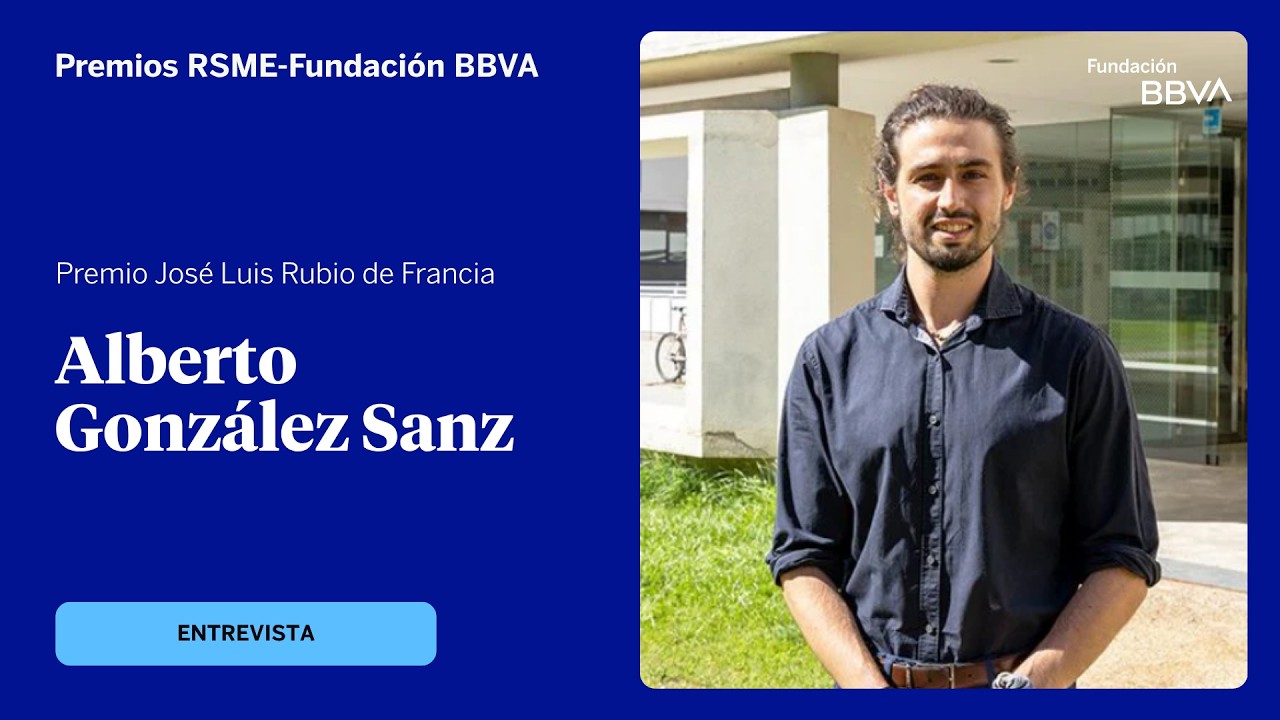
Entrevista a Alberto González Sanz
Keywords
Summary
242 words
Critical Evaluation
Value of the Information & Strength of the Argument
The value of the information is high because the interviewee provides clear explanations of complex mathematical tools, using an accessible analogy (moving sand to fill a hole) to introduce optimal transport. He connects the theoretical work to practical applications such as fairness in machine learning and non-parametric inference, demonstrating the relevance of his research. The argumentation is solid: he gives a coherent overview of his research directions, acknowledges challenges, and supports his points with references to his own work and the broader context of mathematical statistics. The interview is persuasive in showing the importance of foundational research and the need for interdisciplinary communication.
Scientific Rigor, Source Quality, Title Accuracy
The scientific rigor is evidenced by the interviewee’s expertise in the field and his ability to articulate the theoretical underpinnings and potential applications. However, no external sources or citations are provided in the video or description, which limits verifiability. The title adequately reflects the content, as it is a straightforward interview with the researcher. The discussion stays on-topic and provides a genuine insight into his work without sensationalism. The lack of citations is typical for an interview format, but the expert’s credentials provide a baseline of credibility.
205 words
Title / Content Match
The title accurately reflects the content as an interview with Alberto González Sanz.
Quality & Reliability
8/10
The interviewee is a mathematician recognized with a starting grant, explaining his research clearly. The content is expert opinion, not peer-reviewed, but appears reliable and well-founded.
Key Moments
Markers derived by PSI from the transcript: the creator did not define chapters.
- Introduction of optimal transport and the sand/hole analogy.
- Plans for the next three years with BBVA Starting Grant support.
- Discussion of societal relevance, including machine learning fairness.
- Opportunities and risks of artificial intelligence.
- Personal story and inspiration for entering mathematics.
- Key to success in research and assessment of mathematics in Spain.
Contribution & Novelties
The interview presents the researcher’s own contributions to optimal transport and its applications in statistics and data science, including novel computational methods and theoretical advances. It highlights the potential of these tools for fairness assessment in machine learning, which is a timely and impactful application. The discussion also touches on the identity crisis of mathematical statistics and the challenges of integrating AI into research, offering a personal perspective on these methodological issues.
Pour aller plus loin :
- Optimal transport theory — Foundational concept explaining the mathematical problem and its modern importance.
- Wasserstein metric — A key distance derived from optimal transport, widely used in statistics and machine learning.
- Fairness in machine learning — Addresses algorithmic fairness, directly related to the interviewee’s work on equitable AI.
- Nonparametric statistics — Relevant to his research on inference in functional spaces without strong distributional assumptions.
141 words
Radar Profile
The profile shows a balanced video with high reliability and quality, moderate technical depth, and a good quantity of information. The reliability and quality scores are strong, indicating trustworthy expert content, while the technical level and quantity are moderate, suitable for a general audience.