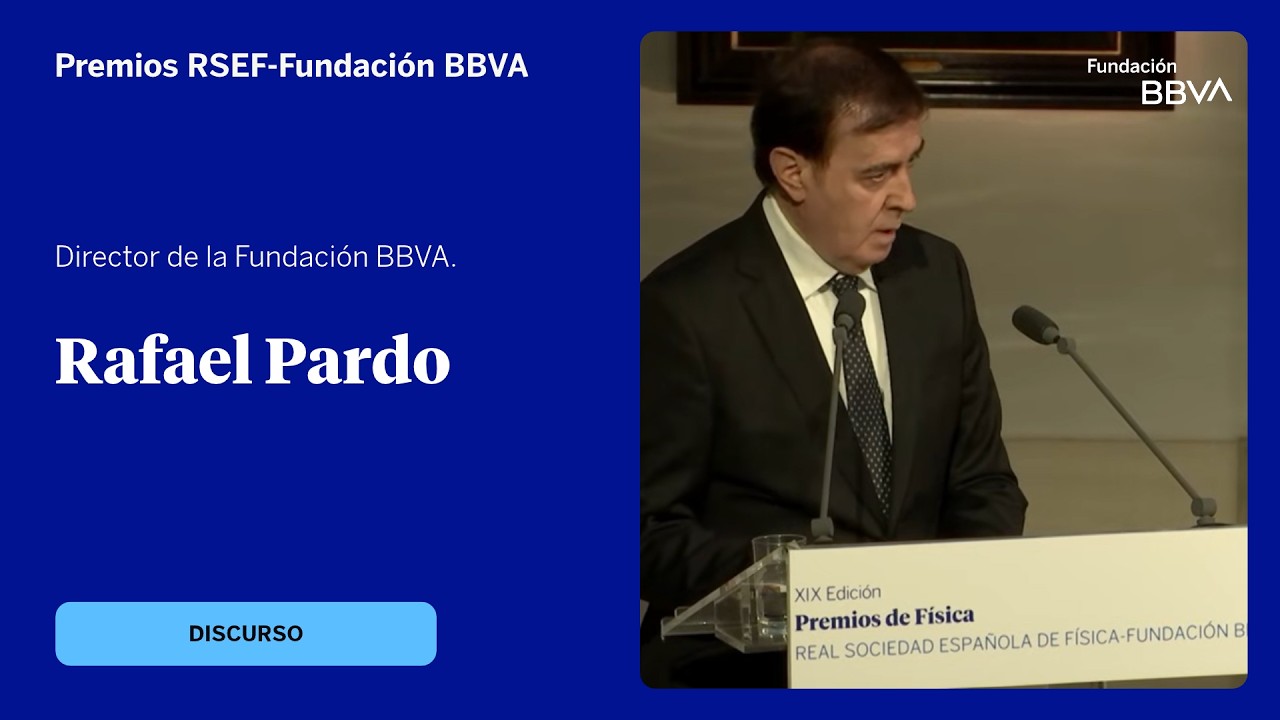
Discurso de Rafael Pardo, Premios de Física RSEF-Fundación BBVA 2026
Keywords
Summary
156 words
Critical Evaluation
Value of the Information & Strength of the Argument
The speech provides a valuable reflection on the state of science and the emerging influence of generative AI. The argumentation is well-structured, moving from intrinsic components of the awards (merit, knowledge, societies) to the contextual variable of AI. Pardo uses established frameworks (Freeman’s innovation typology, Ogburn’s cultural lag) and current examples (Anthropic IPO, AI-discovered vulnerabilities) to support his claims. He raises the crucial question of whether AI can capture the heuristics underlying scientific creativity, and argues convincingly that researchers who do not adopt AI may face relative disadvantage. The speech is persuasive and balanced, acknowledging uncertainties while advocating for adaptation.
Scientific Rigor, Source Quality, Title Accuracy
The speech demonstrates scientific rigor by referencing recognized concepts and citing a recent internal survey, although no specific publications are cited. The quality of sources is decent but limited to anecdotal and current events. The title accurately reflects the content, being a formal address at an awards ceremony. The speaker’s authority as a representative of the foundation and his familiarity with the scientific community lend credibility. However, the nature of the content is expository and opinion-oriented rather than empirically grounded, and the lack of direct references to the awardees’ works or peer-reviewed literature slightly limits its scientific depth.
213 words
Title / Content Match
The title accurately describes the content: it is the formal address given by Rafael Pardo at the 2026 RSEF-BBVA Physics Awards ceremony, focusing on scientific merit, knowledge, and AI's role in science.
Quality & Reliability
7/10
The speech offers a well-structured and thoughtful reflection on scientific recognition, the role of learned societies, and the transformative impact of generative AI on scientific practice. It draws on established concepts (e.g., Christopher Freeman's innovation typology, William Ogburn's cultural lag) and incorporates data from an internal survey, though it remains an opinion piece without systematic empirical evidence or peer review.
Key Moments
Markers derived by PSI from the transcript: the creator did not define chapters.
- Introduction acknowledging the origins of the awards and the role of physicists Delgado and Fernández Rañada.
- Discussion on the three intrinsic components: recognition of merit, celebration of knowledge, and role of scientific societies.
- Presentation of survey results showing physics as the field most identified with science across European countries and the US.
- Introduction of the contextual variable: generative AI, and its classification as a radical innovation or paradigm shift.
- Reflection on AI's impact on scientific creativity, the difficulty of capturing heuristics, and the need to adapt institutional structures.
- Concluding remarks congratulating the awardees and thanking juries and the scientific community.
Cited Sources
- Fundación BBVA on LinkedIn — Official company page mentioned in the video description.
- Fallados los Premios de Física RSEF-Fundación BBVA 2026 — Official news announcement about the awards mentioned in the description.
Concurring Sources
- Eurobarometer on Science and Technology — The speech references Eurobarometer surveys to support claims about public perception of science; the surveys are a relevant concordant source.
- Vienna Circle (Wikipedia) — The speech mentions the distinction between context of discovery and justification, associated with the Berlin/Vienna Circles; this page provides context.
Contribution & Novelties
The speech offers a nuanced perspective on the intersection of scientific recognition and AI, bringing philosophical and historical dimensions (e.g., the distinction between context of discovery and justification) to a contemporary debate. It challenges the scientific community to consider whether AI can replicate the inherently human heuristics that drive discovery.
Pour aller plus loin :
- Cultural lag (Wikipedia) — Concept by William Ogburn relevant to the speech’s discussion of institutional adaptation.
- Christopher Freeman (innovations typology) — Framework of incremental and radical innovations and paradigm shifts.
- Generative artificial intelligence (Wikipedia) — Overview of the technology’s capabilities and impacts, directly tied to the speech’s main theme.
104 words
Radar Profile
The radar profile shows high scores in quality of information and fiability, reflecting the speaker's authority and thoughtful argumentation. Quantitative information is moderate, while technical level is lower since it is a general speech rather than a technical tutorial. The overall balance suggests a reliable expert opinion piece with strong qualitative content.