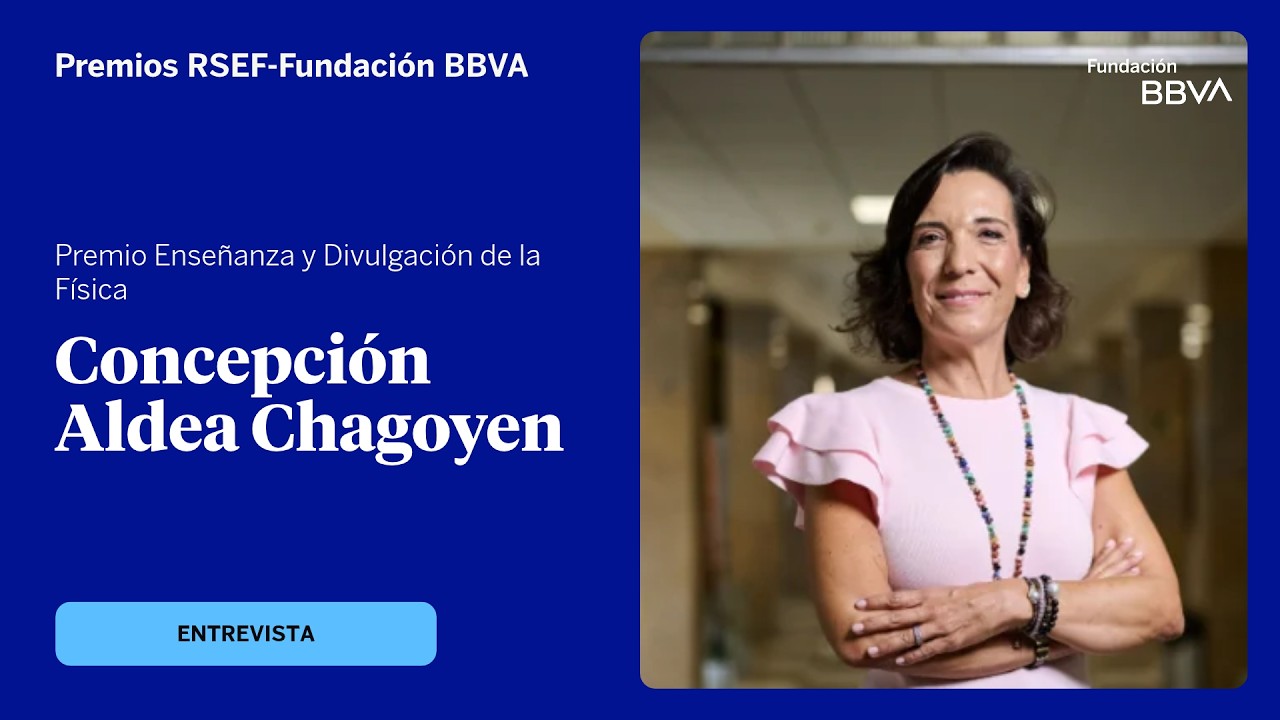
Concepción Aldea Chagoyen: "La curiosidad se transforma en una vocación"
Title history
- Concepción Aldea Chagoyen: "La curiosidad se transforma en una vocación" — observed on 20261120-0930 UTC (YouTube)
Keywords
Summary
224 words
Critical Evaluation
Value of the Information & Strength of the Argument
The informational value lies in a detailed, practice-based account of innovative teaching methods in university physics, supported by concrete examples (ELIGE platform, AI tutoring, enriched notes) and institutional outreach work (11F activities, RSEF women-in-physics group, FECYT project). The argumentation is coherent and experience-driven, though largely supported by personal conviction and anecdotal evidence rather than empirical or measured outcomes. She explicitly adopts a rigorous, research-like approach to teaching (design, controlled application, dissemination in indexed journals), which strengthens the credibility of her claims. The reasoning around catalysts for scientific vocations is grounded in repeated observations from faculty round tables, giving it some inductive value. The discussion remains at a general level, with no data on effectiveness or impact of the methodologies; statements such as ’the view in Spain is very good’ are subjective but clearly presented as optimistic opinions. The argument for science communication as a democratic health issue is well articulated and gives conceptual depth to the interview.
Scientific Rigor, Source Quality, Title Accuracy
The scientific rigor is adequate for an interview format: the interviewee is a recognized expert, and institutional anchors (RSEF, Fundación BBVA, University of Zaragoza) are reliable. However, no specific studies, publications, or measurable results are cited to substantiate the described innovations; the references to Feynman and Marie Curie are illustrative quotes, not scientific sources. The title accurately reflects the content, which focuses on how curiosity becomes a vocation, and the editorial framing is consistent throughout. The description aligns well with the interview’s content, and the award context is official. The thinness of verifiable sources is the main limitation of the video as a scientific resource.
277 words
Title / Content Match
The title accurately reflects the content: the interview revolves around how scientific curiosity, sparked by inspiring teaching and outreach, becomes a vocation.
Quality & Reliability
8/10
Interview conducted and published by Fundación BBVA, an established institution, on the occasion of an official prize awarded by the Real Sociedad Española de Física. The interviewee is a recognized university physics professor. Statements are personal and experience-based with no documented data, but institutional framing and the award context lend credibility.
Key Moments
Markers derived by PSI from the transcript: the creator did not define chapters.
- Presentation of the interview and award context.
- Her main contributions: continuous innovation in physics teaching, project-based methodology, dissemination in congresses and indexed journals.
- Details of methodologies: gamification, flipped classroom, collaborative learning, enriched notes, ELIGE virtual platform, AI tutoring system.
- Work on promoting scientific vocations among girls: outreach activities, 11F events, women in physics group, FECYT project on female scientists.
- Most motivating and most difficult aspects of teaching physics, including linking theory and the experimental lab.
- Her recipe for teaching physics: passion, rigor, implication, curiosity, and debate; alertness to changes like generative AI.
- View on the state of physics teaching in Spain: optimistic about interest and employability; cautious about AI, absenteeism, and talent retention.
- Importance of physics and science communication for 21st-century society; new formats such as social media and monologues; quote from Marie Curie.
Cited Sources
- Fallados los premios de Física RSEF-Fundación BBVA 2026 — Official announcement of the 2026 RSEF-Fundación BBVA physics prizes, mentioned in the video description to contextualize the award.
- Fundación BBVA LinkedIn page — LinkedIn profile of the publisher institution, provided in the video description as a follow-up channel.
Concurring Sources
- Fallados los premios de Física RSEF-Fundación BBVA 2026 — The official announcement corroborates the award, its category, and the grounds cited in the video.
Dissenting Sources
- No discordant sources identified — The video does not make empirical claims that would conflict with other sources; it is primarily a personal testimony.
Contribution & Novelties
The video provides a personal and institutional perspective on innovative university physics teaching in Spain, offering concrete, transferable examples (ELIGE platform, AI tutoring, enriched course notes) and a reflection on turning scientific curiosity into a vocation, particularly for girls. Its originality lies in the combination of teaching innovation with gender-focused outreach, and in the explicit call to treat science communication as a full university task. However, it offers no empirical evidence and stays at the level of qualitative testimony.
Pour aller plus loin :
- Flipped classroom — Directly relevant to one of the core methodologies discussed.
- Gamification — Core concept underlying several of the teaching resources mentioned.
- International Day of Women and Girls in Science — Institutional anchor of the interviewee’s outreach activities.
- Real Sociedad Española de Física — Awarding body; provides institutional context.
- Richard Feynman — Referenced by the speaker on the purpose of knowledge.
- Marie Curie — Referenced on the value of understanding rather than fear.
158 words
Radar Profile
The profile is balanced with a clear peak in reliability (8/10) reflecting the institutional and expert context, while information quantity and technical level remain moderate (6 and 5), typical of a concise interview format. Quality of information (7) sits between high credibility and limited depth of evidence.