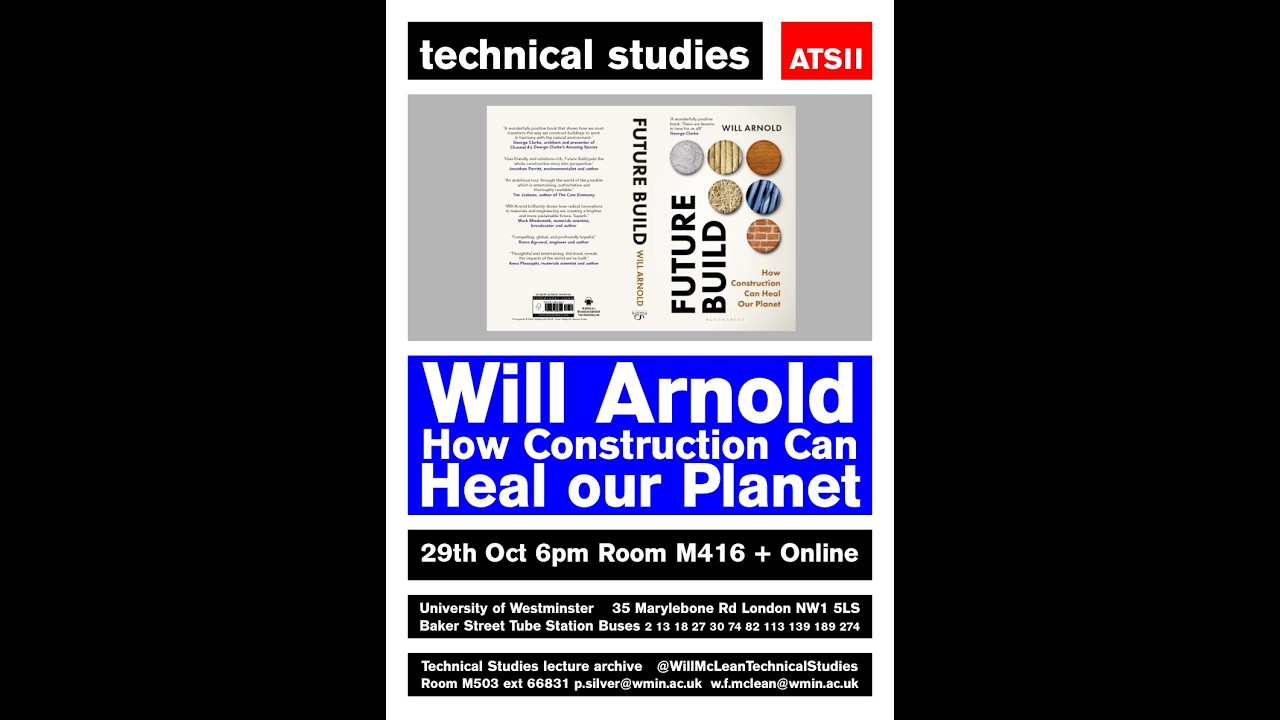
Will Arnold 29/10/2026
Title history
- Will Arnold 29/10/2026 — observed on 20261102-1151 UTC (YouTube)
Keywords
Summary
146 words
Critical Evaluation
Value of the Information & Strength of the Argument
The talk provides valuable insight into the environmental impact of construction materials and presents numerous real-world examples of sustainable alternatives. Arnold’s argument is compelling, supported by case studies and his own engineering experience. He effectively balances the dire state of the industry with pragmatic and feasible solutions, making a strong case for change. The narrative is coherent and well-paced, though some claims could be more rigorously substantiated with quantitative data or references. The focus on practical, existing innovations strengthens the argument, making it both persuasive and actionable.
Scientific Rigor, Source Quality, Title Accuracy
The talk relies on the speaker’s professional expertise and personal involvement in projects, which adds credibility but also limits objectivity. While he mentions specific initiatives and materials, he does not provide citations or external sources within the presentation. The title ‘Will Arnold 29/10/2026’ is completely inadequate, as it reveals nothing about the content and fails to attract or inform potential viewers. There is no scientific rigor in the title, and the content, though informative, would benefit from explicit references to data and studies to enhance reliability. The talk is essentially an expert opinion delivered in an engaging style, but it is not a rigorous scientific analysis.
208 words
Title / Content Match
The title is simply a name and date, giving no indication of the topic or content; it is not descriptive and fails to convey what the presentation covers.
Quality & Reliability
8/10
The talk is delivered by an expert in sustainable materials, grounded in real projects and published innovations. The content is well-structured, but relies on anecdotal evidence and personal case studies rather than peer-reviewed research. The presentation is persuasive and technically informed, though some claims would benefit from robust citation.
Key Moments
Markers derived by PSI from the transcript: the creator did not define chapters.
- Introduction: Will Arnold introduces himself and his background as a structural engineer, and explains the purpose of his book 'Future Build'.
- The problem: Arnold describes the five key construction materials and their environmental footprint, including energy-intensive production and extraction.
- Impact statistics: Construction materials account for 10% of global emissions, 30% of waste, and 50% of resource extraction.
- Solutions part 1: Arnold presents early examples like the straw-bale house in London and the Rwanda Institute for Conservation Agriculture as low-carbon alternatives.
- Innovations: Recycling cement via steel furnaces, which can eliminate a third of cement production, and other novel materials like clay-based cement and carbon-sequestering concrete.
- Innovations continued: Hydrogen-based steel, glass recycling, and bamboo construction are highlighted as real, commercially available solutions.
- Conclusion: Arnold reiterates that a better future is already being built and encourages engineers and architects to embrace these materials.
Contribution & Novelties
The talk offers a comprehensive overview of sustainable construction materials and real-world examples, introducing viewers to lesser-known innovations like cement recycling in steel furnaces and carbon-negative concrete. It also contextualizes these technologies within the broader climate crisis, making a strong case for systemic change in the construction industry.
Pour aller plus loin :
- Bamboo construction — Overview of bamboo as a building material and its sustainability benefits.
- Direct reduced iron — Explanation of hydrogen-based steelmaking, a key alternative to fossil-fuel processes.
- Cement — Background on cement production and its environmental impact.
- Carbon sequestration — Concepts related to carbon-negative building materials.
100 words
Radar Profile
The radar profile shows high scores in quantity and quality of information, with moderate technical level and high reliability. This indicates a content-rich, expert-driven talk that balances depth with accessibility, but lacks formal citation rigor. The discussion is practical and forward-looking, appealing to both professionals and a general audience.