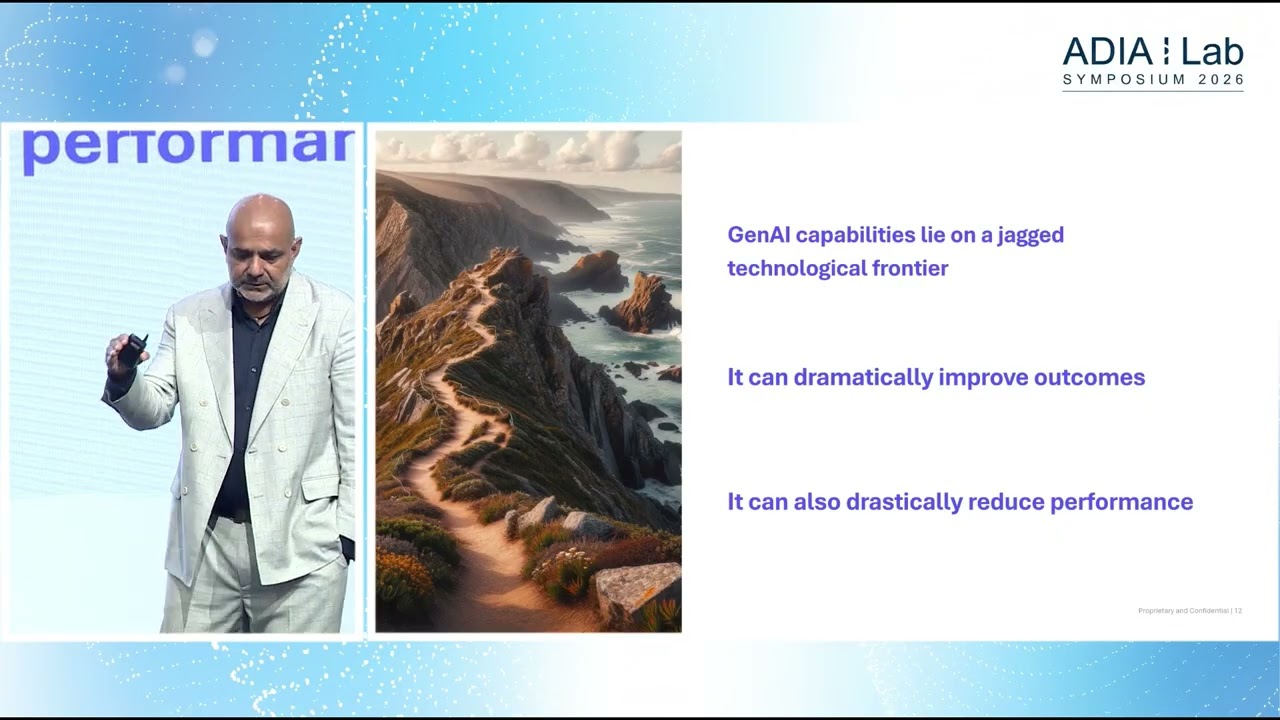
The Jagged Frontier of Deployment | Karim Lakhani | ADIA Lab Symposium 2026
Title history
- The Jagged Frontier of Deployment | Karim Lakhani | ADIA Lab Symposium 2026 — observed on 20261105-1152 UTC (YouTube)
Keywords
Summary
171 words
Critical Evaluation
Value of the Information & Strength of the Argument
The value of the information is high because it is based on causal evidence from randomized controlled trials, which is rare in AI impact research. The argumentation is solid: it combines quantitative performance metrics with qualitative insights (e.g., identity threat, junk food reaction) to provide a nuanced view. The speaker transparently distinguishes between high-certainty RCT results and lower-certainty correlational findings, strengthening credibility. The discussion of the J-curve and organizational absorption adds practical relevance for decision-makers.
Scientific Rigor, Source Quality, Title Accuracy
The scientific rigor is exemplary, relying on peer-reviewed or forthcoming studies with large sample sizes and randomized assignment. Sources include field experiments at BCG and Procter & Gamble, as well as the book ‘Competing in the Age of AI’ (2020). The title precisely reflects the talk’s focus on deployment challenges and the jagged frontier concept. The presentation includes no promotional content; the only source linked is the symposium website. The talk’s methodology and transparency about data quality enhance its reliability.
170 words
Title / Content Match
The title accurately reflects the content: the talk focuses on the 'jagged frontier' of AI deployment, presenting field experimental evidence and organizational implications, perfectly matching the title.
Quality & Reliability
8/10
The talk presents rigorous field experimental evidence from large-scale RCTs involving more than 1,500 professionals at BCG and P&G, combined with established economic and organizational theories. The speaker is a Harvard professor and co-author of widely recognized research, though some findings are preliminary or correlational.
Key Moments
Markers derived by PSI from the transcript: the creator did not define chapters.
- Host introduces Karim Lakhani, highlighting his research on AI and the 'jagged frontier'.
- Lakhani opens with the question: is AI a difference of degree or a difference of kind compared to the internet?
- Discusses AI as a general purpose technology, creating supply and demand shocks.
- Introduces the BCG field experiment design: 758 consultants assigned to strategy and analytical tasks with and without GPT-4.
- Presents results: 12% more tasks completed, 25% faster, 40% quality improvement on strategy; performance degradation on analytical tasks (85% vs 60-70% correct).
- Highlights the 'junk food' reaction from a consultant and the identity threat experienced by top performers.
- Describes three phenotypes of AI usage: centaurs, cyborgs, and self-automators.
- Begins P&G study on teams: individuals with AI match teams without AI in average quality.
- Teams with AI are 3 times more likely to produce top 10% ideas; expertise convergence between R&D and commercial staff.
- Discusses the J-curve effect: firms see a three-year performance dip after AI adoption before improvement, citing Christina McLaren's research.
Cited Sources
- ADIA Lab Symposium 2026 — Official page of the symposium where this keynote was presented.
Contribution & Novelties
This talk provides original empirical evidence from large-scale randomized controlled trials in real-world business contexts, offering a nuanced picture of AI’s impact on work. The concept of the ‘jagged frontier’—where AI dramatically helps on some tasks but harms on others—is a major contribution. Additionally, the finding that AI-augmented individuals can match team performance, while teams with AI excel at producing top-tier ideas, reshapes thinking on team design. The speaker highlights the need for organizational absorption and the J-curve phenomenon, urging leaders to actively manage the adoption process.
Pour aller plus loin :
- Generative artificial intelligence — Background on the technology discussed.
- Randomized controlled trial — The methodology used in the field experiments.
- Learning curve — Related to the J-curve and organizational adaptation.
- The academic paper ‘Navigating the Jagged Technological Frontier’ (2023) — The BCG study, but no direct URL provided.
140 words
Radar Profile
The radar profile likely shows high scores in information quality and reliability due to the rigorous evidence, moderate technical level suitable for a general business audience, and strong information quantity covering multiple studies and concepts. This results in an overall excellent profile.