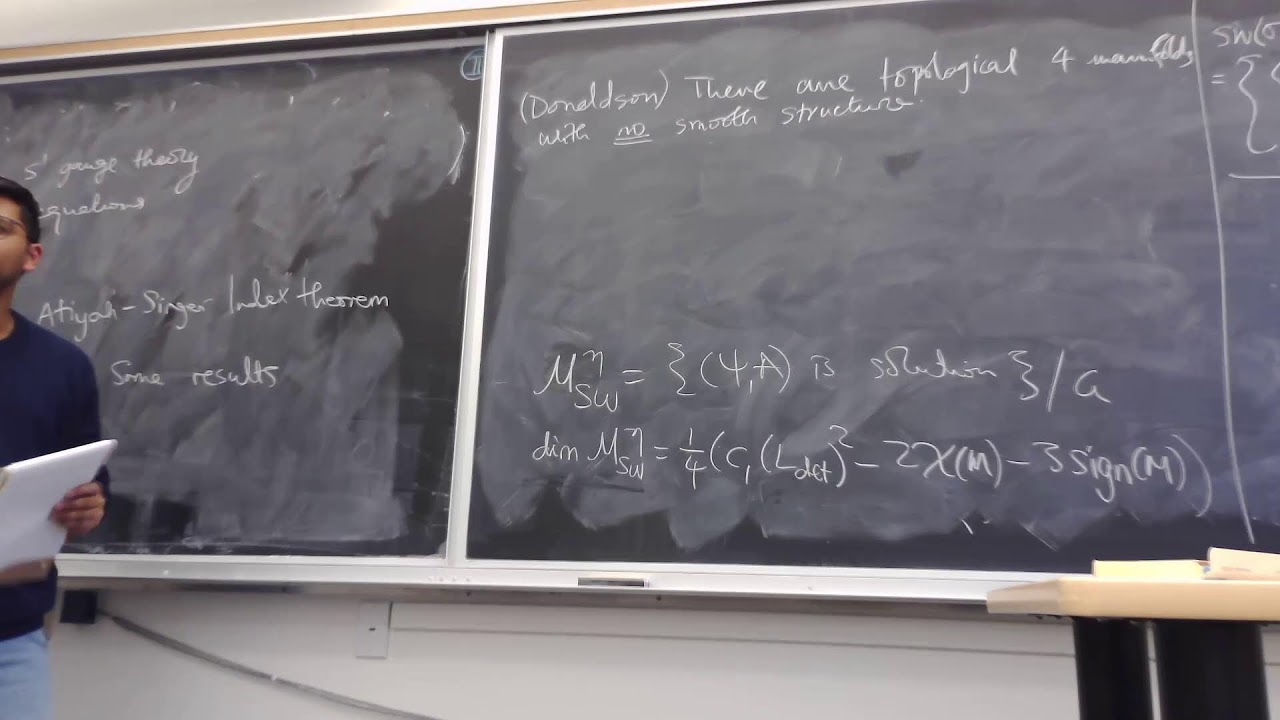
How physics is used to understand the geometry of 4 manifolds
Keywords
Summary
205 words
Critical Evaluation
Value of the Information & Strength of the Argument
The talk provides a clear, intuitive overview of deep connections between physics and pure mathematics. The speaker builds up from elementary concepts (electromagnetic fields) to advanced topics (Seiberg–Witten theory) in a pedagogically effective way. The argumentation is logically structured: definitions of connections, curvature, Dirac operators, and then the Seiberg–Witten equations are introduced with just enough detail. The speaker acknowledges skipped computations and time constraints, which is honest. The main value lies in making accessible the fact that solutions to physical equations encode topological information. The reasoning is consistent, and the derivations, though condensed, are mathematically sound.
Scientific Rigor, Source Quality, Title Accuracy
The talk is rigorous in its use of mathematical terminology and avoids oversimplification. However, it does not cite specific literature or sources, which reduces its verifiability. The title accurately reflects the content—the connection between physics and 4-manifold geometry is demonstrated throughout. The speaker seems knowledgeable, but because no references are given, a viewer cannot easily track down proofs or further reading. The talk is more of a seminar summary than a reference work, but the core statements are correct. No comments are provided to analyze public reception.
198 words
Title / Content Match
The title accurately reflects the content: the talk demonstrates how physics concepts (gauge fields, Dirac operators, Seiberg–Witten theory) are employed to study the geometry and topology of four-manifolds.
Quality & Reliability
7/10
The talk is technically sound and covers advanced topics in differential geometry and gauge theory. However, it is a casual seminar without formal citations, and some steps are handwaved. The speaker acknowledges skipping details. The known theorems (Donaldson, Fintushel–Stern) are accurately stated, and the mathematical framework (connections, curvature, Dirac operator, Seiberg–Witten equations) is presented correctly. Score reflects competence but lack of source substantiation.
Key Moments
Markers derived by PSI from the transcript: the creator did not define chapters.
- Introduction of electromagnetism and the Faraday tensor, setting stage for gauge theory.
- Definition of connection and parallel transport, leading to curvature.
- Discussion of U(1) principal bundle and generalization to non-abelian gauge groups.
- Introduction of Dirac operator and spinor fields.
- Presentation of Seiberg-Witten equations and moduli space.
- Application to Donaldson's theorem and Fintushel-Stern theorem.
Concurring Sources
- Seiberg-Witten invariants — Support the claim that these invariants provide topological information about 4-manifolds.
- Donaldson's theorem — Confirms the existence of four-manifolds with no smooth structure, as mentioned.
- Fintushel-Stern theorem — Relates to the result about infinitely many homeomorphic but non-diffeomorphic manifolds, though the source is specific to exotic R⁴.
Contribution & Novelties
The talk synthesizes known mathematical physics ideas and highlights their application to 4-manifold topology. Its original contribution is the clear exposition of how Seiberg–Witten theory emerges from gauge theory and yields powerful geometric results. The speaker effectively communicates the significance of invariants like the Seiberg–Witten invariant for distinguishing smooth structures.
Pour aller plus loin :
- Seiberg–Witten invariants (Wikipedia) — Standard introduction to the invariants and their role in 4-manifold topology.
- Donaldson’s theorem (Wikipedia) — Explains the result on non-smoothable four-manifolds used in the talk.
- Dirac operator (Wikipedia) — Provides mathematical background for the Dirac operator on spinors.
- Principal bundle (Wikipedia) — Useful for understanding the gauge theory setup.
- Atiyah–Singer index theorem (Wikipedia) — The theorem that gives the dimension of the moduli space.
123 words
Radar Profile
The radar profile indicates a talk strong in quantity of information and technical depth, but weaker in explicit source citation and overall reliability. The moderate scores reflect that while the content is advanced and largely correct, it is presented in a seminar style without formal references.