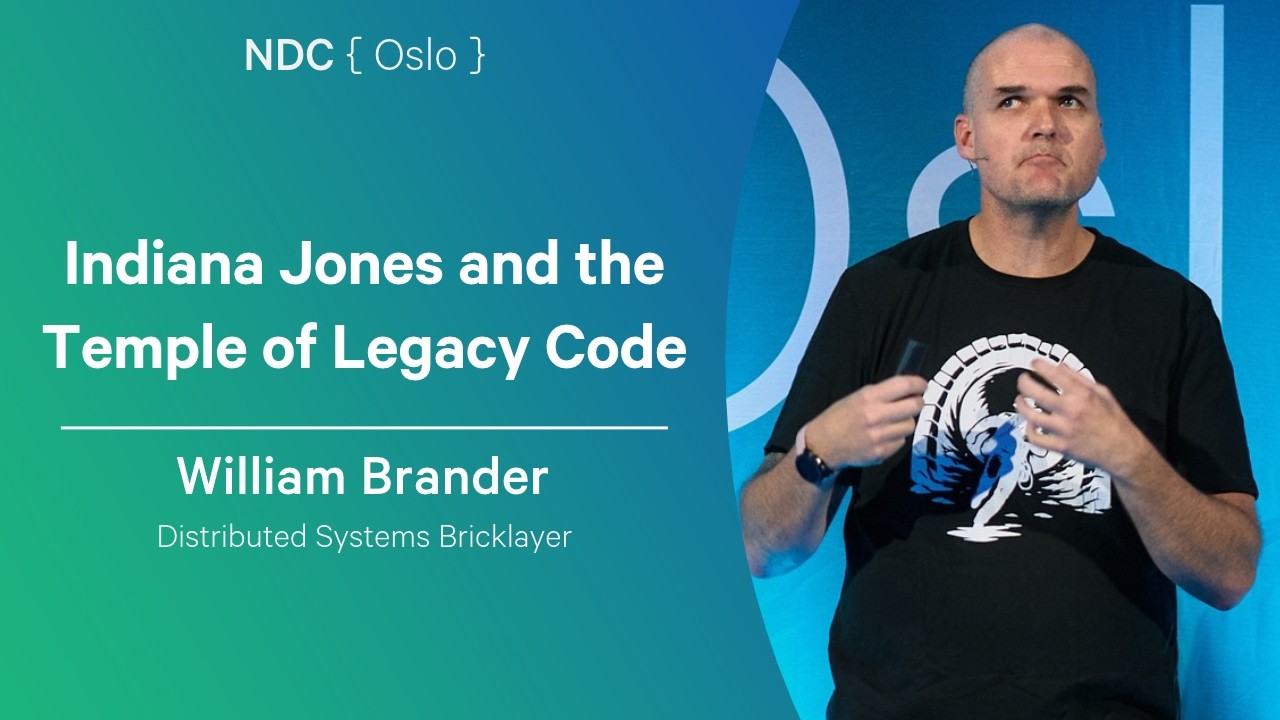
Indiana Jones and the Temple of Legacy Code - William Brander - NDC Oslo 2026
Title history
- Indiana Jones and the Temple of Legacy Code - William Brander - NDC Oslo 2026 — observed on 20261103-1336 UTC (YouTube)
Keywords
Summary
199 words
Critical Evaluation
Value of the Information & Strength of the Argument
The talk delivers valuable, actionable advice for developers dealing with legacy systems. The quadrant framework (understanding vs. supportability) is a clear mental model that helps prioritize efforts. The step-by-step guidance—reproducible builds, pinned dependencies, CI, baseline tests, mutation testing, and observability—forms a coherent strategy. The argumentation is sound and grounded in personal experience, though it lacks quantitative evidence or case studies. The use of humor and relatable analogies (Indiana Jones, folding a fitted sheet) makes the content engaging and memorable. The speaker effectively argues that legacy code is inevitable and that gradual, low-risk improvements are more effective than rewrites.
Scientific Rigor, Source Quality, Title Accuracy
The talk does not cite external academic sources; it relies on the speaker’s professional experience. The only sources mentioned are the conference links (ndcconferences.com, ndcoslo.com) and a comic from Abstruse Goose, which is not formally referenced. The technical concepts (mutation testing, OpenTelemetry, reproducible builds) are well-known and correctly described, but no official documentation is referenced. The title accurately reflects the content, using a playful analogy that aligns with the talk’s tone and subject. The speaker’s credibility is enhanced by his evident familiarity with the topic, but the lack of citations reduces scientific rigor. Overall, the information is practical and plausible, but not evidence-based.
216 words
Title / Content Match
The title cleverly uses the Indiana Jones analogy to frame the talk's content about exploring and surviving legacy code, accurately reflecting the speaker's approach.
Quality & Reliability
7/10
The speaker provides practical, experience-based advice without empirical validation. The framework and techniques are plausible and actionable but lack formal references or metrics.
Key Moments
Markers derived by PSI from the transcript: the creator did not define chapters.
- Introduction of the Indiana Jones analogy and the speaker's personal history with the franchise.
- Defining legacy systems and introducing the two key attributes: understanding and supportability.
- Presenting the quadrant of understanding vs. supportability and explaining the four scenarios.
- Improving supportability: reproducible builds, pinning dependencies, and moving builds to CI.
- Adding tests and using mutation testing to validate test effectiveness; leveraging AI for test generation.
- Introducing observability to understand code flows and mapping the system through spans.
- Using version control history for 'source control archaeology' to understand why code evolved.
- Conclusion: legacy code is inevitable; incremental improvements and safe refactoring are key.
Cited Sources
- NDC Conferences — Conference organizer and host of this talk.
- NDC Oslo — Specific conference site where this talk was recorded.
Contribution & Novelties
The talk’s original contribution is the framing of legacy code as a quadrant based on understanding and supportability, which provides a practical diagnostic tool for engineers. It also offers a concrete sequence of actions to improve a legacy system incrementally. While the individual techniques are known, the structured approach and the analogy to Indiana Jones make it memorable.
Pour aller plus loin :
- Mutation testing — A key technique discussed for evaluating test quality.
- OpenTelemetry — The open-source observability framework recommended for mapping system flows.
- Reproducible builds — The practice of ensuring builds are deterministic, as advocated in the talk.
- Working Effectively with Legacy Code — A foundational book by Michael Feathers that aligns with the talk’s themes.
118 words
Radar Profile
The radar profile shows high marks in technical level and quantity of information, with moderate scores in quality and reliability, reflecting a practical, experience-driven talk with actionable content but limited external validation.