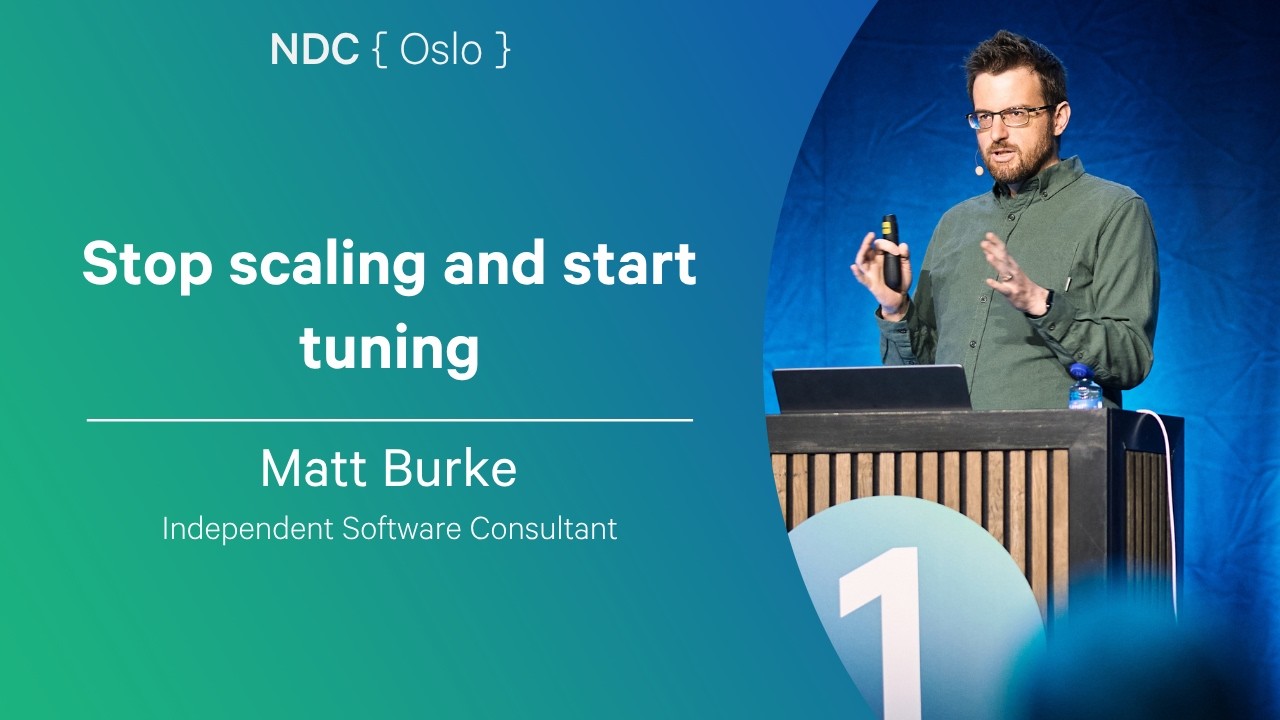
Stop scaling and start tuning - Matt Burke - NDC Oslo 2026
Title history
- Stop scaling and start tuning - Matt Burke - NDC Oslo 2026 — observed on 20261026-2337 UTC (YouTube)
Keywords
Summary
269 words
Critical Evaluation
Value of the Information & Strength of the Argument
The value of the talk lies in its practical, experience-based approach. Burke does not merely list theoretical problems; he shows a real-world scenario with measurable improvements. He argues convincingly that scaling is a short-term fix that becomes unsustainable, and that investing in tuning can yield dramatic performance gains. His reasoning is pragmatic: he weighs the cost of development time against the cost of cloud resources and the risk of breaking features. He also emphasizes the importance of telemetry and baselines, demonstrating that without good monitoring, optimization is guesswork. The argumentation is solid, supported by concrete examples and before/after metrics. However, the talk is anecdotal and does not include controlled experiments or comparative studies, so the claims are based on the speaker’s experience rather than systematic analysis.
Scientific Rigor, Source Quality, Title Accuracy
The talk is scientifically rigorous in the sense that it follows a methodical approach: identifying symptoms, setting up monitoring, gathering data, and testing solutions. Burke references specific tools (Zipkin, App Insights) and ORM features (lazy loading, eager loading) but does not provide external citations or peer-reviewed sources. The sources cited in the description are conference links (NDC Conferences, NDC Oslo), which are not technical references but organizational. The title is appropriate because the core message is to stop scaling and instead tune the system, which matches the content precisely. No comments were provided for analysis, so public reception cannot be assessed.
242 words
Title / Content Match
The title accurately reflects the content: the talk advocates for tuning database and application performance instead of scaling cloud resources, and demonstrates specific techniques to achieve this.
Quality & Reliability
8/10
The talk is grounded in real-world experience and provides concrete metrics and actionable solutions. The speaker clearly explains the reasoning behind each fix and offers a practical blueprint. However, it is anecdotal and not peer-reviewed, and some claims rely on personal observation rather than formal testing.
Key Moments
Markers derived by PSI from the transcript: the creator did not define chapters.
- Introduction: Jira ticket, scale vs. tune dilemma, and the unsustainable growth curve.
- Realization that scaling is not a viable long-term strategy; decision to focus on tuning.
- Setting up telemetry (App Insights) and interpreting traces, spans, and raw SQL.
- First pattern: N+1 queries in list views, with demo showing 7.8s load time.
- Lazy loading footgun, fix with eager loading, and impact on performance.
- Batching as an alternative to joins; results showing 394ms load time.
- Recursive CTEs for hierarchical data, replacing inefficient loops.
- Conclusion: flattening the growth curve and key takeaways.
Cited Sources
- NDC Conferences — Conference website for NDC events.
- NDC Oslo — The specific conference where this talk was given.
External References
Contribution & Novelties
The talk provides a practical, hands-on blueprint for database performance tuning that emphasizes solving root causes rather than scaling resources. It systematically addresses common pitfalls like N+1 queries, lazy loading, and inefficient data access patterns, offering concrete fixes such as eager loading, batching, and recursive CTEs. The speaker shares real-world metrics to demonstrate the impact of these changes, making the content immediately actionable.
Pour aller plus loin :
- N+1 query problem — Overview of the N+1 query pattern and its impact on database performance.
- Eager loading in EF Core — Official documentation on eager loading techniques to avoid lazy loading overhead.
- PostgreSQL recursive queries — Documentation on common table expressions including recursive ones, used for hierarchical data.
- Application Insights — Microsoft’s telemetry and monitoring service, mentioned in the talk for performance diagnostics.
132 words
Radar Profile
The radar profile shows strong scores in information quantity and quality, indicating a content-rich and well-structured talk. The technical level is moderately high, suitable for developers familiar with ORMs and SQL. The overall reliability is good, supported by concrete examples and measurements, though it relies on anecdotal evidence.