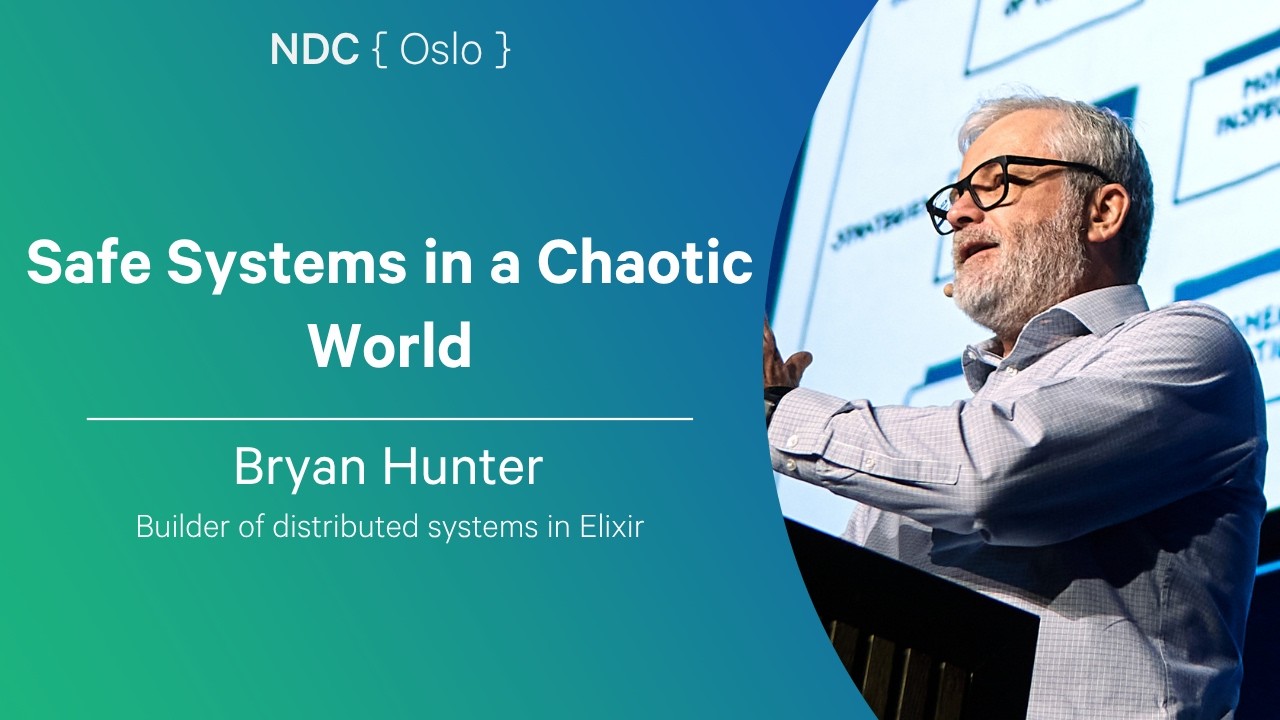
Safe Systems in a Chaotic World - Bryan Hunter - NDC Oslo 2026
Title history
- Safe Systems in a Chaotic World - Bryan Hunter - NDC Oslo 2026 — observed on 20261026-1038 UTC (YouTube)
Keywords
Summary
186 words
Critical Evaluation
Value of the Information & Strength of the Argument
The talk delivers high practical value by bridging established safety engineering (STAMP, poka-yoke) with modern software development, especially in the context of AI and complexity. The argumentation is solid, built on concrete examples like Therac-25 and personal experience, and respects the audience’s intelligence. The speaker’s 32-year career adds credibility. However, some sweeping claims about AI and economic bubbles are presented as facts without evidence, which slightly undermines rigor, but the core technical guidance is well-substantiated.
Scientific Rigor, Source Quality, Title Accuracy
The talk cites authoritative sources: Nancy Leveson’s ‘Engineering a Safer World’, Atul Gawande’s ‘The Checklist Manifesto’, and inputs from Toyota Production System (Shingo, Ohno). These are recognized in their fields. The title is highly appropriate: it captures the essence of the talk—building robust systems under chaotic conditions. No comments were provided to analyze audience reception.
145 words
Title / Content Match
The title accurately reflects the talk's focus on building safe systems via constraints and invariants in chaotic environments, covering both technical and broader systemic challenges.
Quality & Reliability
8/10
Speaks with authority from 32 years in software, references established safety engineering frameworks (STAMP, STPA, poka-yoke) and uses concrete case studies (Therac-25). However, some statements are opinionated and broad (e.g., characterizations of AI bubble, societal issues) without deep data, but the core technical content is well-founded.
Key Moments
Markers derived by PSI from the transcript: the creator did not define chapters.
- Introduction: the hostile tech environment and Kent Beck's fears about AI.
- Therac-25 case study: component safety vs system invariants.
- Introduction to STAMP/STPA and Nancy Leveson's control-based safety model.
- Poka-yoke principles and examples in software and physical systems.
- Andon and Jidoka: stopping the line and automation with human touch.
- Maturity model for mistake-proofing and final takeaways on invariants and constraints.
Cited Sources
- NDC Conferences official site — Conference organizer and host of the talk.
- NDC Oslo 2026 — Event where the talk was recorded.
External References
Contribution & Novelties
The talk’s novelty lies in synthesizing safety engineering — notably STAMP/STPA and poka-yoke — with everyday software development practices, offering a pragmatic framework for building resilient systems. It reframes reliability as a subset of safety and emphasizes invariants and constraints as the primary defense against complexity and chaos. The personal anecdotes and real-world examples (Therac-25, parking garage pipe) make abstract theories accessible.
Pour aller plus loin :
101 words
Radar Profile
The radar profile shows strong scores across information quantity, quality, and reliability, with slightly lower technical depth, indicating a talk that is comprehensive but accessible to a broad technical audience. The balanced profile suggests a well-rounded presentation.