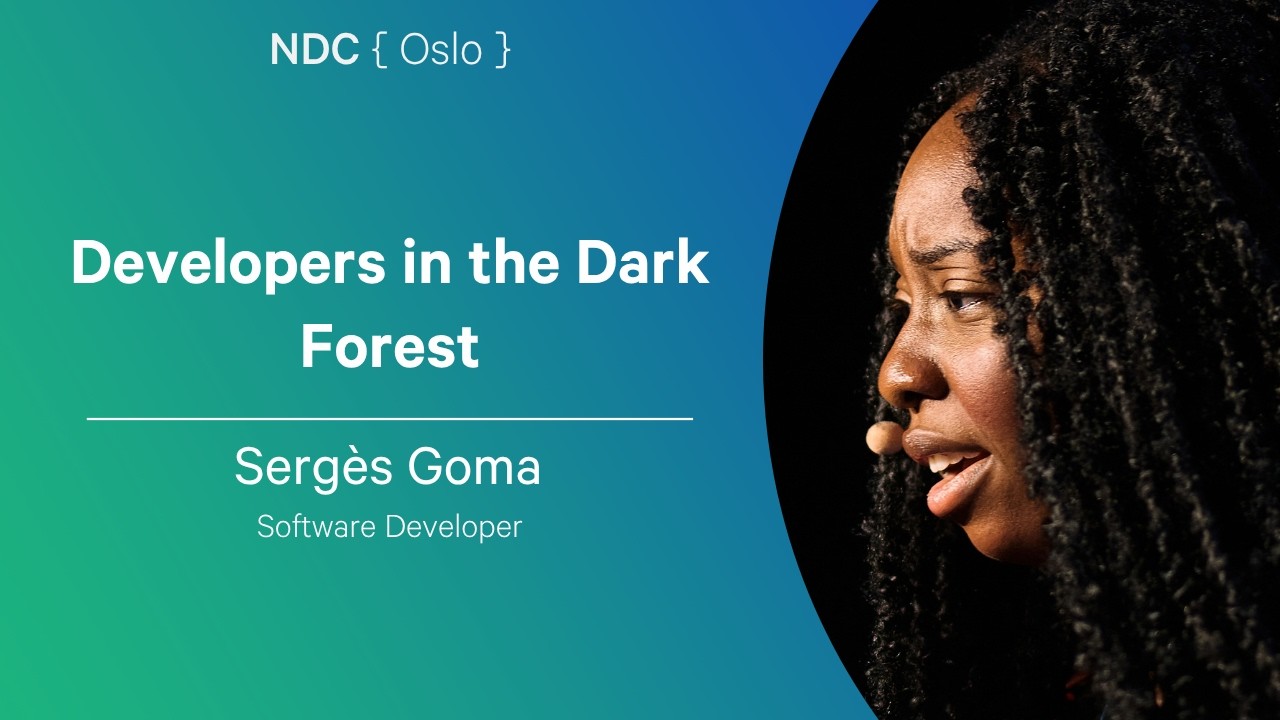
Developers in the Dark Forest - Sergès Goma - NDC Oslo 2026
Title history
- Developers in the Dark Forest - Sergès Goma - NDC Oslo 2026 — observed on 20261030-1154 UTC (YouTube)
Keywords
Summary
188 words
Critical Evaluation
Value of the Information & Strength of the Argument
The talk’s value lies in its synthesis of several theories and real-world examples to explain the current state of the developer internet. Goma effectively connects the personal experience of decreased human interaction with broader systemic changes, such as advertising-driven capitalism and AI-generated content. His argumentation is compelling, using a narrative style that makes complex ideas accessible. However, it lacks deep empirical evidence beyond a single cited study and relies heavily on anecdotal observations. The reasoning is logical and persuasive, but not all claims are rigorously backed with citations.
Scientific Rigor, Source Quality, Title Accuracy
The speaker references a few key sources, including a study on AskDocs, Shoshana Zuboff’s concept of behavioral surplus, and the Cambridge Analytica scandal, but he does not provide explicit citations or URLs during the talk. The conference description includes only links to NDC conferences, which are not directly related to the content. The title is highly relevant and accurately captures the central theme. While the talk is thought-provoking, the lack of precise sourcing lowers its scientific rigor, though it does not undermine the overall argument.
188 words
Title / Content Match
The title accurately reflects the content: the speaker discusses the dark forest theory applied to the internet and how developers have retreated to private spaces.
Quality & Reliability
6/10
The talk presents well-known concepts (dark forest theory, dead internet theory, behavioral surplus) and references a specific study on AI vs human medical answers, but does not provide precise citations or links to primary sources during the presentation. The speaker relies on personal anecdotes and analogies, making the talk engaging but not rigorously sourced.
Key Moments
Markers derived by PSI from the transcript: the creator did not define chapters.
- Introduction: Speaker's confession about replacing friends with AI.
- Discussion of a study on AI vs human answers in the AskDocs subreddit.
- Analysis of Stack Overflow's decline and its relationship with AI.
- Introduction of the dead internet theory and dark forest theory.
- Historical account of internet advertising from the first banner ad to cookies.
- Explanation of behavioral surplus and the Cambridge Analytica case.
- Discussion of AI training on user data and the feedback loop of AI-generated content.
Cited Sources
- NDC Conferences — Official website of NDC conferences where this talk was recorded.
- NDC Oslo — Official website of NDC Oslo 2026, the event where this presentation was given.
Concurring Sources
- Dark forest hypothesis - Wikipedia — Supports the theoretical basis for the dark forest theory of the internet.
- Dead Internet theory - Wikipedia — Provides background on the dead internet theory discussed in the talk.
External References
Contribution & Novelties
The talk provides a fresh perspective by applying the dark forest theory from Liu Cixin’s novel to the developer internet, connecting it with the dead internet theory and the history of behavioral surplus. Goma’s personal narrative makes the abstract concepts tangible, and his analogy of algae blooms to describe the degradation of online spaces is memorable. He also highlights the role of AI in accelerating this process, which is a timely observation.
Pour aller plus loin :
- Dark forest hypothesis — Explanation of the theory as applied to the universe and its adaptation to the internet.
- Dead Internet theory — Overview of the conspiracy theory that online content is increasingly bot-generated.
- Behavioral surplus — Shoshana Zuboff’s concept of behavioral surplus and its implications for data exploitation.
- Cambridge Analytica — Details on the scandal that used behavioral data for political manipulation.
140 words
Radar Profile
The radar profile shows a talk that is information-rich and engaging, with moderate technical depth and reliability. The scores suggest that while the speaker covers a wide range of topics effectively, the lack of precise citations and the reliance on anecdotal evidence slightly lower the overall reliability.