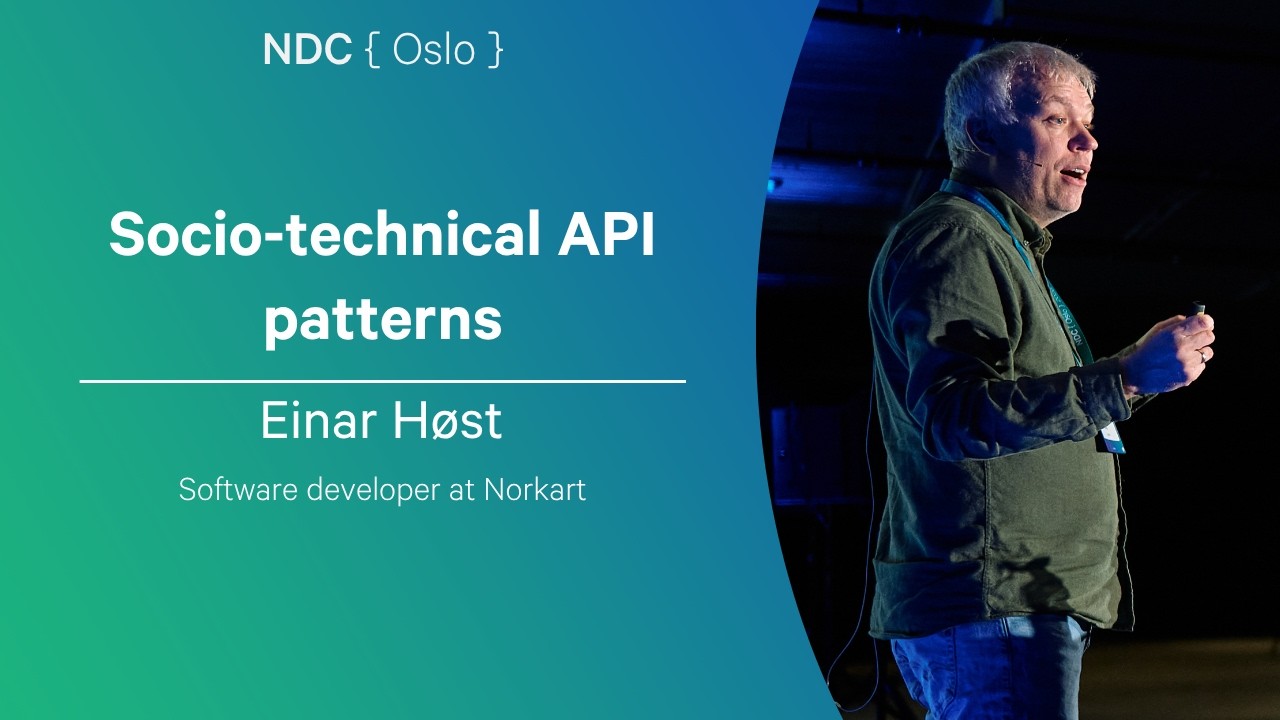
Socio-technical API patterns - Einar Høst - NDC Oslo 2026
Keywords
Summary
165 words
Critical Evaluation
Value of the Information & Strength of the Argument
The value of this talk lies in its practical, experience-based insights into the often-overlooked social dimensions of API development. The speaker argues convincingly that ignoring the socio-technical context leads to misunderstandings and conflicts. He provides a clear typology of API relationships and a set of diagnostic questions that practitioners can immediately apply. The argumentation is solid, built on logical progression from abstraction to analysis, and supported by relatable examples. The distinction between unilateral and bilateral design, and the contract-versus-documentation paradigm, are well-articulated and offer actionable guidance. The talk does not rely on empirical data but rather on accumulated professional wisdom, which is typical for expert talks. The reasoning is coherent, and the speaker acknowledges the complexity without oversimplifying.
Scientific Rigor, Source Quality, Title Accuracy
The talk is an expert opinion piece, not a research presentation. It does not cite external sources, relying instead on the speaker’s extensive industry experience. The lack of references is mitigated by the fact that the content is based on widely recognized patterns and principles in software engineering, and the arguments are internally consistent. The title ‘Socio-technical API patterns’ accurately captures the essence of the talk, which indeed explores patterns that arise from the interplay of social and technical factors. The description is also aligned. No audience comments were provided for analysis, so public reception cannot be assessed. Overall, the scientific rigor is moderate due to the anecdotal nature, but the practical value is high.
248 words
Title / Content Match
The title accurately reflects the content, which focuses on socio-technical patterns in API design and collaboration.
Quality & Reliability
8/10
The speaker provides a well-structured analysis based on professional experience, with clear reasoning and practical insights. The talk is coherent and addresses complex socio-technical aspects of API design.
Key Moments
Markers derived by PSI from the transcript: the creator did not define chapters.
- Introduction: abstraction omits people, leading to incomplete understanding
- Definition of socio-technical systems and nonlinear, nontrivial interactions
- Key questions about provider and consumer contexts, goals, and constraints
- Points of contention: functionality, uptime, errors, and change rate
- Unilateral vs bilateral API design and their implications
- Contract vs documentation: the semantic difference in API specifications
- Need for explicit service level agreements and pitfalls of vague guarantees
Cited Sources
- NDC Conferences — Conference website hosting the talk
- NDC Oslo — Conference event page
Contribution & Novelties
The talk contributes a fresh perspective by framing API design as a socio-technical negotiation rather than a purely technical exercise. It systematically outlines dimensions often ignored in technical discussions, such as power dynamics, communication modes, and the importance of bilateral collaboration. The distinction between contracts and documentation, and the call for hand-written, co-authored API specifications are practical innovations. The talk also emphasizes that non-functional requirements are business requirements and should be explicitly negotiated via SLAs even for internal APIs. Overall, it provides a mental model that practitioners can use to diagnose and improve API initiatives.
Pour aller plus loin :
- Socio-technical system — Core concept underlying the talk’s framework.
- API — Basics of API design and interfaces.
- Service-level agreement — Related to the discussion of formalising uptime and performance expectations.
130 words
Radar Profile
The radar shows high scores in quantity and quality of information, moderate technical depth, and solid reliability. This profile indicates the talk is content-rich and well-argumented, suitable for practitioners seeking practical insights without deep technical complexity. The lower technical score suggests the content is accessible to a general developer audience.