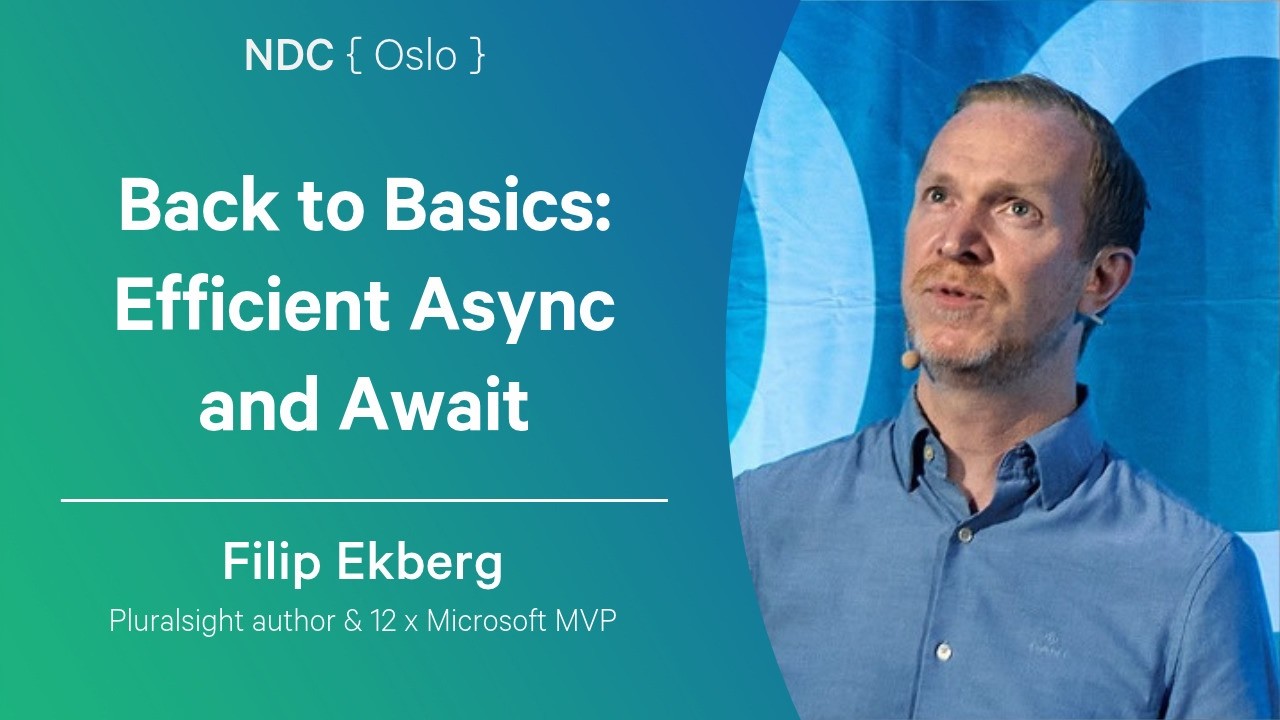
Back to Basics: Efficient Async and Await - Filip Ekberg - NDC Oslo 2026
Keywords
Summary
143 words
Critical Evaluation
Value of the Information & Strength of the Argument
The value of this talk lies in its hands-on demonstration of real-world pitfalls and best practices. The speaker effectively argues that understanding the internal mechanics of tasks and continuations is essential for using async/await correctly. His arguments are supported by live code examples that illustrate subtle issues like exception swallowing and thread pool starvation. He advocates for avoiding Task.Run in favor of native asynchronous APIs, and emphasizes the importance of always awaiting tasks to propagate exceptions. The logical flow from basic concepts to advanced nuances makes the reasoning coherent and convincing.
Scientific Rigor, Source Quality, Title Accuracy
The presentation is rigorous in terms of technical accuracy, but it lacks formal citations or references. The speaker relies on practical experience and common knowledge in .NET development. The title is well-matched to the content, as the talk indeed returns to fundamental principles and efficient usage. The lack of external sources is common for conference talks, but the depth of explanation compensates. The speaker does not overclaim and provides clear reasoning for each recommendation, which enhances credibility.
183 words
Title / Content Match
The title accurately reflects the content, which focuses on fundamental async/await concepts and their efficient usage in .NET applications.
Quality & Reliability
8/10
The talk is delivered by an experienced developer with live demonstrations and practical advice, but it relies on personal expertise rather than formal peer-reviewed sources.
Key Moments
Markers derived by PSI from the transcript: the creator did not define chapters.
- Introduction to why asynchronous programming is needed, including improving user experience and scaling applications.
- Overview of the Task Parallel Library and its role in managing threads efficiently.
- Live demonstration showing how wrapping code in Task.Run can lead to unobserved exceptions and UI update issues.
- Explanation of continuations and the need for synchronization context to return to the UI thread.
- Introduction of async/await as a cleaner alternative to explicit continuations, with emphasis on understanding the underlying state machine.
- Discussion of async void issues and proper exception handling with try-catch and await.
- Best practices summary and future outlook on runtime changes for async operations.
Cited Sources
- NDC Conferences — Official conference website providing information about NDC events.
- NDC Oslo — Conference home page for NDC Oslo, where this talk was recorded.
Contribution & Novelties
This talk contributes by providing a clear, practical walkthrough of async/await mechanics in .NET, highlighting common pitfalls and best practices through live demos. It emphasizes the importance of understanding task internals and synchronization contexts, and offers actionable advice to avoid deadlocks and exception swallowing. The speaker also touches on upcoming runtime improvements, adding a forward-looking perspective.
Pour aller plus loin :
- Async/await - Wikipedia — Overview of the async/await pattern across languages, useful for contextual understanding.
- Task Parallel Library - Wikipedia — Detailed look at the .NET library central to this talk.
- Thread pool - Wikipedia — Explains the concept of thread reuse and starvation, directly relevant to the talk’s warning about Task.Run.
113 words
Radar Profile
The radar profile shows a balanced set of scores, with high quality and information quantity but slightly lower technical depth and rigor (due to lack of formal references). This indicates a practical, experience-based tutorial that is informative but not exhaustive in formal scientific grounding.