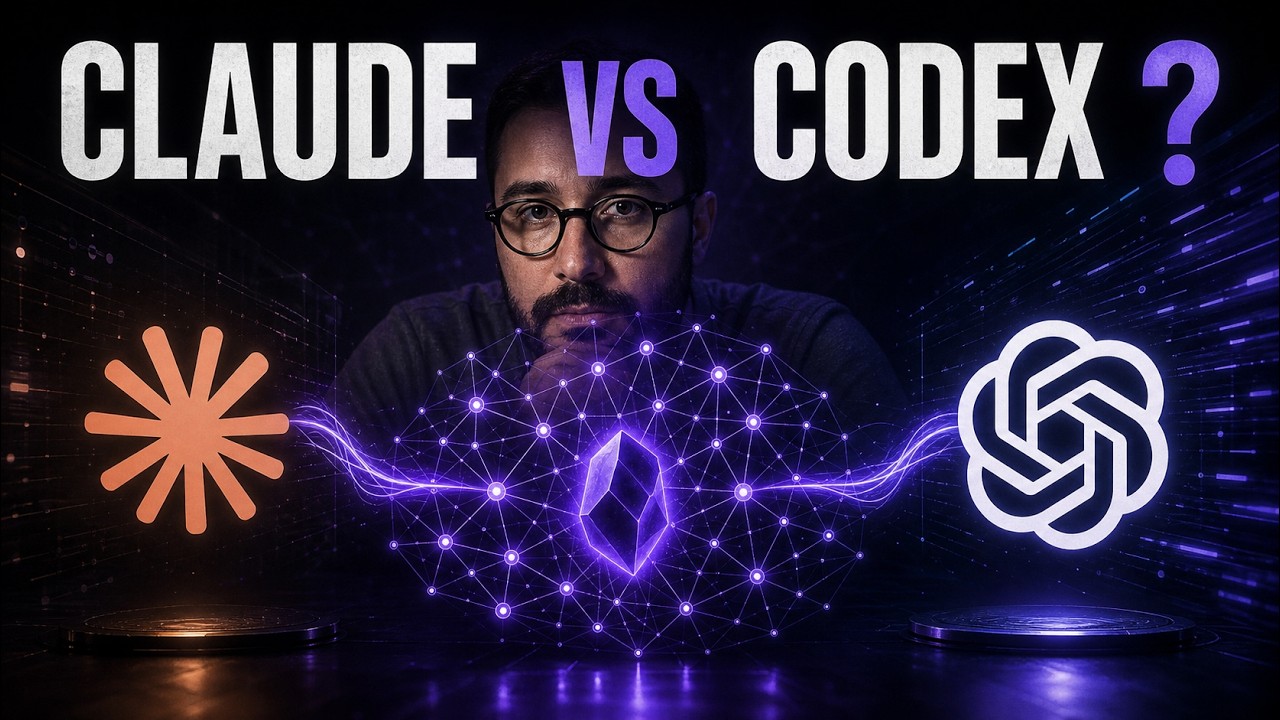
Codex m’a fait douter de Claude Code
Codex made me doubt Claude Code
Title history
- Codex m’a fait douter de Claude Code — observed on 20261101-0121 UTC (YouTube)
Keywords
Summary
208 words
Critical Evaluation
Value of the Information & Strength of the Argument
The video provides valuable practical insights, particularly the emphasis on portable business memory as a strategic asset. The argumentation is compelling because it is grounded in real-world usage and concrete examples (e.g., CRM construction, newsletter front-end), rather than abstract speculation. The author acknowledges limitations, such as the lack of formal benchmarks, which adds credibility. However, the reasoning sometimes relies on anecdotal impressions (e.g., ‘feels more robotic’), and the comparison would benefit from more systematic testing criteria. The ultimate argument—that tools should be plugged into a structured business context rather than serve as the context themselves—is well elaborated and actionable.
Scientific Rigor, Source Quality, Title Accuracy
The video presents no scientific sources or references beyond the single link to the author’s business (https://neocell.ai ) provided in the description. The lack of citations limits scientific rigor, and the evidence is primarily anecdotal. The title-adéquation is strong: the ‘doubt’ is clearly articulated, and the video delivers exactly that narrative, without straying into unrelated topics. The creator’s personal experience is transparently presented, and the conclusion aligns with the opening premise. While the content lacks external validation, it remains honest and self-reflective.
196 words
Title / Content Match
The title accurately reflects the video's core narrative: the author's shift from confidence in Claude Code to doubt after testing Codex, emphasizing the importance of portable business memory rather than a simple tool comparison.
Quality & Reliability
7/10
The video offers an honest, experience-based comparison between two AI coding tools, with practical insights on managing business context. However, it lacks quantitative data or external references to substantiate claims, relying mostly on subjective observations and a single business example.
Chapters
Cited Sources
- NeoCell — Linked in the video description as the author's company site, where he offers AI consulting for SMEs.
Concurring Sources
- Model Context Protocol (MCP) official documentation — The video explicitly references MCP as a key differentiator between Claude Code and Codex, aligning with this official protocol overview.
Dissenting Sources
- No contradictory source found. — No peer-reviewed or official comparison source was cited to contradict or validate the video's claims.
Contribution & Novelties
The video’s original contribution lies in shifting the perspective from a mere tool comparison towards the concept of a portable ‘business brain’ as the critical competitive advantage. It argues that enterprises should own and structure their operational context locally (e.g., with Obsidian) to remain flexible and avoid vendor lock-in. This is not a theoretical claim but a practical recommendation based on direct hands-on switching between Claude Code and Codex. The example of constructing a CRM from 17,000 emails and the integration with Brevo illustrate the concrete application.
Pour aller plus loin :
- Model Context Protocol (MCP) — Protocol for connecting AI agents to external tools and data sources, central to the video’s discussion of tool integration.
- Obsidian — Local-first note-taking and knowledge management tool, used by the author to create his business brain.
- Retrieval-Augmented Generation (RAG) — arXiv paper — Foundational technique for grounding AI outputs in external knowledge, closely related to the concept of feeding structured business context to AI assistants.
162 words
Radar Profile
The radar profile shows a balanced but moderate performance across criteria, with slightly higher scores in information quantity and technical level, reflecting the video's practical focus. The fiabilité (reliability) is lower, consistent with the absence of external references, while the qualitative assessment highlights the subjective yet transferable nature of the experience shared.