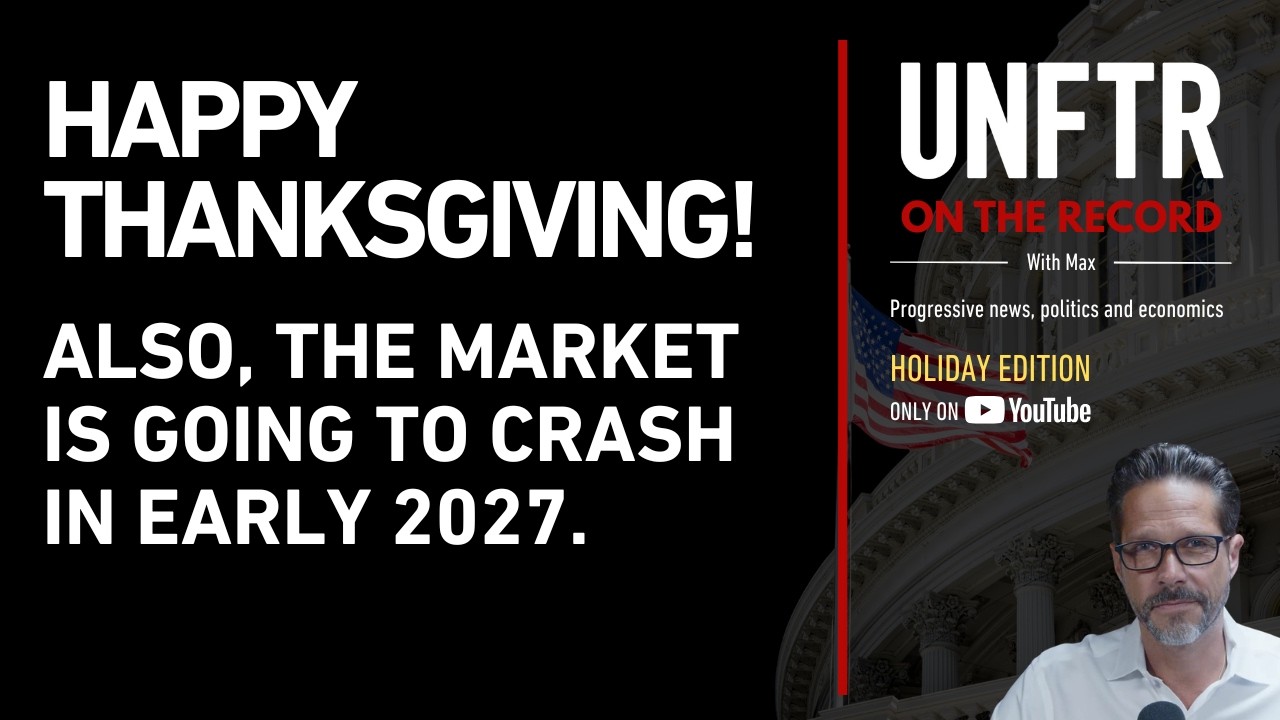
Why the Market Is Crumbling (And How to Explain It at Dinner)
Keywords
Summary
314 words
Critical Evaluation
Value of the Information & Strength of the Argument
The value of the information lies less in any single fact than in the didactic architecture. The host builds a chain that a non-specialist can follow: an external case (Argentina) supplies an intuitive model of an economy held up by an external inflow; the model is then mapped onto the United States, where the inflow is identified as capital chasing the AI trade; the mechanics of the reversal are then spelled out in reasonably conventional terms (a simultaneous drawdown across equities, metals and crypto read as a margin call seen from outside, forced selling of liquid assets to raise cash, widening junk-bond spreads, opacity in private credit, and the distinction between a loan repaid from fire-sale proceeds and capital that simply disappears). That vocabulary is largely correct and is the most transferable part of the episode. The second genuinely useful contribution is the translation of diagnosis into demands, with each demand stated as a mechanism rather than a slogan: remove the cap on earnings subject to payroll tax, refinance student debt at the policy rate with an on-time-payment forgiveness trigger and a school-funded insurance pool, float a bond to buy out private utilities, pair single payer with a displacement scheme for insurance workers. The argumentation, however, is weaker than its scaffolding. The causal chain is asserted rather than demonstrated: a single explanatory variable, financialisation plus the AI narrative, is made to carry an outcome that is ordinarily multi-causal, and the analogy with Argentina is used to license conclusions the comparison cannot bear. Forecasts are stated with a confidence the evidence does not support, and are framed in ways that resist falsification (‘a proper crash in 2027 if we can hold out that long’, ‘it’s just math’, ‘an air of inevitability’). Rhetorical devices repeatedly substitute for data: the appeal to the speaker’s own past prediction record, the invocation of a coming reckoning that will vindicate the position, and the shift between describing observed prices and describing a scenario without flagging the transition. The prescriptive section is internally coherent but one-sided: costs of transition, distributional effects and financing constraints are acknowledged only where they can be dismissed in a sentence, and counter-arguments are represented mainly through caricature (relatives who want to privatise retirement, politicians who want a multi-trillion-dollar price tag). The result is a persuasive and well-structured briefing whose argumentative force rests on narrative momentum rather than on evidence presented in a checkable form.
Scientific Rigor, Source Quality, Title Accuracy
Rigour is the episode’s weakest dimension. Not a single claim is attributed to a dated, retrievable document: no report is named, no table is shown, and the description contains no references, only the channel’s membership, shop and merchandise links. Authorities are invoked vaguely or anecdotally (‘somebody who has the last name White’, ‘somebody who is in town’), and the few named references are used as rhetorical anchors rather than citations: a paraphrase of Warren Buffett’s swimming-naked line, ‘Social Security’s own actuaries’, and ’the Yale analysis’ on single payer, whose published magnitude is markedly smaller than the one-trillion-dollars-a-year figure asserted here. Several numbers appear to conflict with widely published series: the Fed is described as expected to hike in December with consumer prices up 3.7% year-on-year in September, and eight of nine major central banks are said to have raised rates during the year, whereas the policy stance in most of those economies over the period was easing or on hold; the payroll-tax thresholds quoted do not match the published contribution and benefit base. Other elements check out directionally: depletion of the trust fund in the mid-2030s with the large majority of benefits still payable, an administrative overhead of roughly 2% for public insurance, about $1.8tn in outstanding student debt with millions of borrowers in default, and defence outlays as a measurable contributor to headline growth. The overall pattern is a mixture of defensible structural reasoning and precise-sounding figures that would not survive a reader checking them, delivered in a register that invites trust. On title fit, the opening promise of an explanation of the market decline is honoured in substance, whereas the dinner-conversation framing is delivered as a set of pre-written political talking points rather than as an explanation of the crisis itself.
710 words
Title / Content Match
The 'market is crumbling' half of the title is answered at length with concrete market mechanics and figures; the 'how to explain it at dinner' half drifts from explaining the market into a scripted set of four policy demands. The fit is therefore good but not exact, since the explanation of the decline occupies far less space than the advocacy that follows.
Quality & Reliability
3/10
The episode is dense in named indicators and figures, but almost none are sourced, attached to a date, or linked in the description, which contains only the channel's own commercial links. Several quantitative claims appear to conflict with widely published data (a December Fed hike with CPI at 3.7% year-on-year, eight of nine major central banks raising rates in the same year, precise payroll-tax-cap thresholds, a one-trillion-dollar annual saving from single payer). Directionally defensible elements coexist with these (Social Security depletion in the mid-2030s with roughly 80% of benefits payable, ~2% Medicare administrative overhead, ~$1.8tn student debt and millions in default). The framing is explicitly political advocacy delivered in an authoritative register, so the numerical texture creates more confidence than the underlying verification supports.
Key Moments
Markers derived by PSI from the transcript: the creator did not define chapters.
- Opening thesis: the host announces a format-breaking holiday briefing and asserts that markets are coming apart and that a proper crash is the likely horizon.
- Anecdote about an automated, AI-driven personalised-merchandise pipeline that mailed out a slogan the family found offensive, used to illustrate the absence of human review in automated workflows.
- Framing of the Thanksgiving table as the setting where economic arguments will be had, with a promise of a 'holistic' reading of the situation rather than a list of facts.
- Argentina as the worked example: currency management, deep cuts to public works spending, a record-low peso and poverty above 32%, presented as the classic stabilisation playbook that holds only while dollars flow in.
- Transposition to the United States: the AI capital inflow as the anchor, and a same-day fall of more than 3% in equities, gold and bitcoin read as a margin call observed from outside.
- Corporate and positioning evidence: Nvidia falling despite doubled revenue, hedge funds shorting US equities every day for a week, and SoftBank described as the most leveraged believer in the story.
- Rates and inflation: the claim that most major central banks have tightened this year, that US prices rose 3.7% year-on-year in September, and that a December Fed hike of possibly 50 basis points is expected.
- Transmission mechanism: junk-bond spreads posting their widest weekly move of the year, liquidity draining toward staples, Treasuries and the dollar, and forced deleveraging destroying rather than reallocating capital.
- Where the fragility sits: nearly $3tn of regulated bank reserves as the safe core, with the cracks located in private credit lending to mid-sized firms, framed through Buffett's swimming-naked metaphor.
- First policy talking point: lifting the payroll-tax cap, with the argument that the trust fund's projected shortfall could be closed by taxing all earnings, plus a warning against letting people invest contributions in equities.
- Second policy talking point: Medicare for All presented as a cheaper single-payer system, supported by a cited estimate of one trillion dollars a year in national savings and a ~2% administrative overhead.
- Third policy talking point: mass student-debt refinancing at the policy rate, forgiveness after twenty years of on-time payments, and a federal insurance fund financed by institutions accepting federal loan money.
- Closing: a national energy bond to buy out private power producers and rebuild the grid, followed by the membership thank-you and a promotional segment running to the end.
Cited Sources
- Project 2025 (Heritage Foundation 'Mandate for Leadership') — Invoked as the document the host read before making his 2024-2025 predictions, and used to justify his claim that the subsequent policy path was foreseeable.
- Yale University single-payer costing analysis — Cited as the basis for the claim that a single-payer system would cut national health spending by roughly one trillion dollars a year; no author, year or publication given.
- Social Security Trustees Report / Office of the Chief Actuary projections — Invoked for the trust fund depletion date, the share of benefits still payable, and the estimate that taxing all earnings would extend solvency by more than 40 years.
- Warren Buffett, Berkshire Hathaway shareholder letter ('swimming naked') — Paraphrased to describe how a falling liquidity tide exposes leveraged positions in the AI-linked complex.
- Argentina national statistical institute activity and GDP releases — Referenced for the second-quarter contraction, the worse third-quarter activity data and the official GDP publication date of 16 December.
Concurring Sources
- Social Security Administration — Office of the Chief Actuary, Trustees Report — Supports the direction of the argument: trust fund depletion in the mid-2030s and a large majority (though not the full amount) of scheduled benefits still payable.
- Federal Reserve Bank of New York — Household Debt and Credit Report — Consistent with the student-debt order of magnitude quoted and with the rise in serious delinquency among borrowers.
- Galvani et al., 'Improving the prognosis of health care in the USA', PLOS Medicine — Concordant on the direction of the claim (substantial administrative and total-cost savings under single payer) while the magnitude published is materially smaller than the figure asserted in the episode.
Dissenting Sources
- Federal Reserve — FOMC calendars, statements and implementation notes — The episode describes a Fed expected to hike in December, possibly by 50 basis points; the published policy record for the period shows a different and generally easing stance.
- U.S. Bureau of Labor Statistics — Consumer Price Index — The stated 3.7% year-on-year figure for September does not match the published CPI series, which was materially lower over the same period.
- Social Security Administration — Contribution and Benefit Base — The payroll-tax thresholds quoted in the episode do not correspond to the officially published wage base for the relevant years, which shifts the arithmetic of the 'blow the cap' argument.
- Instituto Nacional de Estadística y Censos (INDEC), Argentina — The primary source for the Argentine activity and poverty figures used; the quarterly contraction and the direction of the third quarter described in the episode should be checked against these releases rather than accepted as stated.
External References
Contribution & Novelties
The original contribution is not the diagnosis — the ‘AI trade as an unsustainable capital inflow’ thesis is a widely circulated position — but the packaging. The episode does three things that most macro commentary does not: it supplies an explicit comparative template (an emerging-market stabilisation programme) and then maps a developed-market situation onto it step by step; it insists on the plumbing rather than the headline, distinguishing regulated bank reserves from private credit and distinguishing capital that is reallocated from capital that is destroyed; and it converts the diagnosis into four concrete, mechanism-level demands, each stated with an instrument rather than a slogan (uncap the payroll tax, refinance at the policy rate with a school-funded insurance pool, float a bond to buy out utilities, pair single payer with a redeployment scheme). That last translation step, from ’the market is breaking’ to ‘here is the lever and here is who pays’, is the part a reader can actually reuse, whatever they make of the forecasts.
Further reading:
- Economic bubble — Background for judging the ‘AI trade’ framing and the difference between a valuation episode and a liquidity event.
- Minsky moment — The theoretical label for precisely the mechanism the episode describes: stability breeding leverage, then forced deleveraging when the tide turns.
- Financialization — The structural argument the host leans on when he attributes the outcome to decades of orienting the economy around capital flows.
- Social Security (United States) — Reference frame for the payroll-tax-cap debate, including the taxable maximum and trust fund mechanics.
- Private credit as an asset class (non-bank lending to mid-sized firms) — named in the episode as the locus of hidden fragility and worth reading up on separately, since its marks are not publicly traded.
- Carry trade and dollar funding (concept, no URL given) — Explains why a rising cost of dollar borrowing transmits so quickly to peripheral economies such as the Argentine case used here.
319 words
Radar Profile
The profile is lopsided: information density and topical breadth are high, with scores of figures, mechanisms and policy instruments packed into twenty-two minutes, while verification trails far behind. Technical register sits in the middle — real market plumbing (spread widening, forced deleveraging, reserve versus non-bank credit) is named and explained discursively rather than quantified. Reliability is the binding constraint, which the overall profile reflects rather than the volume of content.