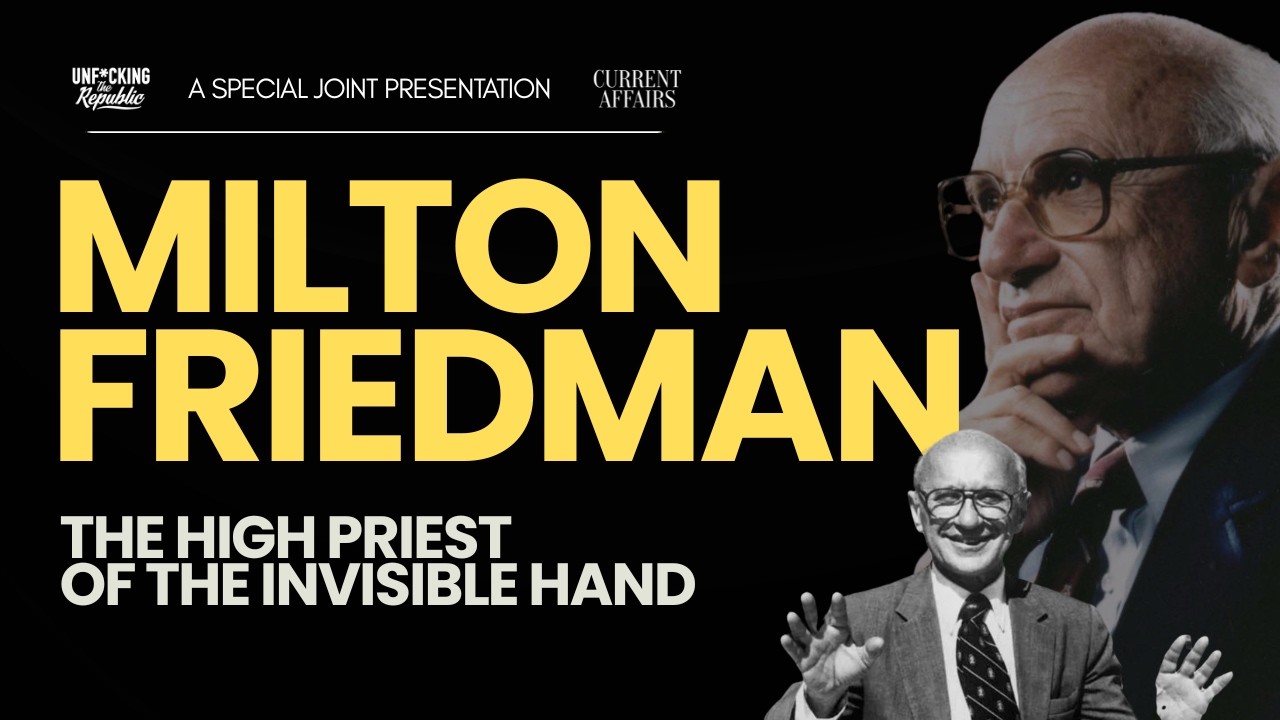
Why We’re Still Living in Milton Friedman’s Neoliberal World
Keywords
Summary
182 words
Critical Evaluation
Value of the Information & Strength of the Argument
The video offers valuable insights by synthesizing a wide range of historical and economic sources into a coherent narrative that is accessible yet rigorous. Its value lies in making complex economic theories understandable and showing their real-world consequences. The argumentation is well-structured, progressing chronologically from Friedman’s upbringing to his intellectual battles and eventual triumph. While clearly taking a critical stance, it supports its claims with concrete examples, such as the Chile experiment and changes in Fed policy. However, the presentation is one-sided, with little engagement with counterarguments, which weakens its persuasive power for those outside the progressive camp.
Scientific Rigor, Source Quality, Title Accuracy
The scientific rigor is high, drawing on books like ‘The Economists’ Hour’ and ‘The Chicago School,’ as well as discussing archival research like the Powell Memo. The title perfectly matches the content, as the entire piece is dedicated to explaining how Friedman’s neoliberal framework persists. The sources cited in the description are reputable, and the collaboration with Current Affairs lends credibility. However, the video does not include dissenting views or direct critiques of its own thesis, which may be a limitation for a fully balanced analysis. Overall, the title is apt and the sourcing is solid, though the editorial perspective is explicitly progressive.
216 words
Title / Content Match
The title accurately reflects the content, as the video explores how Milton Friedman's ideas continue to shape economic policy and societal structures today.
Quality & Reliability
8/10
The video is thoroughly researched, drawing on numerous academic books and historical documents, but it adopts a clear critical perspective without presenting counterarguments, which slightly tempers its objectivity.
Chapters
- Prologue: Max and Nathan Robinson
- Introduction: The High Priest of the Invisible Hand
- The Boy from Rahwey
- A (Very) Brief History of Economics
- The Counter Revolution Convenes
- No Such Thing as a Free Lunch
- From Economic Theory to Doctrine of Faith
- Stagflation Opens the Gate
- The Original 9/11
- The Reckoning That Wasn’t
- The Patsy
- Outro, Credits & Acknowledgements
Cited Sources
- Why We’re Still Living in the World That Milton Friedman Made — Full article by Current Affairs that serves as the basis for the video.
External References
Contribution & Novelties
This video stands out by weaving together biographical details, historical context, and economic theory in a way that makes a compelling case for Friedman’s lasting influence. It also highlights the distinction between Friedman and Hayek, and emphasizes the deliberate construction of neoliberal ideology through institutions like the Mont Pelerin Society.
Pour aller plus loin :
- Neoliberalism — Overview of the term and its historical development.
- Chicago School of Economics — Background on the academic movement associated with Friedman.
- Mont Pelerin Society — Details on the influential group founded in 1947.
- Monetarism — Explanation of Friedman’s key theoretical framework.
98 words
Radar Profile
The radar profile shows high scores across all dimensions, with quantity of information leading at 9/10, reflecting the dense historical and economic detail. Quality, technical level, and reliability are all solid at 8, indicating a well-produced and trustworthy documentary, albeit with a clear ideological slant.
💬 Ferveur. Sur les 30 commentaires analysés, l'immense majorité exprime une grande admiration pour la clarté et la profondeur de l'analyse, certains partageant des anecdotes personnelles liées aux théories de Friedman, tandis qu'aucun ne conteste fondamentalement le contenu.