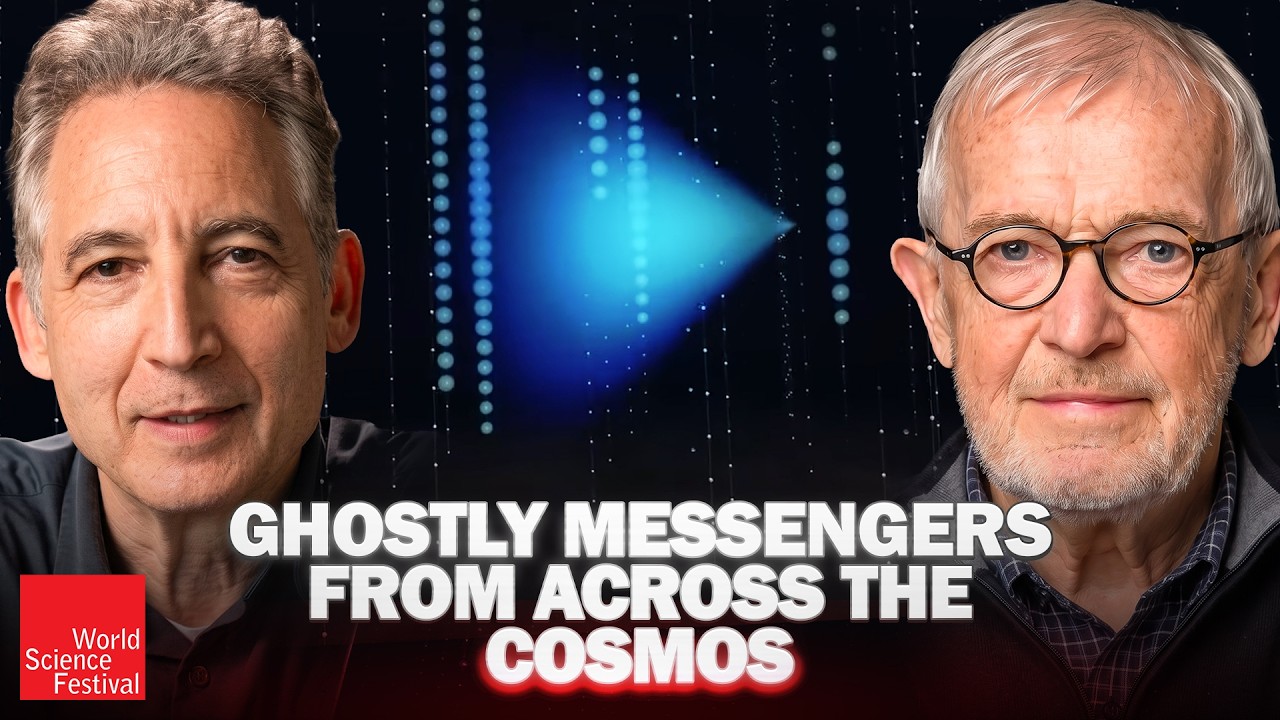
The Gamble That's Revolutionizing Astronomy | World Science Festival
Keywords
Summary
164 words
Critical Evaluation
Value of the Information & Strength of the Argument
The video provides exceptional value by granting an inside perspective from a leading researcher who explains the motivations, setbacks, and breakthroughs behind a Nobel-winning contribution. Halzen’s arguments are logically structured, moving from foundational physics to the engineering and data analysis challenges, and finally to the broader implications for multi-messenger astronomy. The reasoning is transparent about uncertainties and luck, reinforcing the scientific method. The conversation is persuasive yet honest, making a compelling case for the importance of neutrino astronomy without overstating claims.
Scientific Rigor, Source Quality, Title Accuracy
The program is produced by the World Science Festival, known for high editorial standards. The participant is directly involved in the research, and the moderator is a respected theoretical physicist. While no formal references are cited during the conversation, the narrative aligns with established scientific literature, and the description provides links to the organization and its resources. The title appropriately captures the central theme of a risky but successful scientific venture. The discussion adheres to known facts about neutrino physics and the IceCube experiment, with no apparent inaccuracies.
184 words
Title / Content Match
The title accurately reflects the content, focusing on the risky endeavor of building IceCube and its transformative impact on astronomy.
Quality & Reliability
9/10
High quality production by a professional science communication organization, featuring Nobel laureate Francis Halzen and renowned physicist Brian Greene. The information is accurate, well-articulated, and consistent with established scientific knowledge, with clear explanations and candid discussion of the experimental challenges and discoveries.
Chapters
- Introduction: Ghost Particles and a Nobel Prize
- Welcome: Brian Greene and Francis Halzen
- A History of Nobel Prizes in Neutrino Physics
- When Did Halzen Get the Neutrino Bug?
- The Askaryan Idea: Detecting Neutrinos in Ice by Radio Pulse
- From Theory to Amanda and IceCube
- A New Kind of Astronomy: Looking at the Sky With Neutrinos
- What Neutrinos Are and Why They Were So Hard to Detect
- Bohr Was Willing to Give Up Energy Conservation
- How Neutrinos Were First Confirmed: Cowan and Reines in 1956
- Multiple Flavors: The Electron, Muon, and Tau Neutrino
- Do Neutrinos Have Mass? What the Standard Model Gets Wrong
- Why Antarctica? Why Ice? The Gambles of IceCube
- The Big Breakthrough: Ice Is Clearer Than Anyone Expected
- How IceCube Works: Hot Water Drilling and Light Sensors
- The Particle Physics of a Neutrino Interaction in Ice
- 5,000 Sensors, Nanosecond Timing, and a Neutrino Telescope
- Narrating the IceCube Animation: What a Neutrino Event Looks Like
- Energies a Thousand Times Higher Than the LHC
- Separating Cosmic Neutrinos From Atmospheric Background
- One a Minute of Background. One a Month Worth Betting On.
- Where Are the Neutrinos Coming From? Active Galaxies
- Building IceCube Gen2: Ten Times Bigger for About the Same Cost
- Water vs. Ice: Other Neutrino Observatories Around the World
- Multi-Messenger Astronomy: Collaborating With LIGO
- Dark Matter, WIMPs, and Why the WIMP Miracle Didn't Happen
- Testing Quantum Gravity With High-Energy Neutrinos
- AI and Machine Learning: The Galactic Plane Discovery
- Do You Worry About AI Changing the Future of Physics?
- Advice to Young Scientists: Follow Your Obsession
- Closing Thoughts: What Discovery Really Feels Like
Cited Sources
- World Science Festival - Official Website — The organization's website provides additional scientific content and information about the festival and its programs.
- World Science Festival on LinkedIn — Official LinkedIn page of the World Science Festival, sharing updates and professional connections.
Concurring Sources
- IceCube Neutrino Observatory - Wikipedia — Corroborates the existence and capabilities of the detector, as well as its main discoveries concerning astrophysical neutrinos.
External References
Contribution & Novelties
This video offers a unique first-person account of the conception, construction, and scientific payoff of the IceCube Neutrino Observatory, blending technical detail with personal reflection. It discloses the element of luck and the iterative nature of scientific progress, which is rarely captured in formal publications. The conversation also reveals the future direction of neutrino astronomy, including the planned IceCube Gen2 and its role in multi-messenger observations.
Pour aller plus loin :
- IceCube Neutrino Observatory - Wikipedia — Provides a comprehensive overview of the detector’s design, construction, and key scientific results.
- Neutrino - Wikipedia — Details the particle’s properties, history, and detection methods.
- Multi-messenger astronomy - Wikipedia — Explains the combination of different cosmic messengers to study astrophysical sources, a theme central to the video.
124 words
Radar Profile
The profile shows high scores in information quantity, quality, and global reliability, with a slightly lower technical level, reflecting that the content is precise yet accessible to a non-specialist audience.