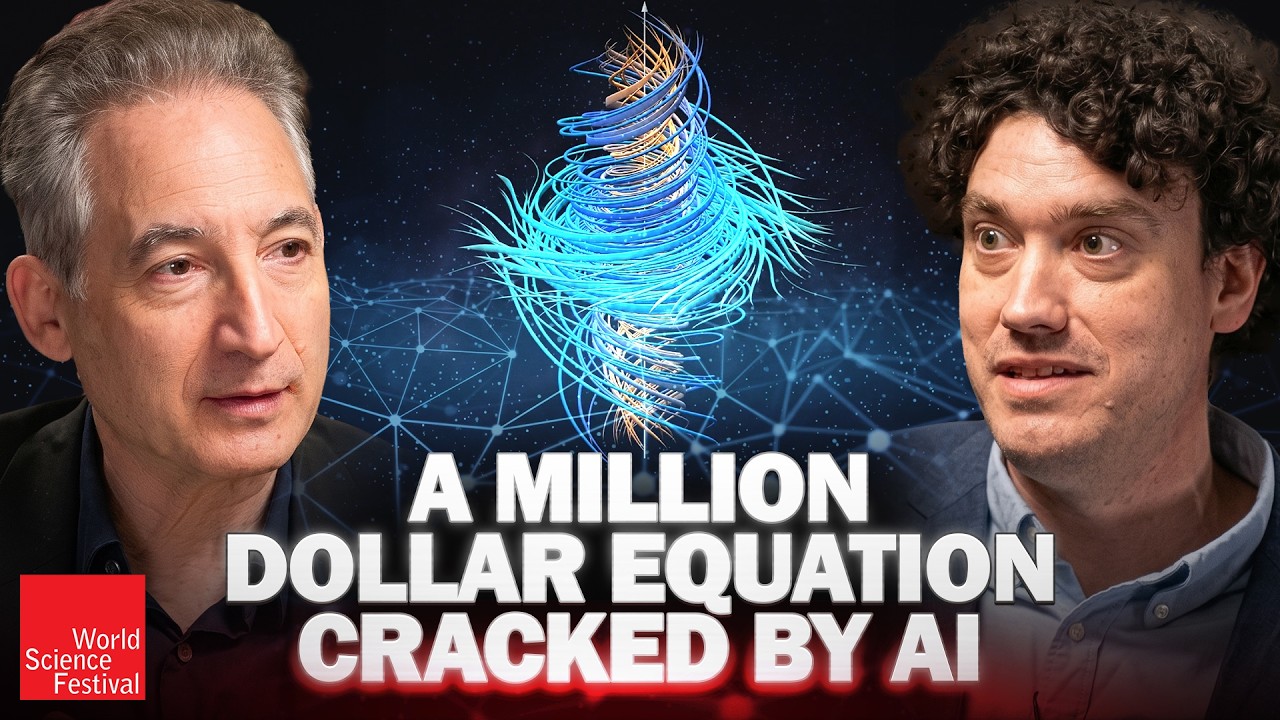
AI Just Changed Mathematics Forever | World Science Festival
Keywords
Summary
201 words
Critical Evaluation
Value of the Information & Strength of the Argument
The video provides exceptional value by offering a first-hand account from a mathematician who directly participated in the AI-assisted work. Buckmaster’s explanations are clear, combining technical depth with accessibility without oversimplification. He argues convincingly that AI is capable of genuine creativity, not just recombination, by drawing parallels with how human mathematicians build on prior ideas. The argumentation is solid; he supports his claims with concrete examples, such as the AI-generated proofs being correct but unreadable to humans, and he carefully distinguishes between established facts and interpretations. Greene’s moderating questions effectively draw out the nuances, especially around the DeepMind and OpenAI collaboration, where Buckmaster reveals unethical behavior by OpenAI in trying to claim credit. The discussion is well-structured and adheres to scholarly standards, ensuring the audience grasps the significance of the breakthrough and its limitations.
Scientific Rigor, Source Quality, Title Accuracy
The scientific rigor is high: the guest is a leading researcher in the field, and the conversation is grounded in peer-reviewed literature, historical developments, and ongoing research. The sources are of good quality, including references to the Clay Institute and specific authors like Leray, Scheffer, and Caffarelli-Kohn-Nirenberg, though no external links to these works are provided in the description. The title ‘AI Just Changed Mathematics Forever’ is apt, as the content does indeed present a compelling case for AI’s transformative role, while also noting the controversy and unresolved aspects. The video maintains a balanced perspective, acknowledging both the achievements and the open questions, which enhances its credibility. Overall, the title is not sensationalized but accurately reflects the provocative yet substantive discussion.
270 words
Title / Content Match
The title accurately reflects the content, as the discussion focuses on how AI has contributed to a potential solution of the Navier-Stokes problem, a major mathematical breakthrough.
Quality & Reliability
8/10
The guest is a leading expert in fluid dynamics and mathematics at NYU's Courant Institute, and the conversation is moderated by a renowned physicist. The content is rigorous, well-structured, and addresses both technical details and broader implications, though it relies on the guest's personal testimony and does not independently verify every claim.
Chapters
- Can AI Really Be Creative?
- How AI Is Changing Mathematics
- Understanding the Navier-Stokes Equations
- Why Fluid Equations Can Break Down
- The Millennium Prize Problem
- The History of the Navier-Stokes Problem
- The “Nightmare” Solutions
- How Simulations Led to Mathematical Proofs
- Computer-Assisted Mathematical Proofs
- Why the Millennium Problem Remained Unsolved
- Using Neural Networks to Search for Singularities
- Why DeepMind Couldn’t Solve the Core Problem
- How LLMs Approach Mathematical Proofs
- How AI Agents Help Solve Math Problems
- AI-Generated Proofs and Verifying Their Accuracy
- When AI Starts Creating Its Own Language
- AI’s Progress Toward Solving the Euler Problem
- The Anthropic–OpenAI Competition
- Has AI Solved the Millennium Prize Problem?
- How the OpenAI and Buckmaster Work Connect
- AI Compresses Years of Mathematical Progress
- How AI Could Change Mathematics
- The Future of Mathematicians
- The Next Big Questions in Fluid Dynamics
- What AI Beyond Human Intellect Could Mean
Cited Sources
- World Science Festival — Official website of the organization hosting the program, providing background on the series and related content.
- Video Link — Direct link to the YouTube video, used for reference and verification.
External References
Contribution & Novelties
This video offers a unique, insider perspective on the recent AI-assisted solution to the Navier-Stokes Millennium Problem, detailing the collaboration with DeepMind and the controversy with OpenAI. It provides novel insights into how AI generates original mathematical proofs that are beyond human comprehension yet verifiable, and the broader implications for mathematical practice and research. The discussion also highlights the ongoing unresolved questions in fluid dynamics, such as the emergence of lift, which are rarely covered in such depth.
Pour aller plus loin :
- Navier–Stokes equations — Essential background on the equations and the Millennium Prize formulation.
- Millennium Prize Problems — List of the seven problems, including the Navier-Stokes problem and its status.
- Computer-assisted proof — Context on the use of computers in proving theorems, relevant to the discussion of AI-generated proofs.
131 words
Radar Profile
The radar profile shows very high scores across all dimensions, indicating a comprehensive and technically deep discussion with robust information. The slightly lower reliability score reflects the reliance on personal accounts and the ongoing controversies, but overall the profile demonstrates a high-quality educational content.
💬 Sur les 30 commentaires analysés, la tendance est très positive : la grande majorité des spectateurs saluent la clarté pédagogique de Brian Greene et la profondeur des échanges avec Tristan Buckmaster. Quelques commentaires critiques expriment des doutes sur la réalité de la contribution de l'IA, mais ils restent minoritaires.