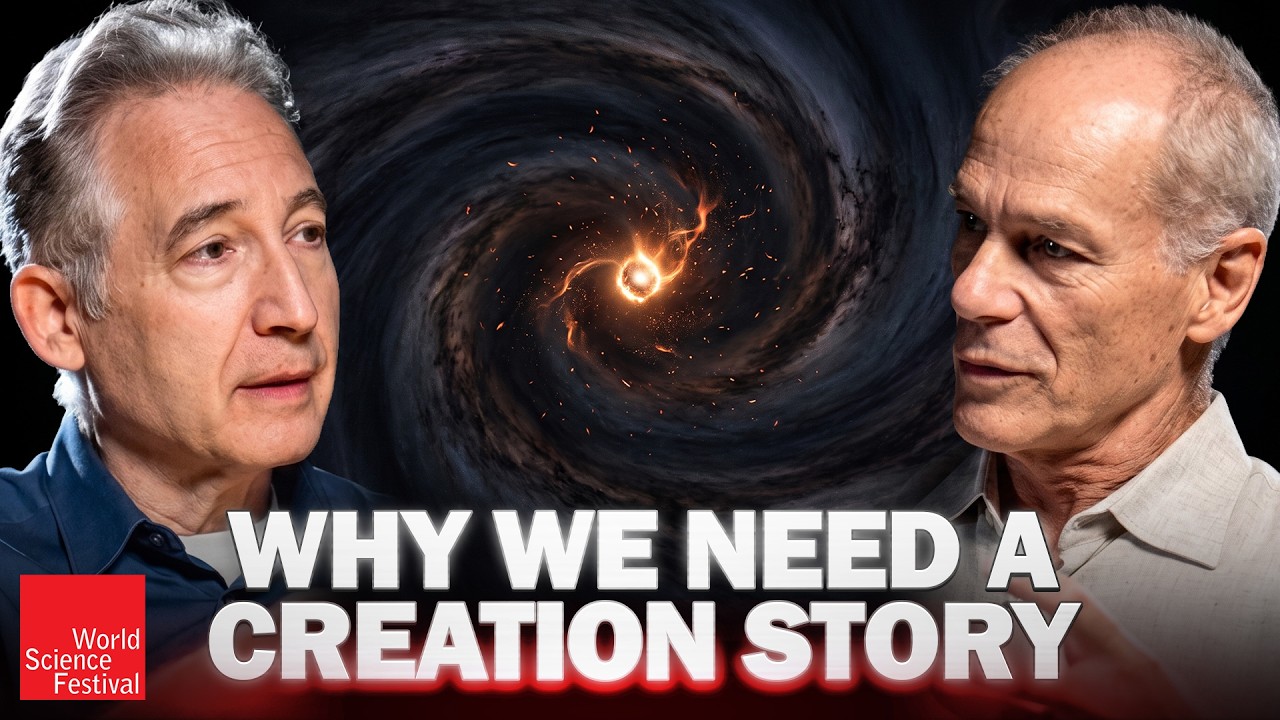
Are There Limits To What Physics Can Explain? | World Science Festival
Keywords
Summary
237 words
Critical Evaluation
Value of the Information & Strength of the Argument
The conversation offers substantial conceptual value by framing several unresolved scientific problems in accessible but non-trivial terms. Gleiser’s argument about the limits of physics rests on an epistemic rather than ontological claim: even if a final theory existed, we could not know we had reached it because probing deeper always requires new technology, leading to an infinite regress of composite structures. This is a coherent and well-established line of reasoning in philosophy of science. Greene’s counterpoint about the simplicity of fundamental ingredients is presented as a possibility rather than a certainty, and he explicitly acknowledges that the standard model may not be the end of the story. On the origin of life, both speakers distinguish between practical and in-principle reproducibility, and Gleiser introduces the useful distinction between unguided emergence and laboratory creation guided by intention. Greene’s argument from natural selection’s vast trial-and-error capacity is a standard and defensible position. The discussion of autonomy in bacteria is more speculative: Gleiser attributes an urge to stay alive to single-celled organisms, while Greene reduces this to complex particle interactions governed by physical law. Neither position is fully argued, and the exchange remains at the level of competing intuitions rather than evidence. The treatment of panpsychism is brief and dismissive without detailed engagement with its strongest formulations. The mathematics debate is framed as a binary between invention and discovery, which oversimplifies a nuanced philosophical literature. Overall, the argumentation is rigorous in tone and honest about uncertainty, but it prioritizes breadth over depth and does not resolve the tensions it raises.
Scientific Rigor, Source Quality, Title Accuracy
The discussion is scientifically rigorous in the sense that both participants are established researchers who avoid overclaiming and repeatedly flag speculation as such. However, the format does not include formal citations, data, or references to specific studies, so the viewer cannot easily verify the claims made. The sources mentioned are intellectual touchstones rather than empirical evidence: Ernest Becker’s The Denial of Death, Henri Bergson’s élan vital, Philip Goff’s panpsychism, and Simon Conway Morris, the 2025 Templeton Prize winner. These are named but not cited with precision, and no URLs or publications are provided in the description beyond the festival’s own channels. The title’s question about limits to physics is addressed, but the conversation is broader than the title suggests, covering mortality, psychedelics, and AI. The title is therefore not misleading, but it undersells the range of topics. The description accurately summarizes the main themes and correctly identifies the participants and the series context. The absence of a formal bibliography is typical of the format but limits the note’s source-based verifiability.
441 words
Title / Content Match
The title asks whether physics has limits, and the conversation does address that question directly, though it also ranges widely into mortality, consciousness, psychedelics, and AI. The title is therefore broadly accurate but narrower than the actual content.
Quality & Reliability
7/10
The discussion is led by two recognized physicists, Brian Greene and Marcelo Gleiser, and stays within the bounds of mainstream scientific and philosophical debate. Claims are presented as interpretations and open questions rather than settled facts, and the speakers distinguish between empirical findings and speculative positions. However, the format is a conversational interview without formal citations, data presentation, or peer-reviewed references, which limits verifiability. No advertising sequence is present in the transcript.
Chapters
- Could We Ever Know We've Reached the Bottom of Reality?
- Where Does the Urge to Understand Everything Come From?
- Awe and Wonder vs. Fear of Death: Are They the Same?
- How Mortality Shaped Gleiser's Work
- Are We Matter Thinking About Itself?
- How Did Life Happen Without a Conductor?
- What Does Autonomy Mean for a Bacterium?
- Autonomy, Free Will, and the Laws of Physics
- Can We Recreate the Origin of Life in a Laboratory?
- The Inner Workings of a Single Cell
- Is Life Common in the Universe?
- Have We Lost Something by Abandoning Creation Stories?
- The Transhumanist Movement
- The Map and the Territory
- Is Mathematics Invented or Discovered?
- Psychedelics and the Doors of Perception
- Will AI Ever Provide Answers Physics Cannot?
- Can an AI System Ever Be Truly Conscious?
Cited Sources
- World Science Festival — Official website of the organizing institution, provided in the video description.
- World Science Festival LinkedIn — Institutional social media link from the description.
- World Science Festival YouTube channel — Subscription link provided in the description.
- Are There Limits To What Physics Can Explain? (short link) — Short URL for the video itself, listed in the description.
Concurring Sources
- Ernest Becker, The Denial of Death — Becker's Pulitzer Prize-winning work is explicitly discussed by both speakers as a shared influence on their thinking about mortality.
- Henri Bergson — Gleiser mentions Bergson's élan vital in the context of vitalism and the origin of life.
- Philip Goff — Gleiser references Goff as a prominent advocate of panpsychism, a position he says he cannot yet embrace.
- Simon Conway Morris — Mentioned as the 2025 Templeton Prize winner in the context of evolutionary convergence and the rarity of life.
Contribution & Novelties
The conversation’s original contribution lies in the juxtaposition of two distinct epistemic attitudes toward the limits of physics: Greene’s cautious optimism that fundamental ingredients may be fully identified, and Gleiser’s insistence that technological mediation makes any final knowledge unattainable. The exchange on abiogenesis adds a useful distinction between unguided natural emergence and intentional laboratory creation, which is rarely articulated so clearly in public discussions. The dialogue also connects the psychology of mortality to the scientific drive for explanation, drawing on Becker’s work in a way that bridges existential psychology and physics. The discussion of AI as a source of unverifiable answers raises a timely epistemological question about what counts as knowledge when the underlying reasoning cannot be independently checked.
Pour aller plus loin :
- Ernest Becker — Author of The Denial of Death, central to the discussion of mortality and the human drive to understand.
- Abiogenesis — The scientific study of the origin of life from non-living matter, directly relevant to the laboratory debate.
- Panpsychism — The philosophical view that consciousness is a fundamental feature of reality, mentioned in relation to Philip Goff.
- Philosophy of mathematics — The field addressing whether mathematics is invented or discovered, corresponding to the 39:04 chapter.
- Henri Bergson and the concept of élan vital — Referenced in the discussion of vitalism and the origin of life; no URL provided due to uncertainty about the most appropriate stable source.
233 words
Radar Profile
The profile shows a strong emphasis on conceptual quality and reliability, with a moderate technical level appropriate for a public-facing dialogue between experts. Information quantity is solid but not exhaustive, reflecting the conversational format. The overall shape suggests a thoughtful, philosophically oriented discussion rather than a data-driven or technical exposition.
💬 Balanced and largely positive, with high engagement and appreciation for the speakers. On the 30 comments analyzed, most express enthusiasm for the conversation and the pairing of Greene and Gleiser, while a few raise substantive objections about the mathematics debate and the timing of consciousness discussions.