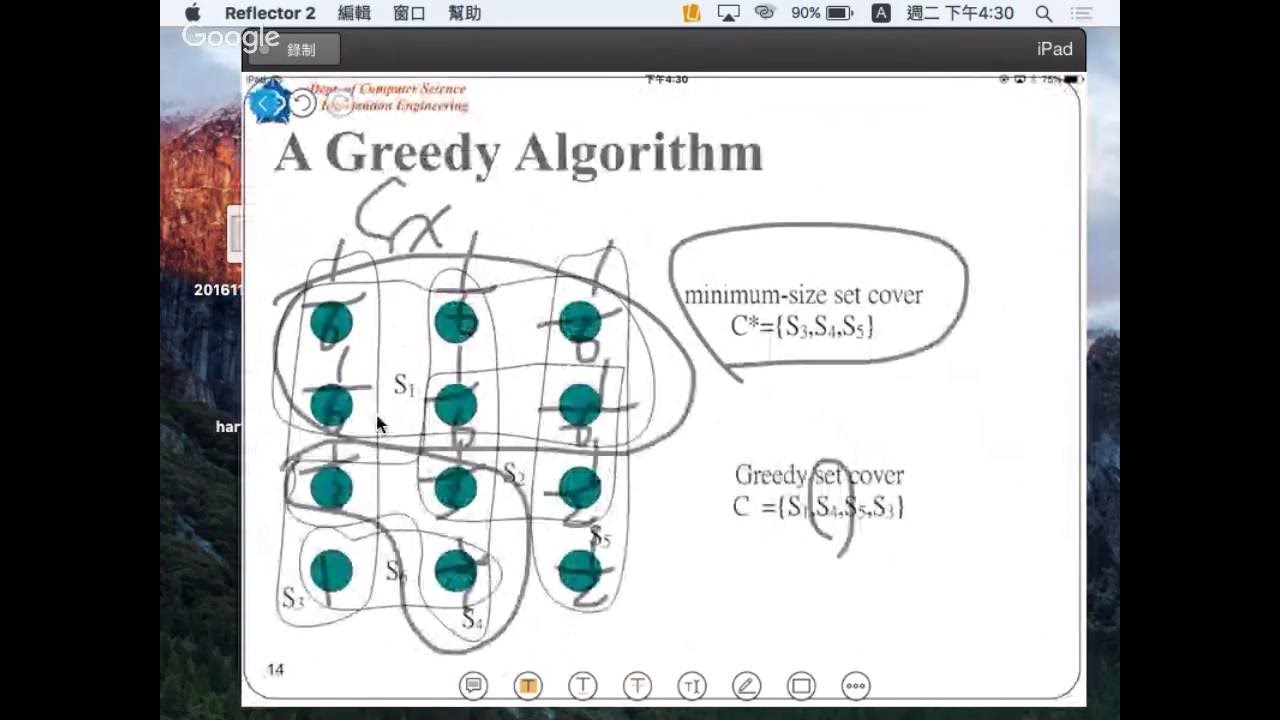
20161129 Set Cover 2 & Randomized Approximation Algorithm
Title history
- 20161129 Set Cover 2 & Randomized Approximation Algorithm — observed on 20261025-2342 UTC (YouTube)
Keywords
Summary
138 words
Critical Evaluation
Value of the Information & Strength of the Argument
The value of the information lies in its rigorous demonstration of how approximation algorithms can be analyzed. The argumentation is solid, with clear step-by-step proofs and intuitive explanations. The lecturer successfully conveys both the mathematical techniques and the reasoning behind them, making complex proofs accessible to graduate students.
Scientific Rigor, Source Quality, Title Accuracy
The scientific rigor is high; the lecture follows standard theoretical computer science principles. While no external sources are explicitly cited, the content is based on well-known results in approximation algorithms, such as the greedy set cover bound and the randomized rounding for MAX SAT. The title aligns perfectly with the content, and the presentation is coherent and academically sound.
122 words
Title / Content Match
The title accurately reflects the two main topics: set cover approximation and randomized approximation algorithms.
Quality & Reliability
8/10
The video is a graduate-level lecture presenting rigorous proofs and clear explanations of approximation algorithms, based on established theoretical foundations.
Key Moments
Markers derived by PSI from the transcript: the creator did not define chapters.
Contribution & Novelties
The lecture provides a clear pedagogical presentation of classic approximation techniques, emphasizing the proof structure and the role of randomness. It offers a foundation for understanding more advanced topics in approximation algorithms.
Pour aller plus loin :
- Approximation algorithm — Overview of approximation algorithms and their guarantees.
- Set cover problem — Detailed description and complexity status.
- Probabilistic method — Technique used to prove existence and analyze randomized algorithms.
68 words
Radar Profile
The radar profile shows high scores in information quantity, quality, and technical level, indicating a dense and rigorous presentation. Reliability is slightly lower, reflecting the lack of external citations but overall strong academic grounding.