3 Dynamic Programming (English)
Keywords
Summary
136 words
Critical Evaluation
Value of the Information & Strength of the Argument
The video provides a thorough and coherent introduction to dynamic programming, grounding each concept in concrete examples and rigorous complexity analysis. The argumentation is solid: it starts from first principles (optimal substructure, overlapping subproblems), shows the failure of naïve recursion, and systematically builds toward efficient solutions. The LCS example is particularly well-explained, with the recurrence derived step by step and validated through a worked table. The discussion of Hirschberg’s algorithm is clear and correctly explains the divide-and-conquer approach for linear space. The later parts on parallelization and Four-Russians are more advanced but still presented logically. Overall, the information is accurate and the reasoning is sound.
Scientific Rigor, Source Quality, Title Accuracy
The content is scientifically rigorous, based on standard textbook algorithms and well-known results in computer science. The complexity analyses (O(2ⁿ) for naïve Fibonacci, O(mn) for LCS, O(M+N) space for Hirschberg) are correct. However, no external sources are cited in the video or description, so the reliance is on the lecturer’s expertise. The title ‘3 Dynamic Programming’ is somewhat generic but accurately describes the subject; the extra ‘3’ likely indicates it’s the third lecture in a series, and the ‘(English)’ clarifies the language. The title-contenu match is strong, with the video thoroughly covering DP as promised.
215 words
Title / Content Match
The title accurately reflects the topic: the video is a lecture on dynamic programming.
Quality & Reliability
8/10
Clear and structured lecture on dynamic programming, covering standard algorithms (Fibonacci, LCS) with correct complexity analysis. Content is consistent with established computer science theory.
Key Moments
Markers derived by PSI from the transcript: the creator did not define chapters.
- Introduction to dynamic programming with the Netflix analogy
- Definition of optimal substructure and overlapping subproblems
- Naïve Fibonacci recursion tree and exponential complexity
- Introduction to Longest Common Subsequence (LCS) problem
- LCS recurrence and optimal substructure when last characters match
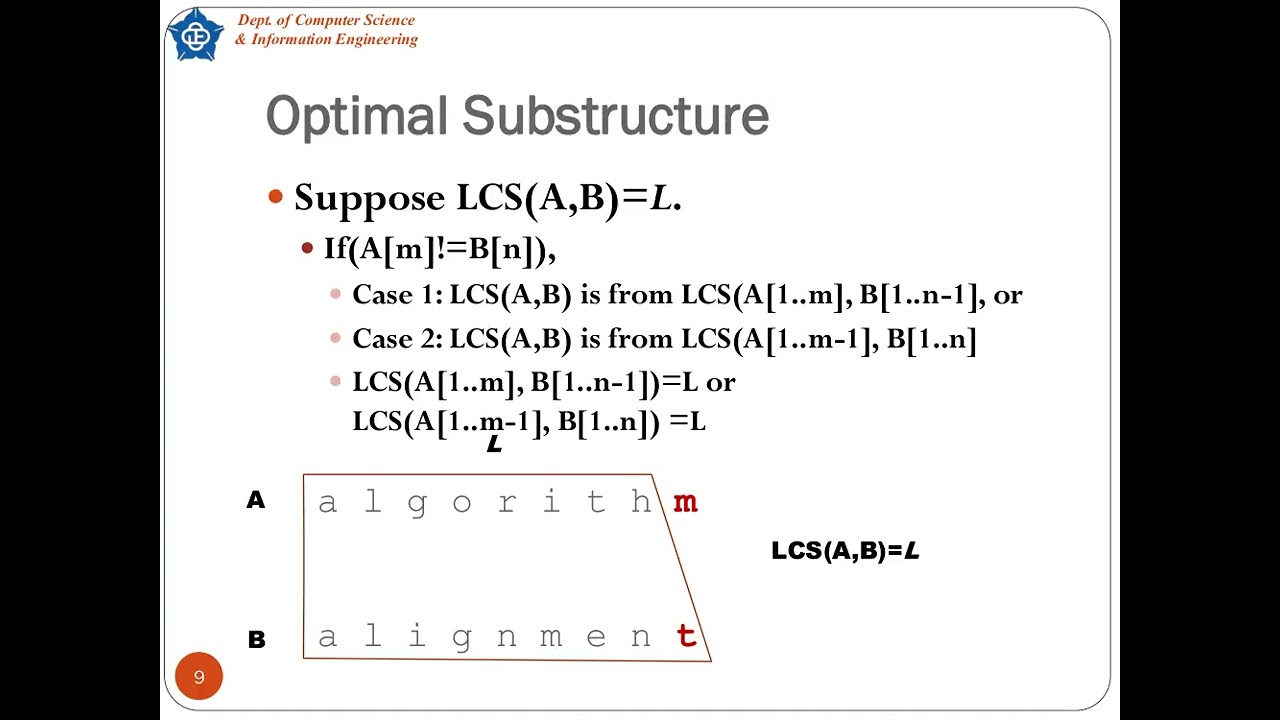
- LCS recurrence when last characters differ
- Top-down memoized approach for LCS
- Bottom-up DP table construction and example with X=ABCB, Y=BDCAB
- Complexity analysis: O(n²) time and space
- Hirschberg's algorithm for linear-space LCS
- Parallelization strategies (anti-diagonal, SIMD) and Four-Russians method
Contribution & Novelties
The video offers a comprehensive tutorial on dynamic programming, with a particular strength in the detailed walkthrough of the LCS problem and the explanation of Hirschberg’s algorithm for space optimization. While it doesn’t present new research, it provides a clear pedagogical contribution by connecting classical algorithms to modern optimizations. The coverage of parallelization and the Four-Russians method adds depth beyond typical introductory treatments.
Pour aller plus loin :
- Dynamic programming (Wikipedia) — Overview of the technique and its applications.
- Longest common subsequence (Wikipedia) — Detailed explanation of the problem and algorithms.
- Hirschberg’s algorithm (Wikipedia) — Specifics on the linear-space alignment method.
- Four Russians method (Wikipedia) — Explanation of the block-computation speedup.
111 words
Radar Profile
The radar profile shows high scores in quantity and quality of information, indicating a dense and accurate lecture. Technical level is high, suitable for graduate students, while reliability is strong given the standard content. The overall note of 4 reflects excellent teaching but not groundbreaking novelty.