16 Polynomial Time Approximation Scheme (English)
Keywords
Summary
145 words
Critical Evaluation
Value of the Information & Strength of the Argument
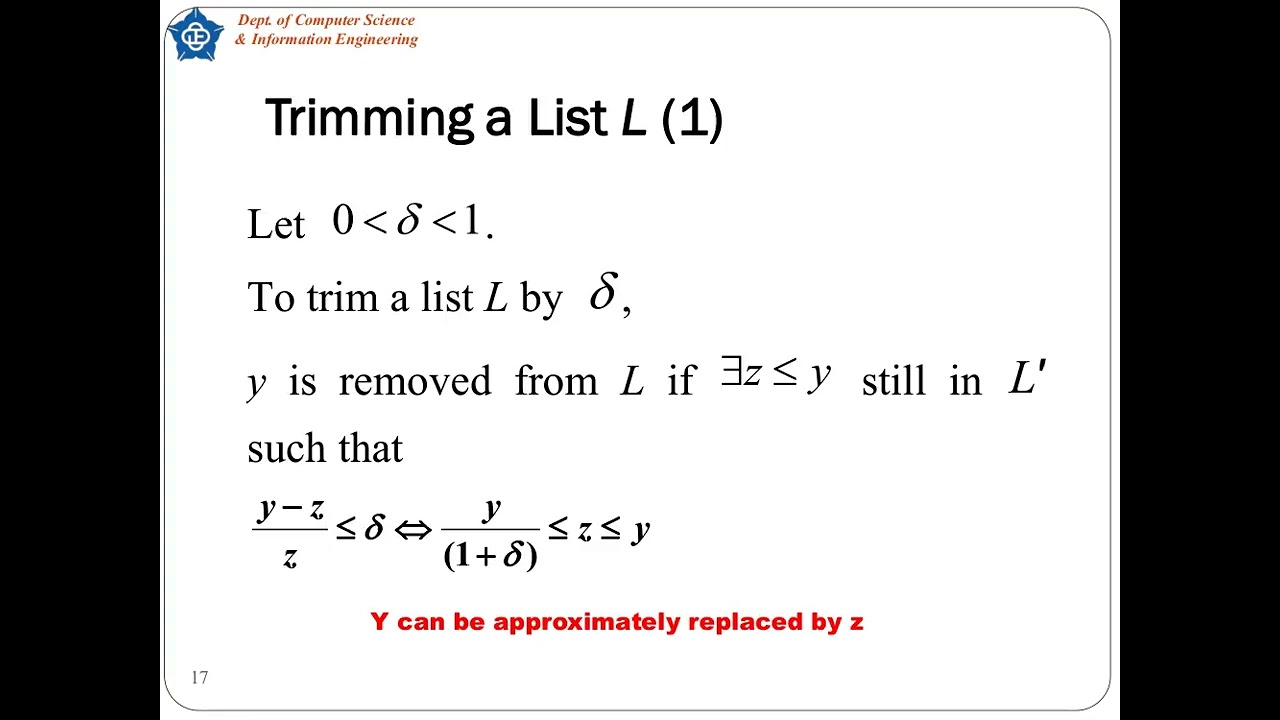
The lecture provides a clear and pedagogical explanation of approximation schemes, using the subset-sum problem as a concrete case. The argumentation is solid: it starts with the definition of ρ-approximation, introduces the concept of an approximation scheme, and then builds the FPTAS step by step. The inclusion of a working example with explicit list evolutions makes the algorithm transparent. The proof of the approximation ratio is thorough, using the trimming argument to bound list sizes and demonstrate polynomial time. The choice of δ = ε/(2n) is justified by the need to maintain the (1+ε) guarantee across all iterations. The lecture effectively conveys both the intuition and the formal details, making it valuable for students of algorithms.
Scientific Rigor, Source Quality, Title Accuracy
The video is a self-contained lecture; no external sources are cited, and the description contains no links. The content aligns with standard algorithmic literature, and the techniques (merge-trim) are known from classic approximation algorithm texts. The title is accurate and not misleading. There is no evidence of rigor issues; the definitions and proofs follow conventional patterns. The lecture appears to be part of a graduate algorithms course, given the depth and formalism.
203 words
Title / Content Match
The title accurately reflects the content, which is a lecture on polynomial-time approximation schemes.
Quality & Reliability
8/10
Well-structured lecture covering PTAS/FPTAS with rigorous definition, examples, and proof. The explanation is logically consistent and follows standard algorithmic analysis. No apparent errors in the derivation.
Key Moments
Markers derived by PSI from the transcript: the creator did not define chapters.
- Definition of ρ(n)-approximation and its properties.
- Introduction of approximation schemes and PTAS.
- Definition of FPTAS and its polynomial time in 1/ε.
- Subset-sum problem formulation and brute-force approach.
- Merge-list operation and trimming concept.
- Detailed example of APPROX_SUBSET_SUM with list evolution.
- Proof of approximation guarantee and running time analysis.
Contribution & Novelties
The video provides a self-contained tutorial on a classical algorithmic technique. It does not introduce new research, but offers a clear pedagogical walkthrough of FPTAS for subset-sum, emphasizing the trimming step. The concrete example and step-by-step proof are valuable for learners. The originality lies in the clarity of exposition rather than in novel contributions.
Pour aller plus loin :
- Polynomial-time approximation scheme - Wikipedia — Overview of PTAS and FPTAS.
- Subset sum problem - Wikipedia — Background on the problem and known algorithms.
- Approximation algorithm - Wikipedia — General context and definitions.
92 words
Radar Profile
The radar chart likely shows high scores in technical level and information quality, with slightly lower but still strong scores in quantity and reliability. The overall profile indicates a rigorous, in-depth lecture suitable for advanced students.