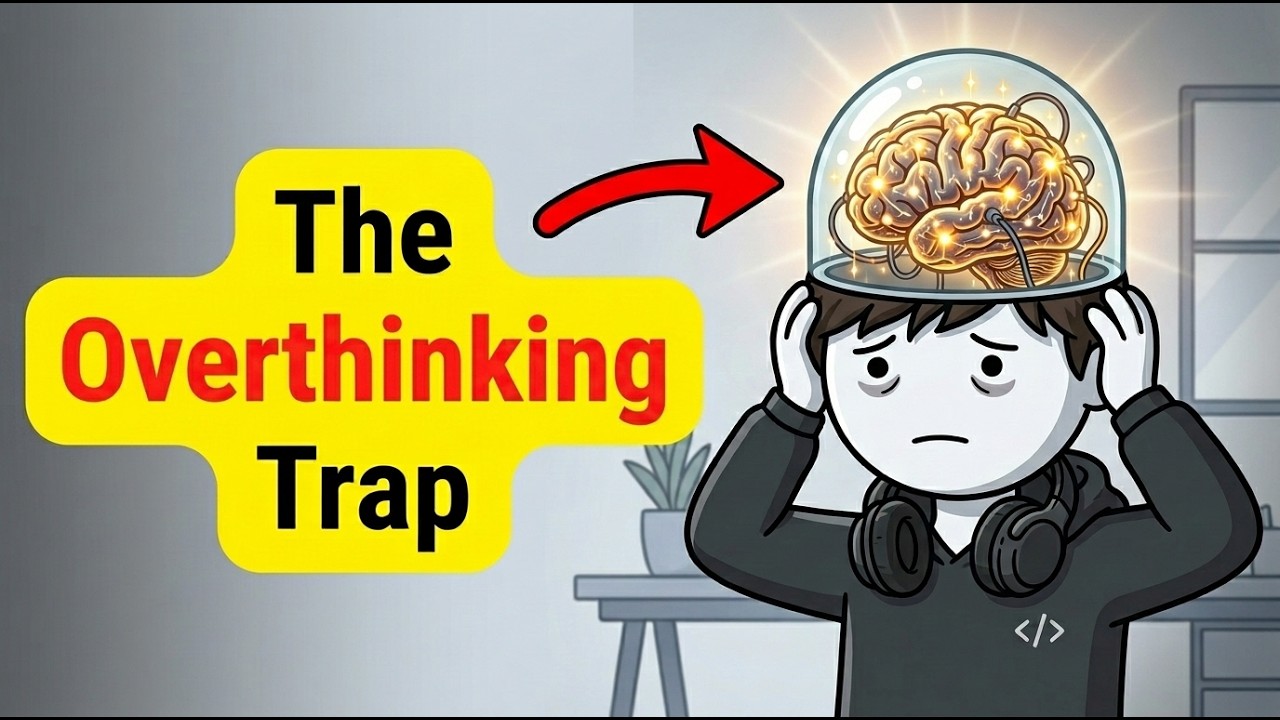
The Psychology of Developers Who Overthink Everything
Title history
- The Psychology of Developers Who Overthink Everything — observed on 20261101-0121 UTC (YouTube)
Keywords
Summary
159 words
Critical Evaluation
Value of the Information & Strength of the Argument
The video offers valuable insight into a widespread issue among developers, articulating a clear causal chain from professional conditioning to mental exhaustion. The argument is persuasive because it draws on established psychological concepts (e.g., maladaptive rumination, cognitive defusion) and applies them specifically to the software engineering context. The use of relatable examples, such as over-engineering simple projects or obsessing over edge cases, makes the content highly engaging. However, the reasoning relies on general claims without empirical data or direct studies, which weakens its scientific depth. The solution strategies, while practical, are presented as general advice rather than evidence-based interventions. Still, the video’s strength lies in its accessible synthesis of known ideas, offering a cohesive narrative that resonates with its target audience.
Scientific Rigor, Source Quality, Title Accuracy
The video demonstrates a solid understanding of basic psychology but does not provide explicit sources, footnotes, or references to research. It refers to concepts like the default mode network and cognitive defusion but without citing studies or originating works. The title is perfectly aligned with the content, as the entire video is devoted to the psychology of overthinking in developers. The description also matches, though it omits any external links. No public comments or engagement metrics beyond likes (93) were provided, so it is not possible to assess audience reaction. Overall, the lack of citations makes it more of an essay based on the author’s expertise than a scientifically rigorous piece.
247 words
Title / Content Match
The title perfectly matches the content: the video analyzes the phenomenon of overthinking in software developers, covering its causes, consequences, and potential strategies to overcome it.
Quality & Reliability
7/10
The video presents well-known psychological concepts accurately and coherently, but lacks explicit citations. The arguments are logical and relatable, yet the absence of sources reduces its scientific rigor
Key Moments
Markers derived by PSI from the transcript: the creator did not define chapters.
- Introduction to the paradox: brilliant engineers who are mentally exhausted from overthinking code.
- Explanation of how programming conditions the prefrontal cortex to anticipate failures, leading to hyper-vigilance.
- Discussion of maladaptive rumination and the illusion of mental progress, causing analysis paralysis.
- Imposter syndrome during code reviews: how comments trigger defensive over-explaining.
- Burnout as a result of chronic overthinking—the nervous system throttling cognitive resources.
- Introduction of cognitive defusion and the practice of 'good enough' to break the loop.
Contribution & Novelties
This video adds value by translating clinical psychology concepts into the software engineering context, making them accessible to developers who may not be familiar with them. It provides a coherent framework linking professional habits to mental health, offering practical steps to counteract overthinking. However, it doesn’t present original research or novel data; its contribution is primarily in the synthesis and communication of known ideas.
Pour aller plus loin :
- Cognitive defusion — Relevant as the main solution proposed in the video.
- Rumination (psychology) — Defines maladaptive rumination, a core concept.
- Analysis paralysis — Describes the decision-making stall described in the video.
101 words
Radar Profile
The radar profile shows moderate scores across information quantity, quality, and reliability, with a lower technical level. This indicates a well-communicated but not deeply technical or heavily sourced piece, typical of an expert opinion video.