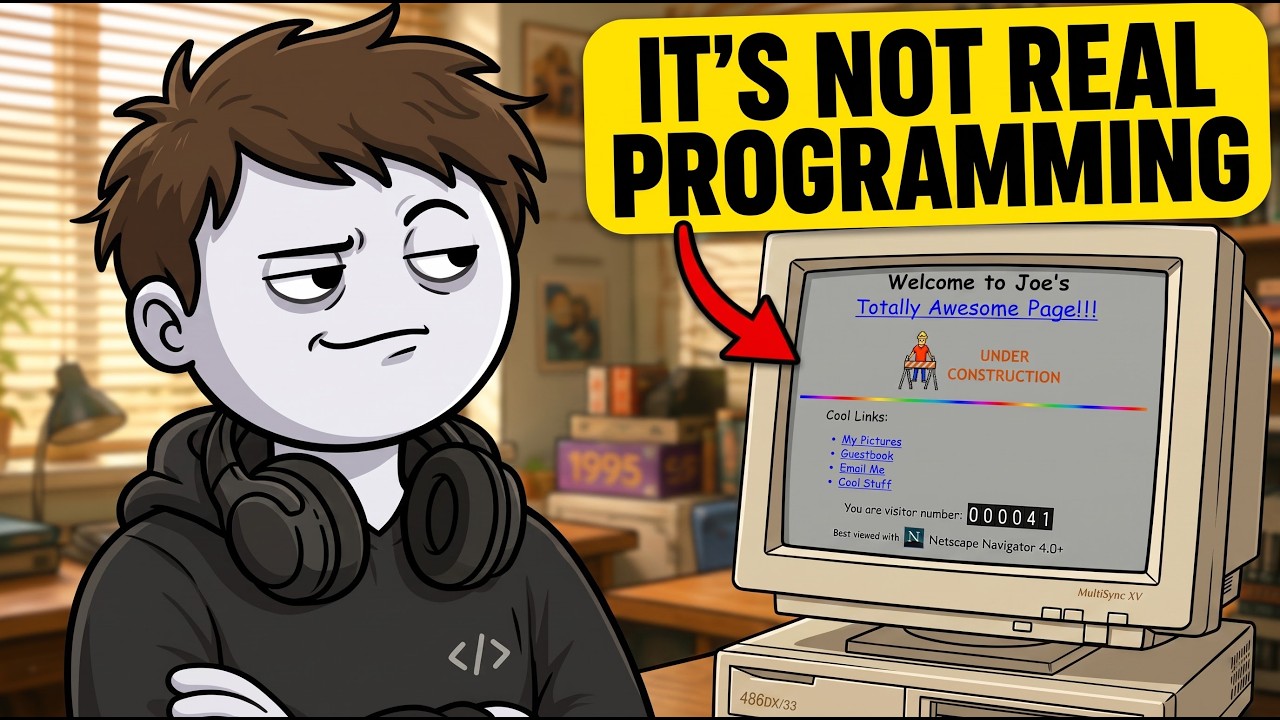
What If You Learned to Code in the 90s? (1990 to 2000)
Title history
- What If You Learned to Code in the 90s? (1990 to 2000) — observed on 20261101-0052 UTC (YouTube)
Keywords
Summary
164 words
Critical Evaluation
Value of the Information & Strength of the Argument
The video’s value lies in its vivid, firsthand account of the 1990s coding landscape, capturing both the technical details (e.g., mode 13h, memory models, BSP) and the emotional and social dynamics. It effectively argues that the pattern of expertise becoming obsolete is not new, using historical examples to frame the current AI debate. The argumentation is thoughtful and nuanced: the author acknowledges that criticisms of VB and Java had validity, yet still sees them as reactions to loss of scarcity. He distinguishes between being wrong about technology and right about money, and ultimately poses a compelling question about the difference between knowledge and a moat. However, the essay is subjective, and the claim that ‘depth was a liability’ is a provocative interpretation rather than a proven fact.
Scientific Rigor, Source Quality, Title Accuracy
The video adheres to good scientific practice by citing well-known public records (Netscape IPO figures, NASDAQ close, Doom release date, AOL CD claim) in the description, and it explicitly includes a disclaimer separating facts from interpretation. The author even invites corrections. The title is apt, and the content matches it, exploring the experience and implications of learning to code in the 90s. While the sources are not academic, they are reliable for the historical events mentioned, and the video is transparent about its narrative nature. The commentary section is not provided, so no public feedback analysis is possible; however, the video’s structure and clarity suggest it would appeal to both nostalgic programmers and younger developers curious about tech history.
261 words
Title / Content Match
The title accurately reflects the content: a step-by-step account of learning to code in the 1990s, culminating in insights about automation and expertise.
Quality & Reliability
8/10
The video presents well-documented historical facts accurately, clearly distinguishing them from personal interpretation. The author issues a disclaimer and cites public records, enhancing credibility, though the central argument is opinion-based.
Chapters
- A piece of paper in your house with a phone
- One — you find out you're not the only one
- Two — you ask a stranger for help in public
- Three — you learn by breaking someone else's work
- Four — everyone becomes a beginner on the same day
- Five — it all gets easier and you are furious about it
- Six — the money arrives and changes the people
- Seven — the morning it stops
- Which of them were actually right
Cited Sources
- Netscape IPO historical data — Description: priced at $28, first trade ~$71, closed $58.25, market cap $2.1B on 16-month-old company with $17M revenue.
- NASDAQ close on 10 March 2000 — Description: closed at 5,048.62, a figure cited as the peak before the dot-com crash.
- AOL CD distribution claim — Description: attributed to AOL's former CMO Jan Brandt, stating roughly half of CDs manufactured worldwide at the time carried AOL branding.
- Doom shareware release — Description: shipped 10 December 1993 with first episode as shareware.
- 3dfx Voodoo Graphics — Description: began shipping in late 1996, which subsequently made software rendering skills obsolete.
Contribution & Novelties
The video’s original contribution is framing the 1990s transition as a case study for current AI anxiety. It personalizes history by describing the emotional journey of a programmer, and it challenges the assumption that technical depth guarantees career resilience, proposing that adaptability and recognizing when to abandon hard-won expertise are the real survival skills. The ‘moat’ concept—separating knowledge that is genuinely valuable from expertise that merely protects one’s position—offers a fresh lens when discussing automation. The narrative also highlights the parallel between the dismissal of Visual Basic/Java and reactions to modern AI tools, effectively arguing that such dismissals are as much about identity and scarcity as about technical merit.
Pour aller plus loin :
- Visual Basic (Wikipedia) — Background on the language whose ease-of-use sparked debates about real programming.
- Dot-com bubble (Wikipedia) — Provides broader context on the 1995-2000 market overvaluation and crash.
- Usenet (Wikipedia) — Explains the distributed discussion system where experts offered help, including the RTFM culture.
- Mode 13h (Wikipedia) — Details the low-level graphics mode that gave programmers direct memory access before Windows 95.
- WAD (Wikipedia) — The file format used by Doom modders, which taught architecture through reverse engineering.
193 words
Radar Profile
The radar profile shows strong scores in information quantity and quality, with moderate technical depth and slightly lower reliability due to the interpretive nature. This aligns with a video that is rich in historical examples and insights but is not an academic or exhaustive study.