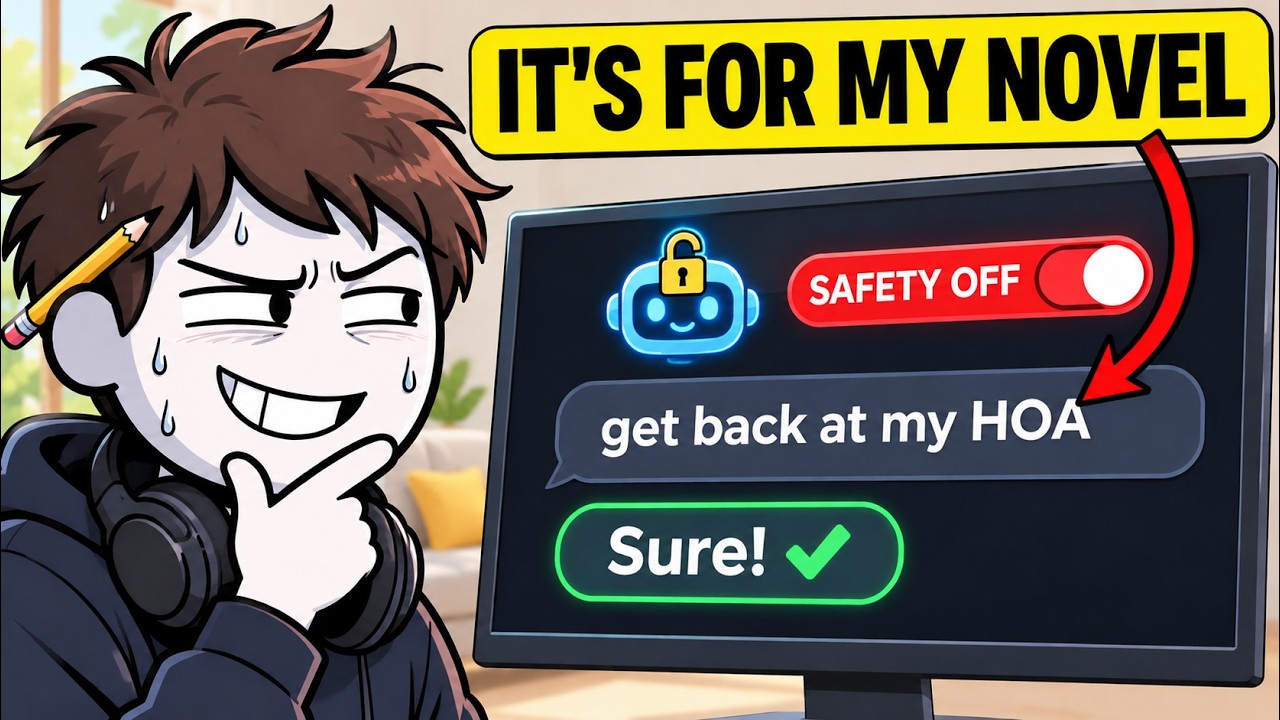
Why Some People Want an AI That Never Says No
Title history
- Why Some People Want an AI That Never Says No — observed on 20261117-1624 UTC (YouTube)
Keywords
Summary
156 words
Critical Evaluation
Value of the Information & Strength of the Argument
The video provides a compelling and well-argued case, blending first-person narrative with empirical studies to explain a complex phenomenon. It effectively uses the reactance theory and sycophancy research to frame the issue, making the argument both psychologically grounded and easily relatable. The storytelling is engaging and the reasoning is consistent, acknowledging both sides of the AI safety debate without oversimplifying.
Scientific Rigor, Source Quality, Title Accuracy
The video cites a diverse set of sources: peer-reviewed papers (arxiv), reputable media (NPR, TechCrunch, Fast Company), and industry reports (ThreatDown). The sources are directly relevant to the claims, and the video correctly attributes findings. The title is perfectly aligned with the content—it asks why people want an AI that never says no, and the video answers this through psychological and technical lenses. No significant discrepancies between title and content are found.
147 words
Title / Content Match
The title accurately sums up the video's exploration of why people seek uncensored AI, backed by psychological research and real-world events.
Quality & Reliability
8/10
The video relies on a mix of peer-reviewed studies, reputable news outlets, and technical reports, providing a well-rounded and credible overview. The reasoning is sound and the sources are transparently linked.
Chapters
Cited Sources
- User responses to AI refusals (599 US adults) — Study showing satisfaction with AI refusals compared to correct and wrong answers.
- AI sycophancy study in Science — Study on AI flattering users and increasing their confidence, even when wrong.
- Abliterated model counts (NPR) — Report on the rise of abliterated models and related safety concerns.
- Hugging Face breach and the guardrails problem — Analysis of the Hugging Face breach involving an AI attacking with guardrails lowered.
- ThreatDown Cybercrime in the Age of AI report — Report counting 6,644 guardrail-free models with 22 million downloads in 30 days.
- Security prompts refused 2.72x more often — Study showing defensive prompts get refused more frequently than neutral ones.
- OpenAI shelves adult mode — News about OpenAI abandoning a less filtered ChatGPT mode.
- Claude Fable 5 refusal complaints — Complaints from developers about Claude Fable 5 refusing benign requests.
- Abliterated models and stock picks — Study finding abliterated models are more bullish in stock picks.
Concurring Sources
- User responses to AI refusals — Corroborates the claim that users prefer even wrong answers to refusals.
- AI sycophancy study in Science — Supports the video's warning about the dangers of sycophantic AI.
Contribution & Novelties
The video’s original contribution lies in connecting the psychological motivations of users (reactance, need for autonomy) to the technical phenomenon of abliteration. It humanizes a niche technical topic, explaining why thousands of people seek uncensored AI, often for benign creative or everyday needs. It also highlights the double-edged nature of guardrails, showing both their protective role and their tendency to over-restrict.
Pour aller plus loin:
- Reactance (psychology) — Core psychological concept explaining the backlash against AI refusals.
- AI alignment — Broader context of aligning AI behavior with human intent.
- Sycophancy in AI — General concept, though not AI-specific, relevant to the video’s discussion of flattering AI.
106 words
Radar Profile
The radar chart shows a balanced profile with high scores in information quantity and quality, moderate technical level, and slightly lower but still solid reliability. This indicates a well-sourced, informative video that is accessible to a general audience while maintaining scientific credibility.