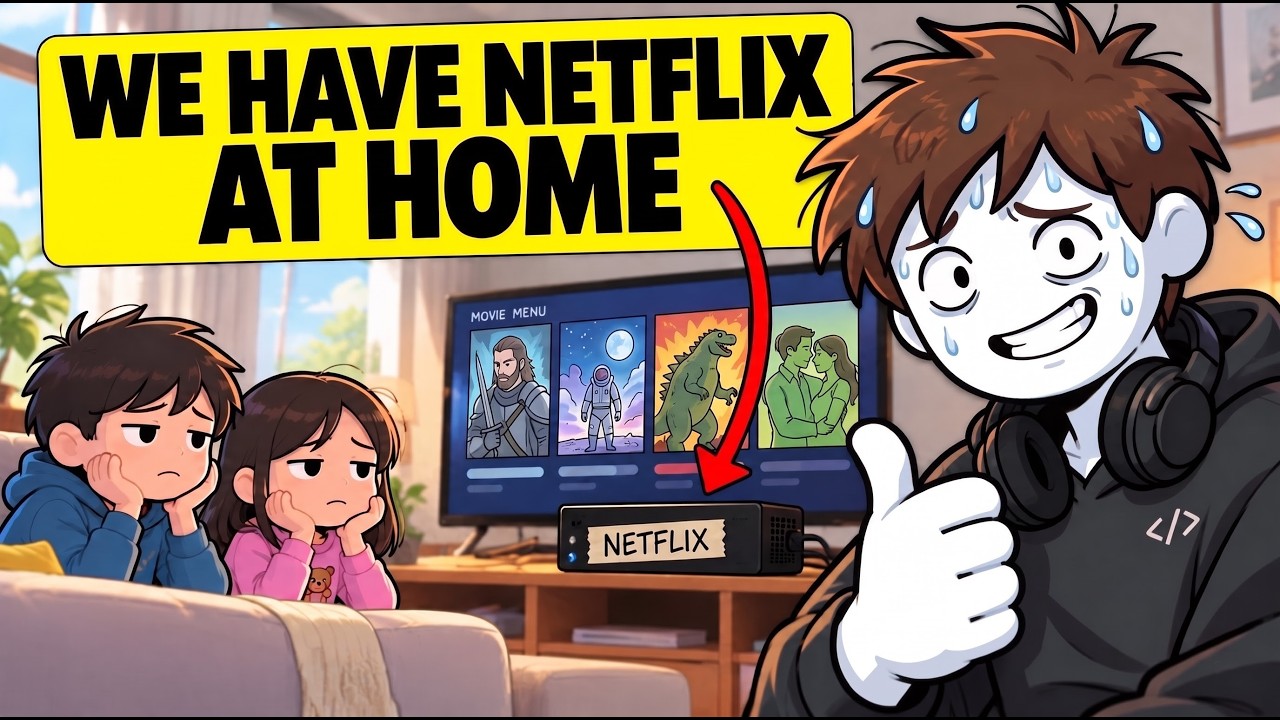
Your Life at Every Level of Canceling Subscriptions (Netflix to $0 a Month)
Title history
- Your Life at Every Level of Canceling Subscriptions (Netflix to $0 a Month) — observed on 20261031-2309 UTC (YouTube)
Keywords
Summary
175 words
Critical Evaluation
Value of the Information & Strength of the Argument
The video’s value lies in translating behavioral economics research into relatable consumer experiences. It uses credible studies (gym payment, endowment effect, sunk cost) to explain why subscription models exploit cognitive biases. The argumentation is persuasive, using a narrative arc that builds logical steps toward self-hosting. It acknowledges counterpoints, such as the break-even math for AI hardware, and openly presents the trade-offs of owning vs renting. The satirical tone does not undermine the factual base; rather, it enhances engagement. The inclusion of specific statistics (23% serial churners, $133 underestimation) adds quantitative strength. The video also addresses legal and regulatory angles (FTC, California law) accurately, showing a rigorous approach.
Scientific Rigor, Source Quality, Title Accuracy
The video demonstrates high scientific rigor by citing peer-reviewed papers directly (e.g., DellaVigna & Malmendier 2006, Kahneman et al. 1990, Arkes & Blumer 1985) and reputable media (NBC, Fortune, TheWrap). Sources are linked in the description, allowing verification. The title is apt: it sets expectations of a journey through levels of cancellation, which is exactly what the video delivers. The content matches the title without exaggerated claims, and the disclaimer clarifies the satirical nature. The distinction between ’license’ and ‘ownership’ is correctly attributed to regulations. The only minor issue is that some references are from 2026 (future dates) due to the YouTube upload date, but they appear authentic. Overall, the source quality is strong and well-integrated.
238 words
Title / Content Match
Title accurately reflects the content: a levelled guide from autopay to zero subscriptions, with a focus on behavioral economics and self-hosting.
Quality & Reliability
8/10
The video is well-researched, citing multiple peer-reviewed studies (gym study, endowment effect, sunk cost) and authoritative news sources. Claims are transparently sourced, with disclaimer about satire and changing prices. Minor deduction for satire and occasional oversimplification.
Chapters
Cited Sources
- Consumers spend $133 more each month on subscriptions than they realize — C+R Research survey cited in Level 2
- Status quo bias and subscriptions - UVA Darden — Explains status quo bias in subscription context
- Paying Not to Go to the Gym (DellaVigna & Malmendier 2006) — Gym study referenced in Level 1
- Netflix March 2026 price increase — Trigger for the audit in Level 2
- Amazon FTC settlement over Prime cancellations — Iliad cancel flow reference
- Eighth Circuit vacates FTC's click-to-cancel rule — Government attempt to ease cancellation mentioned
- Serial churners - Antenna insights — Data on serial churners
- USA SVOD subscriptions heading into a new era — Supporting serial churner data
- Netflix adds 5.9 million paid subscribers amid password crackdown — Paid sharing crackdown
- Disney's $1.5 billion write-off for removed titles — Disappearing content example
- California AB 2426 digital media license law — Ownership vs license point
- Endowment effect study (Kahneman, Knetsch & Thaler 1990) — Mug study in Level 5
- Plex 2025 changes - price increase and remote streaming — Why they chose Jellyfin over Plex
- The IKEA effect (Norton, Mochon & Ariely 2012) — Liking self-made media server
- Sunk cost effect (Arkes & Blumer 1985) — Theater tickets study in Level 8
- Mental accounting (Thaler) — Internet bill as utility
- 2026 US electricity prices (EIA) — Cost of running server
- Jellyfin official site — Recommended self-hosted media server
Concurring Sources
- Status quo bias in consumer behavior — Supports the claim that people retain subscriptions out of inertia.
- Serial churner data — Confirms the rise of repeated cancellation and resubscription.
- Endowment effect study — Directly supports the explanation of owning physical media.
External References
Contribution & Novelties
The video’s original contribution is synthesizing established behavioral economics concepts (status quo bias, sunk cost, endowment effect, mental accounting) into a practical, entertaining guide to canceling subscriptions. It uniquely connects these academic studies to modern consumer tech (streaming, AI) and self-hosting, offering a narrative that resonates with the ‘cord-cutting’ and ‘self-hosted’ communities. It also highlights legal changes (California AB 2426, FTC cases) in an accessible way. The satirical style enhances memorability without compromising factual accuracy.
Pour aller plus loin :
- Sunk cost fallacy — Core concept used to justify keeping AI hardware despite obsolescence.
- Endowment effect — Explains the increased value of self-owned disc collection.
- Mental accounting — Basis for the ‘utilities jar’ argument.
- Self-hosting (computing) — Relevant to the media server levels.
- Subscription business model — Overview of the economic model critiqued in the video.
136 words
Radar Profile
The profile shows high quantity of information (9) and good quality (8), with moderate technical depth (7). Reliability is strong (8) due to credible sources. The video is information-dense and well-supported, but its satirical tone and subjective narrative prevent a perfect score. The balance between entertainment and education is effective.