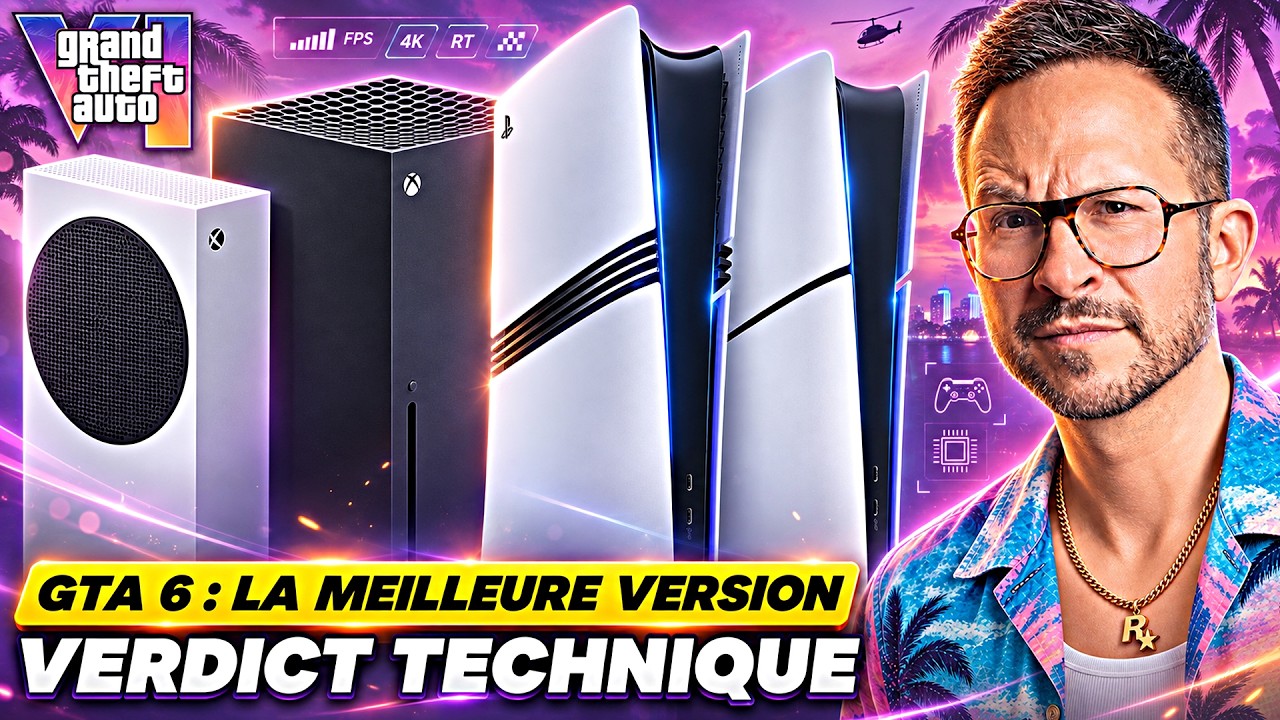
GTA 6 : PS5 vs XBOX 🔥Quelle est la MEILLEURE VERSION ? VERDICT 🚨 PS5 I PS5 PRO I XBOX SERIES X I S
GTA 6: PS5 vs. XBOX 🔥 Which is the BEST VERSION? VERDICT 🚨 PS5 | PS5 PRO | XBOX SERIES X | S
Keywords
Summary
342 words
Critical Evaluation
Value of the Information & Strength of the Argument
The informational value lies in consolidation: rather than a loose reaction, the video walks through each platform in turn, quotes Digital Foundry’s conclusions almost verbatim, and condenses them into a comparative table and a final ranking that a viewer can hold in mind in a few minutes. The detail level is decent for a news format — internal resolution (720p upscaled to 1080p on Series S, 1440p reconstructed toward 4K via PSSR on PS5 Pro), upscaler choice (FSR on Series S, PSSR replacing TAA on PS5 Pro), ray-traced reflections and shadows, strand hair, draw distance, shadow resolution, VRR at 120 Hz, and the CPU bottleneck that keeps every console at 30 fps. Two additions give it more than aggregator value: the remark that the Series S shares a CPU close to the Series X’s, which explains why it degrades gracefully in simulation terms while collapsing on the GPU side, and the explicit separation between Sony’s ‘plays best on PS5’ slogan and measurable resolution/frame-rate performance, with the DualSense immersion argument treated as a genuine but non-technical differentiator. The argumentation is linear and easy to follow, and the presenter regularly distinguishes what DF states from his own commentary. Its limits are structural: the video rests on a single upstream analysis, offers no counter-measurement or methodological check, and the comparative table reproduces DF’s conclusions rather than testing them. The reasoning is also occasionally loose, drifting into personal asides and a somewhat rhetorical build-up to a verdict that is simply DF’s own. Finally, the forward-looking part (potential VRR support on PlayStation, hypothetical 40 or 60 fps modes) is explicitly speculative and presented as such.
Scientific Rigor, Source Quality, Title Accuracy
Source discipline is one of the video’s stronger points: Digital Foundry is named repeatedly, its conclusions are quoted with attribution, and the article is linked in the description, so the chain of provenance is traceable. The presenter is also careful about the marketing framing — he notes that Sony never explicitly promised better resolution or frame rate and that the ‘plays best on PS5’ claim rested on immersion features — which is a fair reading rather than a straw man. The weakness is that no source beyond Digital Foundry is mobilised, no methodological information is given about how frame-rate and resolution figures were captured, and the technical vocabulary is occasionally approximate or garbled in speech (upscaler names, ray-tracing denominations). Numbers are quoted as orders of magnitude (‘around 15 fps’, ‘25 to 30 fps’) rather than exact measurements, which is acceptable for the format but limits precision. Title-content adequacy is good: the announced verdict on the best console version is genuinely delivered and justified, even though the verdict originates with Digital Foundry rather than with the channel.
461 words
Title / Content Match
The title promises a verdict on the best console version, and the video does deliver a clear four-way ranking (PS5 Pro > Xbox Series X > PS5 > Series S); it is however a relayed verdict rather than an original one.
Quality & Reliability
6/10
The video is an honest, well-labelled second-hand compilation of Digital Foundry's technical comparison, with direct quotations and the primary source linked in the description. Its reliability therefore rests almost entirely on that single external analysis: no independent measurements, no raw capture data and no verification are produced by the channel itself. The framing is careful (the marketing slogan 'plays best on PS5' is correctly qualified, the DualSense/immersion argument is separated from raw performance), and no implausible claim is made. The main weaknesses are the reduced sample of sources, the absence of any methodological detail on how DF's measurements were obtained, and a presentation style that mixes technical reporting with opinion.
Key Moments
Markers derived by PSI from the transcript: the creator did not define chapters.
- Introduction of Digital Foundry's four-way console comparison and its 'surprising ranking' framing.
- Xbox Series S breakdown: FSR upscaling from 720p to 1080p, cutbacks on clouds, shadows, hair and draw distance.
- Series S performance drops below 30 fps and down to about 15 fps in intense scenes, plus occasional audio cut-outs.
- Transition to the standard consoles and the role of the CPU in the Series S's relatively graceful degradation.
- PS5 vs Xbox Series X: both target 30 fps with dips to 25–30 fps; PS5 drops more often, Series X benefits from 120 Hz VRR.
- PS5 Pro analysis: PSSR replacing TAA, 1440p base reconstructed toward 4K, improved ray-traced shadows and reflections.
- PS5 Pro remains capped at 30 fps due to CPU limits but is the most stable of the four consoles.
- Summary table and final ranking: PS5 Pro, Xbox Series X, PS5, Xbox Series S.
- Discussion of Sony's 'plays best on PS5' slogan, the DualSense immersion argument and future patch prospects.
- Closing judgement: all versions playable, no Cyberpunk-style launch, impressive achievement on 2020 hardware.
Cited Sources
- Digital Foundry — The Big GTA 6 Console Comparison: PS5 vs PS5 Pro, Xbox Series X and Series S — Primary and essentially only technical source of the video; quoted at length for each platform and explicitly linked in the description.
Concurring Sources
- Wikipedia — Grand Theft Auto VI — Background reference on the game's platforms and release, consistent with the video's framing of a current-gen-only title.
- Wikipedia — Variable refresh rate — Technical background for the video's claim that 120 Hz VRR on Xbox Series X mitigates minor frame-rate dips.
Dissenting Sources
- Sony / PlayStation marketing claim 'GTA 6 plays best on PS5' — The marketing claim implies the PS5 offers the best experience, whereas Digital Foundry's measurements as reported here place the Xbox Series X above the standard PS5 on frame-rate stability and put the PS5 Pro ahead only at a much higher price point; the presenter reconciles the slogan by reading it as an immersion argument (DualSense) rather than a performance claim, which remains an interpretation rather than an established fact.
External References
Contribution & Novelties
The original contribution is modest but real: the video converts a long, dense Digital Foundry feature into a navigable four-platform synthesis with a comparison table and an explicit ranking, and it adds one genuinely useful analytical nuance — the Series S shares a CPU close to the Series X’s, which explains why its simulation holds up while its GPU-bound image quality and frame rate collapse. It also separates the marketing question from the technical one, arguing that Sony’s ‘plays best on PS5’ slogan rested on DualSense immersion features (haptics, adaptive triggers, controller speaker) rather than on resolution or frame rate, and that the game’s mere ability to run on 2020 hardware is itself the headline finding. Nothing here is new to someone who has read the source article; the value is in the condensation and the framing.
Pour aller plus loin :
- Digital Foundry — The Big GTA 6 Console Comparison — The primary analysis behind every figure quoted in the video; the indispensable reference for anyone wanting the raw measurements.
- Wikipedia — Variable refresh rate — Explains the VRR/120 Hz mechanism that gives the Xbox Series X its stability advantage in this comparison.
- Wikipedia — PlayStation 5 Pro — Hardware context for the mid-generation refresh and its machine-learning upscaling capabilities discussed here.
- Wikipedia — Temporal anti-aliasing — Background on TAA, the technique PSSR replaces on PS5 Pro in this comparison.
- AMD FSR (FidelityFX Super Resolution) — the upscaler used on Xbox Series S here; worth consulting AMD’s own documentation rather than a secondary page.
255 words
Radar Profile
The profile is that of a well-informed news round-up rather than an original technical investigation: information quantity and technical level are solid, driven by detailed resolution, frame-rate and upscaling data, while overall reliability is capped by the reliance on a single upstream analysis. Quality sits slightly below quantity, reflecting accurate but second-hand figures and speech-level approximations of the numbers.