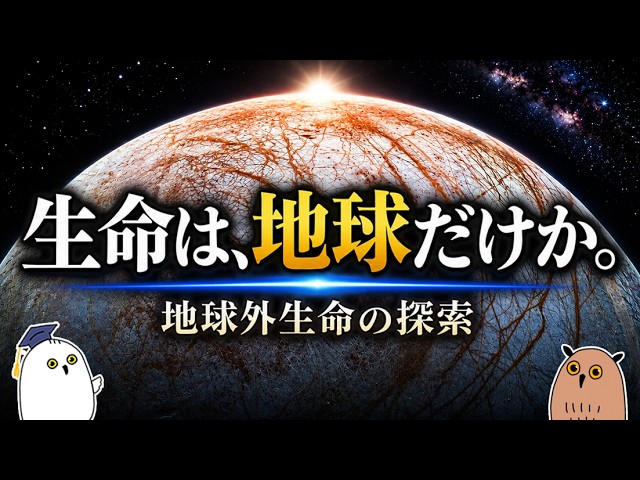
【ゆっくり解説】宇宙に生命は存在するのか? | 地球外生命の研究の歴史【科学】
【Slow Explanation】Does Life Exist in Space? | The History of Research on Extraterrestrial Life【Science】
Title history
- 【ゆっくり解説】宇宙に生命は存在するのか? | 地球外生命の研究の歴史【科学】 — observed on 20261113-1110 UTC (YouTube)
Keywords
Summary
250 words
Critical Evaluation
Value of the Information & Strength of the Argument
The video provides valuable information for a general audience, synthesizing key concepts in astrobiology without oversimplifying the scientific uncertainties. The argumentation is solid: it repeatedly stresses that the absence of direct evidence does not preclude scientific investigation, and it carefully differentiates between observed facts (e.g., magnetic induction on Europa, hydrogen in Enceladus’s plumes) and interpretations. The N=1 problem is well-explained as a fundamental limitation in biology. The discussion of the arsenic life case is particularly strong, as it notes the initial excitement, the failure to replicate, and the eventual retraction, illustrating how science self-corrects. The presentation of extremophiles appropriately extends the habitability range but also warns that current extremophiles are not necessarily proxies for life originating elsewhere. The explanation of water’s role as a solvent and the need for energy gradients (like in mitochondria) is accessible and accurate. However, the video occasionally jumps between topics without deep technical depth, and some claims (e.g., the exact number of amino acids from OSIRIS-REx) are presented without citing sources, though they align with published findings.
Scientific Rigor, Source Quality, Title Accuracy
The scientific rigor is generally high for a popular science channel. The video correctly states that no extraterrestrial life has been found and avoids overclaiming. It references specific missions (Kepler, Galileo, Cassini) and discoveries (Europa’s induced magnetic field, Enceladus’s hydrogen) but does not provide direct citations to primary literature. The description includes only links to related videos and background music, not to scientific papers, which limits the traceability of claims. The discussion of historical figures (Lucian, Epicurus, Lowell) is accurate, and the mention of Pluto’s discovery is correct. The title and content are well-aligned; the title promises a discussion of the existence of life and the history of research, which is delivered. The video could improve its reliability by adding references to peer-reviewed sources or official mission pages. Overall, the rigor is adequate for the target audience, but it is not a primary scientific source.
332 words
Title / Content Match
The title accurately reflects the content: the video explores whether life exists in the universe and traces the history of extraterrestrial life research.
Quality & Reliability
7/10
The video presents a scientifically grounded overview of astrobiology, discussing the N=1 problem, habitable zones, biosignatures, and specific missions (Kepler, Galileo, Cassini). It correctly notes that no extraterrestrial life has been found and distinguishes facts from interpretations. However, it lacks detailed citations or direct references to primary literature, relying on general scientific consensus and a few well-known examples. The discussion of the arsenic life controversy correctly mentions the retraction, showing reliability awareness.
Chapters
Cited Sources
- Life's Origin (related video) — Referenced as a related video on the origin of life, deepening the topic.
- Evolution by Mitochondria (related video) — Referenced as a related video explaining the mitochondrial origin, used to illustrate ATP production.
- Extremophiles (related video) — Referenced as a related video on extremophiles, supporting the section on extreme environments.
External References
Contribution & Novelties
The video’s original contribution lies in its clear synthesis of the N=1 problem as a driving motivation for astrobiology and its methodical separation of ’evidence’ from ‘interpretation’. It presents a novice-friendly explanation of why water and carbon are prioritized in the search for life, while honestly noting that this is an Earth-centric assumption. The inclusion of the retracted arsenic life case demonstrates scientific self-correction, a nuance often omitted in popular discussions. The historical overview from ancient Greek ideas to modern missions adds educational value. However, it does not present new research findings or novel scientific arguments.
Pour aller plus loin :
- Astrobiology (Wikipedia) — Provides a broad overview of the field, including concepts like habitability and biosignatures.
- Drake equation — A probabilistic argument about the number of civilizations, complementing the discussion of why we search.
- Extremophile (Wikipedia) — Details on organisms thriving in harsh conditions, directly relevant to the section on extremophiles.
- Enceladus (NASA) — Official information on Enceladus’s plumes and ocean, supporting the video’s claims.
- Europa (NASA) — Overview of Europa’s subsurface ocean and missions like Europa Clipper, extending the discussion.
182 words
Radar Profile
The radar profile shows balanced scores, with quantitative and qualitative information slightly higher than technical depth and overall reliability. This indicates a video that provides a good introductory survey but does not delve deeply into technical methodology or cite primary literature, making it suitable for a general audience seeking context rather than advanced study.