L13 No Cloning Theorem, Quantum Circuit, and IBM Quantum
Keywords
Summary
188 words
Critical Evaluation
Value of the Information & Strength of the Argument
The lecture provides high educational value by offering clear, step-by-step derivations of key quantum computing results. The no-cloning theorem is proven rigorously via contradiction, demonstrating the logical structure of quantum information constraints. The argumentation is solid, as each step is explicitly justified, from the linearity of unitary operators to the handling of tensor products. The instructor also connects the theorem to practical implications, such as skepticism toward algorithms that require state copying. This makes the content both theoretically sound and applied to real-world scenario.
Scientific Rigor, Source Quality, Title Accuracy
The lecture is a pedagogical tutorial relying on fundamental physics and quantum information theory. No external scholarly sources are explicitly referenced, but the mathematical proofs are self-contained and consistent with known results. The title is a faithful description of the content: the no-cloning theorem is the central focus, quantum circuit notation is introduced, and IBM Quantum is mentioned as a tool for assignments. The adequacy between title and content is high. As no user comments were provided, an analysis of audience tendencies is omitted.
183 words
Title / Content Match
The title accurately reflects the content: the lecture covers the no-cloning theorem, quantum circuits, and references IBM Quantum for assignments.
Quality & Reliability
8/10
The lecture is delivered by an academic expert and provides rigorous mathematical proofs of quantum computing concepts. The content aligns with established quantum information theory and is presented with pedagogical clarity.
Key Moments
Markers derived by PSI from the transcript: the creator did not define chapters.
- Announcements about assignment deadlines and midterm preparation, including advice on using AI for practice.
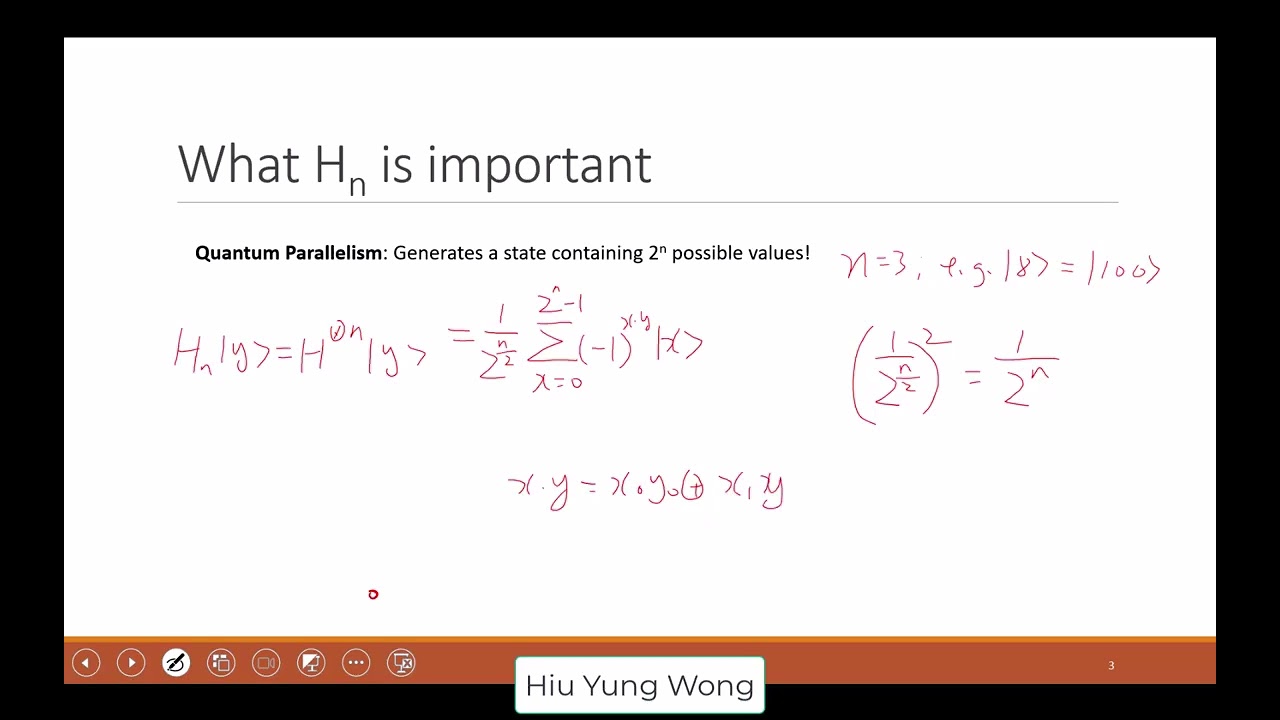
- Review of the Hadamard gate on multiple qubits (H^n) and derivation of the normalization factor 1/2^(n/2).
- Introduction to the no-cloning theorem, explaining its impossibility and connection to superluminal communication.
- Proof of the no-cloning theorem by contradiction, using linearity of unitary operators and the tensor product structure.
- Transition to quantum circuits, introducing Bell states, gate ordering, and the significance of MSB/LSB convention.
Cited Sources
- Quantum Computing, TCAD, Semicond - Course Playlist — Official playlist for the course containing lecture videos and supplementary materials.
Contribution & Novelties
The lecture’s original contribution lies in its pedagogical approach: it deconstructs the no-cloning theorem with a clear, step-by-step proof while emphasizing computational methods that students can apply to other algorithms. It reinforces the connection between quantum mechanics and information theory. The instructor also highlights the practical utility of the theorem for evaluating quantum algorithms and companies.
Pour aller plus loin :
- No-cloning theorem — Provides a formal statement and historical background, including the original proofs by Wootters, Zurek, and Dieks.
- Quantum circuit — Explains the standard notation and components of quantum circuits, including gates and measurement.
- Hadamard gate — Details the matrix representation and properties of the Hadamard gate used throughout the lecture.
- IBM Quantum — The platform mentioned for assignments; offers access to real quantum hardware and simulators for hands-on learning.
132 words
Radar Profile
The radar profile shows high technical level and reliability, with strong scores in information quantity and quality. This indicates a dense, rigorous lecture that demands prior knowledge, while the slightly lower score in global quality reflects its niche nature as a course presentation rather than a standalone resource.