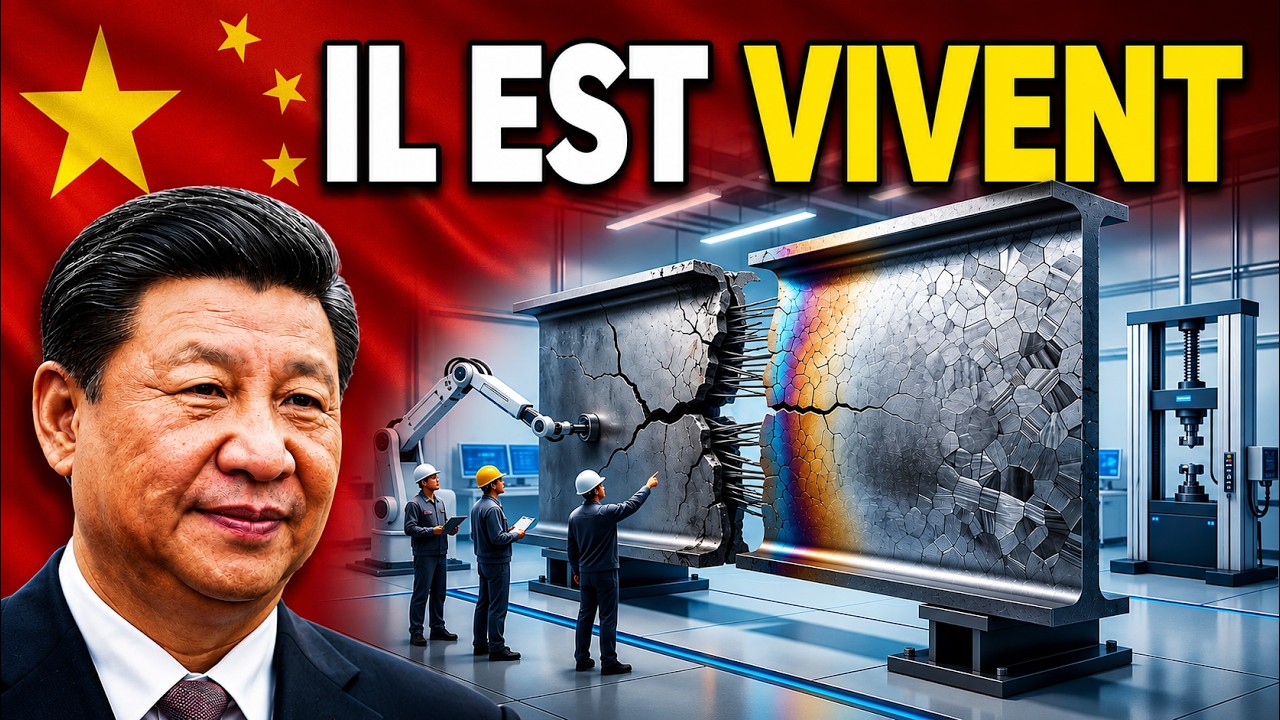
Ce Nouveau Métal Chinois se Répare Tout Seul… Et il Pourrait Tout Changer
This New Chinese Metal Repairs Itself... And It Could Change Everything
Title history
- Ce Nouveau Métal Chinois se Répare Tout Seul… Et il Pourrait Tout Changer — observed on 20261101-0111 UTC (YouTube)
Keywords
Summary
197 words
Critical Evaluation
Value of the Information & Strength of the Argument
The video provides significant technical detail on the proposed mechanism and engineering challenges, making it informative for viewers interested in materials science. It builds a coherent argument: starting from the historical problem of metal fatigue, moving to the theoretical barrier (Griffith criterion), then the discovery and development of the NiTi alloy, the manufacturing and certification hurdles, and finally the economic/strategic context. The argumentation is structured and logical, but it relies on unverifiable claims about specific results and certifications. The presenter acknowledges limitations (cost, temperature) but tends to accept the validity of Chinese results without independent replication. Comparisons to historical cases like Shechtman’s quasicrystals add rhetorical strength but may overstate the parallel.
Scientific Rigor, Source Quality, Title Accuracy
The video mentions peer-reviewed publication and independent verification by a German institute, but provides no specific paper titles, DOIs, or links. The description contains no references. The title is largely aligned with the content, though the phrase ‘could change everything’ is sensationalist. The scientific rigor is moderate: the video explains the physics but does not critically assess the methodology of the original studies. No comments were provided, so public reception is unknown.
198 words
Title / Content Match
The title accurately reflects the content, which discusses a self-healing metal alloy developed in China, though the title's dramatic tone slightly overstates certainty.
Quality & Reliability
6/10
The video presents plausible scientific claims with specific numbers (94% recovery, 4.3x fatigue life) and mentions peer review, but lacks concrete citations, paper titles, or verifiable details. The tone is engaging but sometimes sensationalist. No actual sources are provided in the description.
Key Moments
Markers derived by PSI from the transcript: the creator did not define chapters.
- Introduction of the 94% tensile strength recovery claim
- Aloha Airlines flight 243 accident as illustration of metal fatigue
- Explanation of Griffith's criterion and why self-repair seemed impossible
- First Beihang result in 2013 and international skepticism
- Martensitic transformation mechanism and dual-layer design
- Manufacturing tolerances and AI-based microstructure verification
- Independent certification data showing 4.3x fatigue life extension
- Costs and adoption challenges, call to action
Contribution & Novelties
The video synthesizes information about a potentially transformative materials science development, presenting it in a comprehensible way for a general audience. Its main novelty is framing the Chinese program as an institutional breakthrough rather than a simple scientific one, highlighting the role of manufacturing precision and verification infrastructure. However, it does not provide primary data or verifiable references, limiting its contribution to the field.
Pour aller plus loin :
- Self-healing material — Wikipedia overview of self-healing materials, useful for background.
- Shape-memory alloy — Wikipedia page on shape-memory alloys, including NiTi, which is central to the video.
- Fatigue (material) — Wikipedia page on material fatigue, providing the scientific basis of the problem.
- Griffith’s criterion — Wikipedia page on fracture mechanics, includes Griffith’s energy criterion.
- Martensitic transformation — Wikipedia article explaining martensitic transformations, a key mechanism discussed.
135 words
Radar Profile
The profile shows strong scores in quantity and technical level but lower in quality and reliability, indicating a technically detailed yet unsupported presentation. The balance suggests a promising topic with insufficient sourcing.