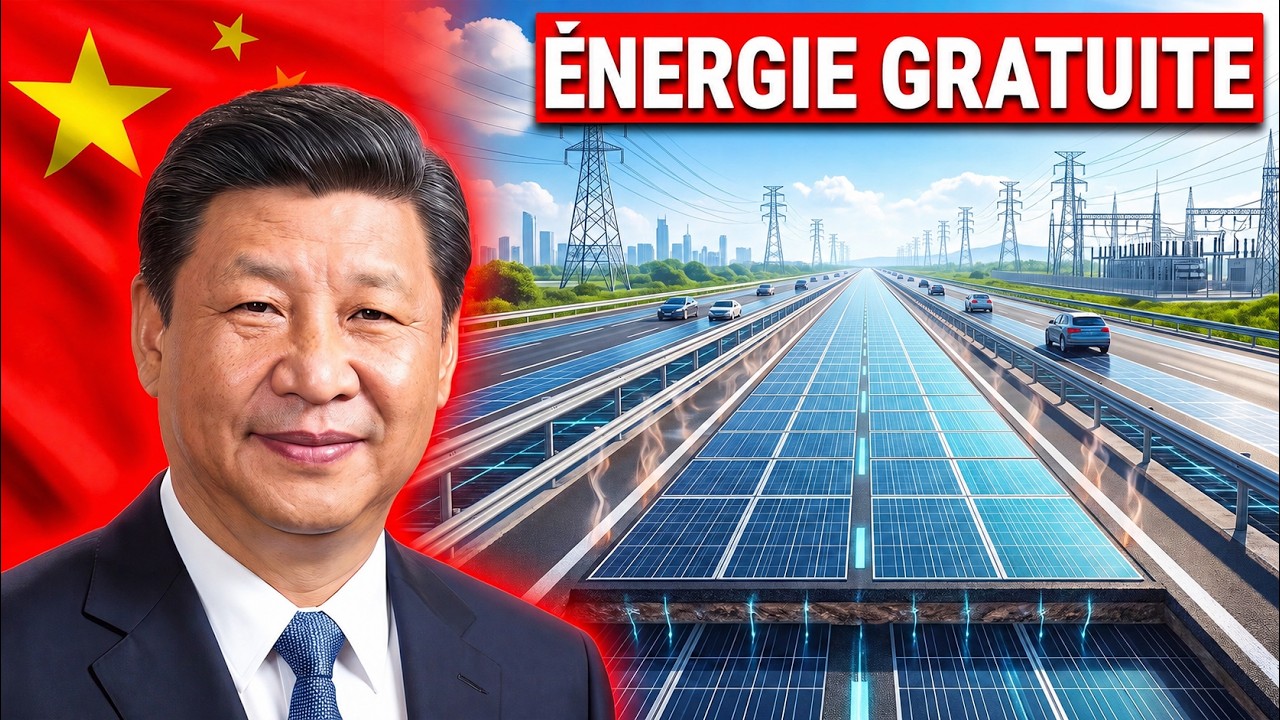
La Chine Construit Une Route Qui Produit De L'Électricité Avec La Chaleur
China Is Building a Road That Generates Electricity From Heat
Title history
- La Chine Construit Une Route Qui Produit De L'Électricité Avec La Chaleur — observed on 20261101-0100 UTC (YouTube)
Keywords
Summary
146 words
Critical Evaluation
Value of the Information & Strength of the Argument
The video offers high value by breaking down complex engineering concepts into understandable segments, using concrete numbers and analogies. It presents a balanced argument: while acknowledging the technology’s current limitations (low efficiency compared to renewables), it stresses the unique advantage of generating electricity exactly where needed, eliminating separate power lines and battery maintenance. The argumentation is logically structured, moving from the problem (heat damage) to the solution (thermoelectric harvesting) and then to practical applications and realistic challenges. The reasoning is sound, and the presenter avoids overhype by clearly stating what has and hasn’t been proven.
Scientific Rigor, Source Quality, Title Accuracy
The scientific rigor is notable: the video cites a peer-reviewed publication (Renewable Energy, 2022), names specific universities and researchers, and mentions independent replication. It explains methodology (finite element simulation, outdoor testing) and durability metrics (10,000 cycles, 246,000 cycles). The title accurately captures the essence without sensationalism, and the content aligns closely with it. The video appropriately dismisses the idea of replacing solar farms, instead positioning the technology as a niche for infrastructure self-sufficiency. No comment analysis is provided, as none were submitted.
192 words
Title / Content Match
The title accurately reflects the video's core claim—a road that generates electricity from heat—without overstating the technology's current scale or maturity.
Quality & Reliability
8/10
The video presents a well-documented account of thermoelectric road technology, citing specific published results (6.207 V, 700.49 mW) from a 2022 Renewable Energy paper, and explains the underlying physics (Seebeck effect) and engineering challenges. It acknowledges limitations and notes independent replication, supporting overall credibility.
Key Moments
Markers derived by PSI from the transcript: the creator did not define chapters.
- Introduction of the breakthrough result: 6.207 V and 700.49 mW from 900 cm² of asphalt.
- Explanation of how road heat causes damage and why it was always seen as a problem.
- Wei Jiang's early 2017 prototype and the modest voltage output.
- Physics of the Seebeck effect and its use in space probes.
- Design of hot and cold side modules, emphasizing the cold side as the bottleneck.
- The record result and durability tests of 10,000 cycles.
- Scaling challenges, positioning modules on the side rather than under wheels.
- Applications: sensors, black ice detection, local de-icing.
- Comparison with early solar panels and efficiency arguments.
- Call to action and question to viewers about policy and adoption.
Cited Sources
- Renewable Energy (2022) article on thermoelectric road generator — The video explicitly cites this journal and year for the record result.
- Wei Jiang's 2017 paper on early prototype — Mentioned as the first published work by the Chang'an team.
Contribution & Novelties
The video provides a comprehensive and accessible overview of an emerging technology, highlighting a specific published achievement and explaining its technical foundations. It gives viewers a clear understanding of how waste heat can be converted into usable electricity, without overclaiming. The comparison to early solar panels offers a forward-looking perspective on potential adoption.
Pour aller plus loin:
- Seebeck effect — Foundation of thermoelectric generation.
- Energy harvesting — Overview of harvesting ambient energy for small devices.
- Asphalt — Material properties and its role in infrastructure.
84 words
Radar Profile
The profile shows strong performance in information quantity and quality, reflecting a well-structured and informative video. Technical level is moderate-high, suitable for interested laypeople while still managing depth. Reliability is high due to citation of peer-reviewed work and balanced discussion.