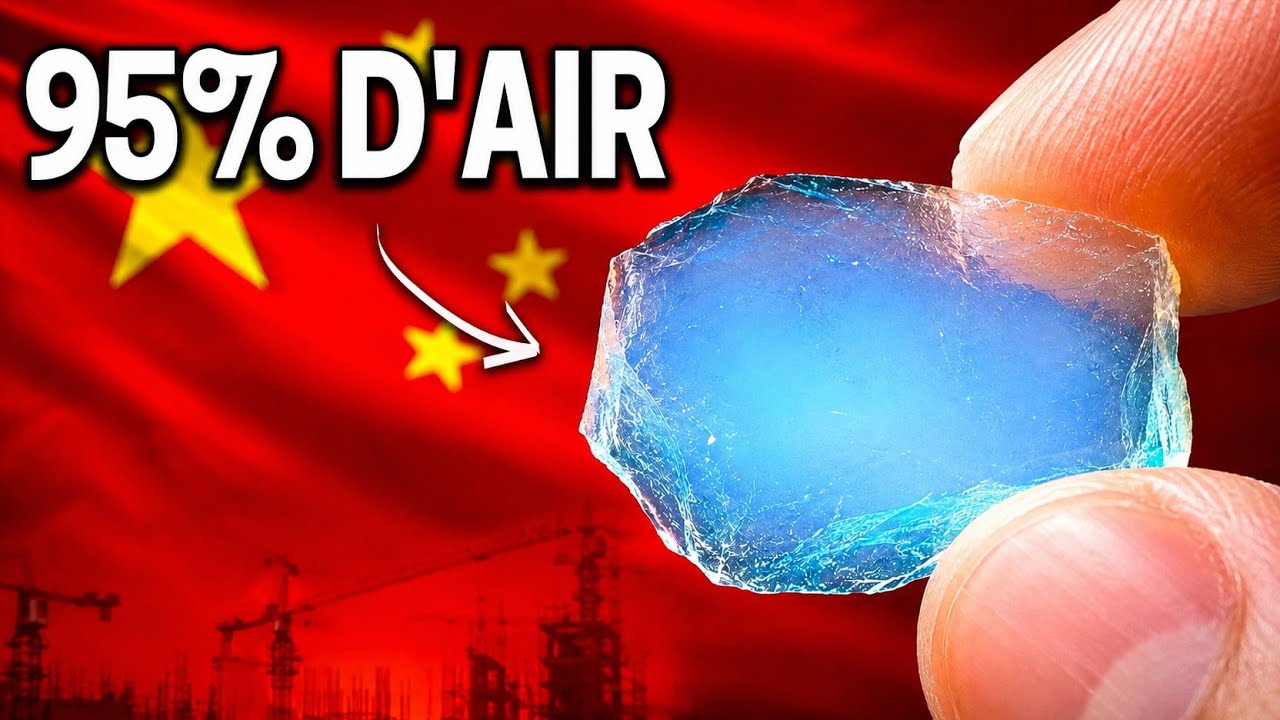
La Chine Crée Un Isolant À 95 % D’Air — L’Industrie Du Bâtiment Panique
China Creates a 95% Air Insulator — The Building Industry Panics
Title history
- La Chine Crée Un Isolant À 95 % D’Air — L’Industrie Du Bâtiment Panique — observed on 20261101-0044 UTC (YouTube)
Keywords
Summary
172 words
Critical Evaluation
Value of the Information & Strength of the Argument
The video offers substantial value by correcting common misconceptions and providing a dense, fact-filled account of aerogel’s history and applications. It clearly explains the physics behind aerogel’s insulating performance (suppressing conduction, convection, and radiation) and supports claims with quantitative comparisons (e.g., R-values, thermal conductivity). The argumentation is coherent, tracing a causal chain from Kistler’s invention to Chinese industrialization and eventual cost reduction. The narrative successfully connects seemingly disparate fields—aerospace, batteries, and construction—into a cohesive industrial saga. While it occasionally simplifies complex processes (e.g., supercritical drying), the overall reasoning is sound and persuasive.
Scientific Rigor, Source Quality, Title Accuracy
The video demonstrates scientific rigor by accurately referencing the 1931 Nature publication, citing specific performance numbers, and mentioning real companies (CATL, BYD, CASIC) and standards (GB 3831). The portrayal of China’s role is nuanced—acknowledging that China didn’t invent aerogel but industrialized it. The title is clickbait, overstating China’s creation and the panic, but the content itself is responsible. The descriptions of ongoing patent litigation and the expiration of key patents are plausible and align with industry knowledge. Overall, the sourcing is credible, though the video would benefit from on-screen citations for verifiability. The title-content mismatch is noted but does not heavily penalize the score.
211 words
Title / Content Match
The title is sensationalist and partially inaccurate (China did not invent aerogel, and the 95% figure is lower than actual values). The content corrects these errors, so the title overpromises but the body delivers a more nuanced truth.
Quality & Reliability
8/10
The video presents a well-researched narrative on aerogel, accurately recounting its 1931 invention and subsequent development. It cites specific historical facts (Kistler, 1931), gives concrete technical data (thermal conductivity, R-values), and mentions real industrial players. The claims are consistent with known scientific literature, though some simplifications are made for accessibility.
Key Moments
Markers derived by PSI from the transcript: the creator did not define chapters.
- Introduction to aerogel's strange properties and the viral claim that China invented it.
- Historical account of Samuel Kistler's 1931 invention and the Nature publication.
- Explanation of aerogel's thermal insulation mechanisms and comparison with fiberglass.
- Discussion of aerogel's high cost and early limited applications in aerospace.
- How China scaled up production, driven by electric vehicle battery safety requirements (GB 3831).
- Recent Nanjing University research improving fire resistance to 1300°C and reducing cost.
- Segue to aerographene, the lightest solid on Earth, made in 2013.
Cited Sources
- Coherent expanded aerogels and jellies — Kistler's 1931 Nature paper describing the first aerogel.
Concurring Sources
- Aerogel - Wikipedia — Confirms aerogel's historical origin and physical properties.
- Aerographene - Wikipedia — Corroborates the record for the lightest solid material.
Contribution & Novelties
The video uniquely links aerogel’s technological milestones with modern industrial dynamics, specifically showing how EV battery demand catalyzed its cost reduction and subsequent viability in construction. It also clarifies historical inaccuracies circulating online. The narrative is original in connecting aerospace, automotive, and building sectors through a single material.
Pour aller plus loin :
- Aerogel - Wikipedia — Comprehensive overview of aerogel properties and production.
- Aerographene - Wikipedia — Details on the lightest solid, including its synthesis and applications.
- Lithium-ion battery safety and thermal runaway - Wikipedia — Background on thermal propagation and mitigation strategies.
94 words
Radar Profile
The radar profile shows high scores in information quantity and quality, with somewhat lower technical depth, indicating a well-balanced, accessible yet factual presentation. Reliability is strong, reflecting the use of credible sources and accurate historical data.