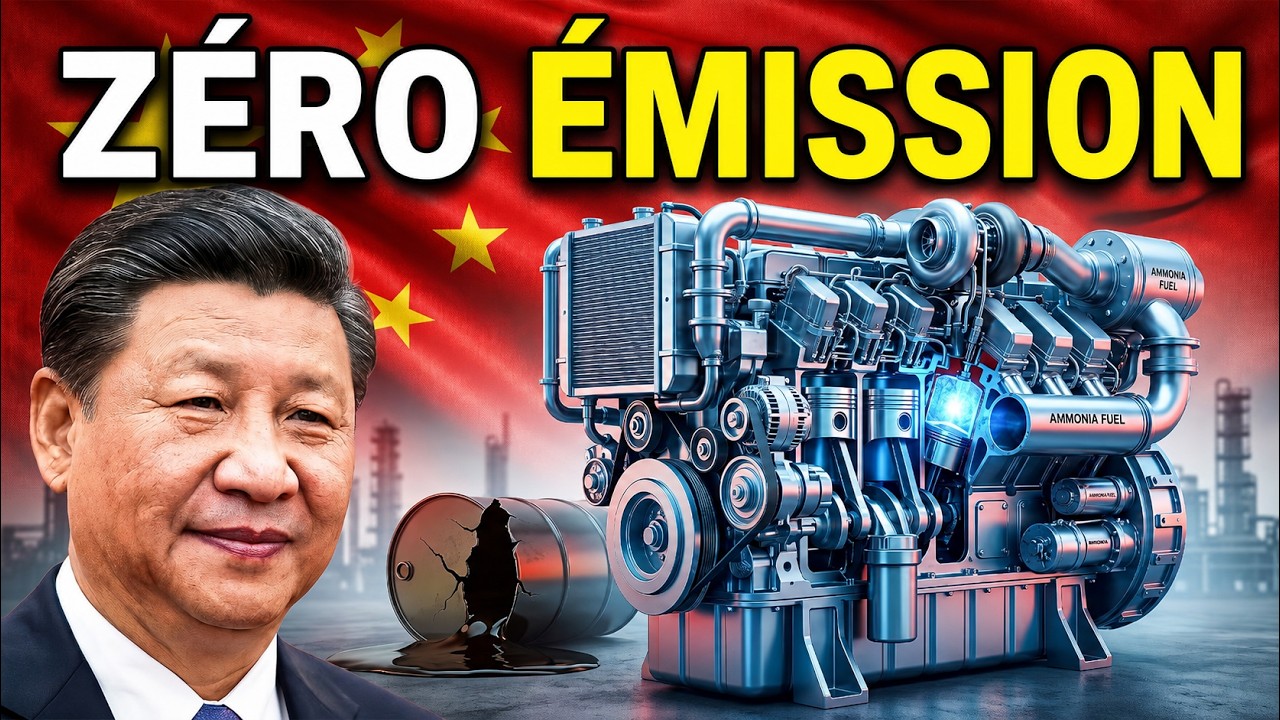
Le Nouveau Moteur Chinois À L’Ammoniac Fait Paniquer Les Géants Du Pétrole
New Chinese Ammonia Engine Has Oil Giants Panicking
Title history
- Le Nouveau Moteur Chinois À L’Ammoniac Fait Paniquer Les Géants Du Pétrole — observed on 20261101-0105 UTC (YouTube)
Keywords
Summary
168 words
Critical Evaluation
Value of the Information & Strength of the Argument
The video provides high-value information by explaining complex engineering concepts clearly and substantiating claims with specific numbers and comparisons. The argumentation is structured logically: it identifies the problem (thermal efficiency plateau), presents the innovation (co-combustion with hydrogen and on-board cracking), and addresses counterarguments (NOx emissions, infrastructure). It uses analogies and simulation (e.g., orchestra conductor) to make the system understandable. The cost and emission calculations are presented with concrete figures, strengthening the persuasiveness. However, the sourcing is not fully transparent, and the video’s persuasive style may overstate certainty, but overall the reasoning is sound and well-supported.
Scientific Rigor, Source Quality, Title Accuracy
The video references credible organizations such as the Society of Automotive Engineers, the International Energy Agency, and the International Maritime Organization, and mentions publications in the journal ‘Fuel’. It also cites specific engine models (Toyota Dynamic Force, Mazda SkyActiv-X) and regulations (EPA standards, Clean Air Act). However, no direct links to these sources are provided, and the 44.7% claim is not independently verifiable from the content. The title accurately reflects the subject but adds a sensationalized tone. The video appears technically accurate, but the lack of direct references and potential simplifications reduce its scientific rigor somewhat.
206 words
Title / Content Match
The title is somewhat sensationalist but accurately reflects the video's focus on a Chinese ammonia engine achieving record efficiency, though the 'panics oil giants' element is speculative.
Quality & Reliability
7/10
The video presents detailed technical explanations and cites reputable organizations (IEA, IMO, SAE), but lacks direct links to the primary research, and the 44.7% efficiency claim is not independently verified within the content. The style is persuasive, yet the technical arguments are coherent and consistent.
Key Moments
Markers derived by PSI from the transcript: the creator did not define chapters.
- Introduction of the 44.7% thermal efficiency result from Tianjin University, surpassing Toyota's 41%.
- Explanation of thermal efficiency limits and the historical plateau around 40-42% due to thermodynamics.
- Discussion of ammonia's drawbacks: slow flame speed, low energy density, corrosiveness, and SAE's dismissal.
- Presentation of the co-combustion solution with hydrogen generated via catalytic cracking of ammonia, and the closed-loop control system.
- Coverage of NOx emissions and SCR aftertreatment, and how the system achieves EPA limits while maintaining high efficiency.
- Economic and infrastructure analysis: cost savings, existing ammonia supply chains, and comparison with battery and hydrogen fuel cells.
- Discussion of industry adoption: IMO's decarbonization strategy, MAN Energy Solutions and Wärtsilä developing ammonia-compatible marine engines.
- Conclusion: ammonia combustion engines could be a transitional technology, but green ammonia production remains a challenge.
Cited Sources
- Toyota Dynamic Force engine — Mentioned as having achieved 41% thermal efficiency, benchmarking against the Tianjin engine.
- Mazda SkyActiv-X — Referenced for its auto-ignition approach to improve efficiency.
- Society of Automotive Engineers (SAE) — Cited for its assessment that ammonia was not viable as a fuel and for confirming limits on gasoline engine efficiency.
- University of Tianjin research findings — The main subject: a paper claiming 44.7% thermal efficiency with an ammonia-hydrogen engine.
- Fuel journal — Mentioned as the publication venue for the Tianjin research.
- IEA World Energy Outlook 2023 — Used as a source for 13% of global CO2 emissions from sectors difficult to electrify.
- International Maritime Organization (IMO) — Referenced for its 2023 strategy identifying ammonia as a key zero-carbon fuel for shipping.
- MAN Energy Solutions — Announced development of ammonia-compatible marine engines.
- Wärtsilä — Announced development of ammonia-compatible marine engines.
- Haber-Bosch process — Mentioned as the main production route for ammonia, currently based on natural gas.
Contribution & Novelties
This video synthesizes a technical breakthrough in internal combustion engines, presenting a comprehensive analysis of the ammonia-hydrogen co-combustion system, including on-board catalytic cracking, SCR aftertreatment, and closed-loop control. It provides accessible explanations of complex engineering concepts and compares the technology with conventional engines and alternative fuels. The original contribution lies in contextualizing the 44.7% efficiency claim within the broader energy transition and infrastructure challenges.
Pour aller plus loin :
- Ammonia as fuel — Overview of ammonia’s use as an energy carrier and combustion fuel.
- Haber-Bosch process — Industrial production of ammonia, relevant to green ammonia supply discussion.
- Selective catalytic reduction — The aftertreatment technology used to reduce NOx emissions.
- Thermal efficiency — Fundamental concept explaining why engines cannot convert all heat into work.
123 words
Radar Profile
The radar profile shows high scores in information quantity, quality, and technical level, with slightly lower reliability. This indicates a video that is rich in technical details and generally well-argued, but with some concerns about verifiability and transparency of sources.