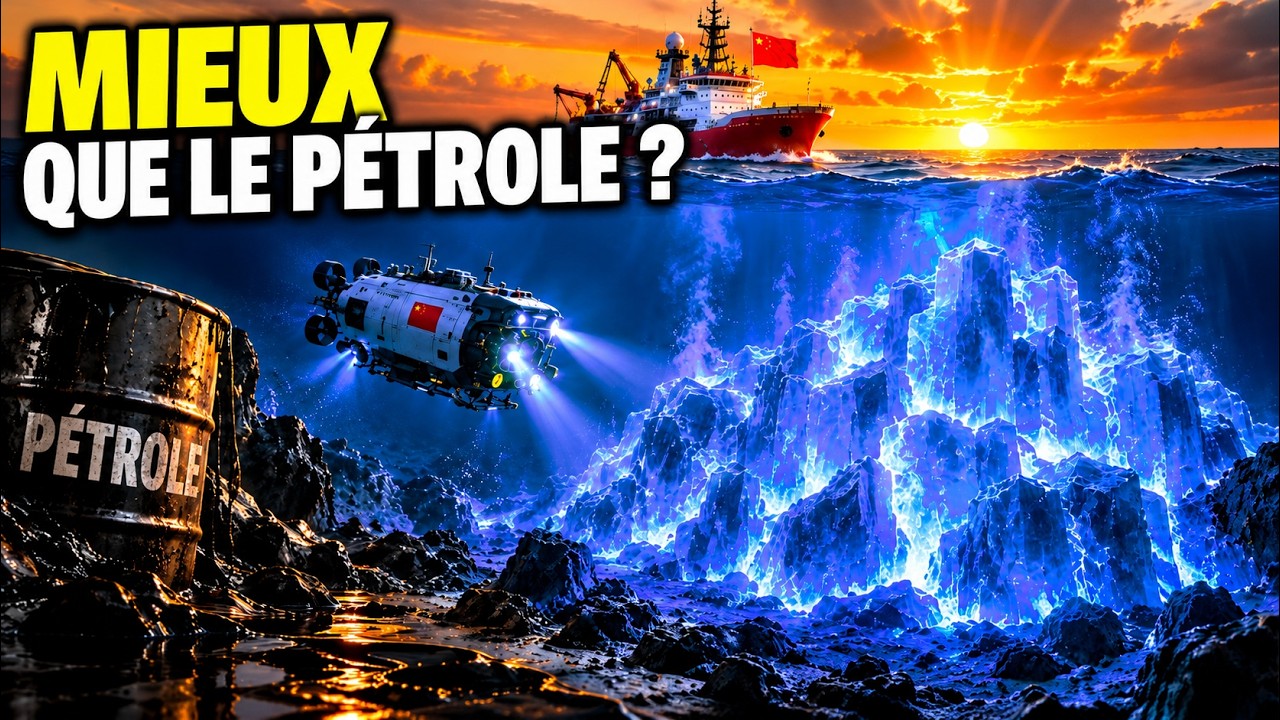
La Chine A Trouvé Quelque Chose De Bien Meilleur Que Le Pétrole
China Found Something Much More Valuable Than Oil
Title history
- La Chine A Trouvé Quelque Chose De Bien Meilleur Que Le Pétrole — observed on 20261031-2320 UTC (YouTube)
Keywords
Summary
203 words
Critical Evaluation
Value of the Information & Strength of the Argument
The video provides substantial value by connecting historical events and strategic decisions into a coherent explanation of China’s rare earth dominance. It effectively argues that control over the refining and processing stages, rather than extraction, is the critical factor, using the Mountain Pass collapse and the Magnequench sale as concrete examples. The argumentation is logical and well-paced, building from simple demonstrations (magnets in earphones) to complex geopolitical analysis (export controls, military applications). The inclusion of specific numbers (94% of magnets, 72% quota reduction, 110 dollar/kg price floor) strengthens the narrative, though these figures are presented without direct citations, somewhat reducing the capacity for verification.
Scientific Rigor, Source Quality, Title Accuracy
The video demonstrates reasonable scientific rigor by referencing documented events such as the EPA investigation at Mountain Pass, the GM/Magnequench sale, and the 2010 export quotas. However, it rarely cites primary sources directly, relying instead of a broad narrative. The title perfectly matches the content, as the video repeatedly compares the strategic importance of rare earths to oil. The single source provided in the description is a promotional ebook, which is not a scientific reference. No other external sources are mentioned, limiting the viewer’s ability to cross-check claims. The absence of explicit references to scholarly or industry reports reduces the overall reproducibility of the content.
224 words
Title / Content Match
The title accurately reflects the content, as the video indeed discusses China's rare earths monopoly as a strategic resource comparable to oil, and it devotes significant time to explaining its implications. The comparison is explicit throughout the video.
Quality & Reliability
8/10
The video presents a well-structured historical narrative about China's dominance in rare earths, citing specific events, dates, and figures such as the Magnequench sale, the 2010 export quotas, and the 2025 samarium licensing requirements. It relies on widely reported facts but does not directly cite primary sources. The argumentation is coherent and aligns with public knowledge of the topic, though the presentation occasionally simplifies complex technical and economic details.
Key Moments
Markers derived by PSI from the transcript: the creator did not define chapters.
- Introduction to rare earth magnets in everyday devices and military hardware.
- Explanation that rare earths are not rare; the real challenge is separation and refining.
- History of Mountain Pass: discovery, operations, and radioactive waste issues.
- The 1995 Magnequench sale and its transfer of technology to China.
- China's market flooding strategy and the 2010 export quota crisis.
- The role of samarium in missiles and China's 2025 export licensing requirement.
- U.S. response: Pentagon partnership with MP Materials and its limitations.
- Broader pattern of Chinese industrial strategy applied to other sectors like solar and shipbuilding.
Cited Sources
- Le Décrochage De L’occident (ebook) — Promoted book in the video description, likely related to the same topic.
Contribution & Novelties
The video’s original contribution lies in synthesizing multiple historical events into a cohesive explanation of China’s rare earth monopoly, highlighting the rarely discussed role of the Magnequench sale and the environmental collapse of Mountain Pass. It offers a compelling geopolitical interpretation of supply chain dependencies that goes beyond simple market analysis.
Pour aller plus loin :
- Rare-earth elements — Overview of rare earth elements, properties, and applications.
- MP Materials — Details about the company operating Mountain Pass and its recent defense contracts.
- Mountain Pass mine — Historical and current information about the mine’s operations and closure.
- China’s export controls — Background on China’s trade policies and export restrictions, relevant to the 2010 quotas.
113 words
Radar Profile
The radar profile shows strong scores in quantity and quality of information, moderate technical depth, and slightly lower global reliability due to the absence of cited sources. This suggests a well-structured documentary that informs but leaves some room for verification, aligning with its narrative-driven approach.