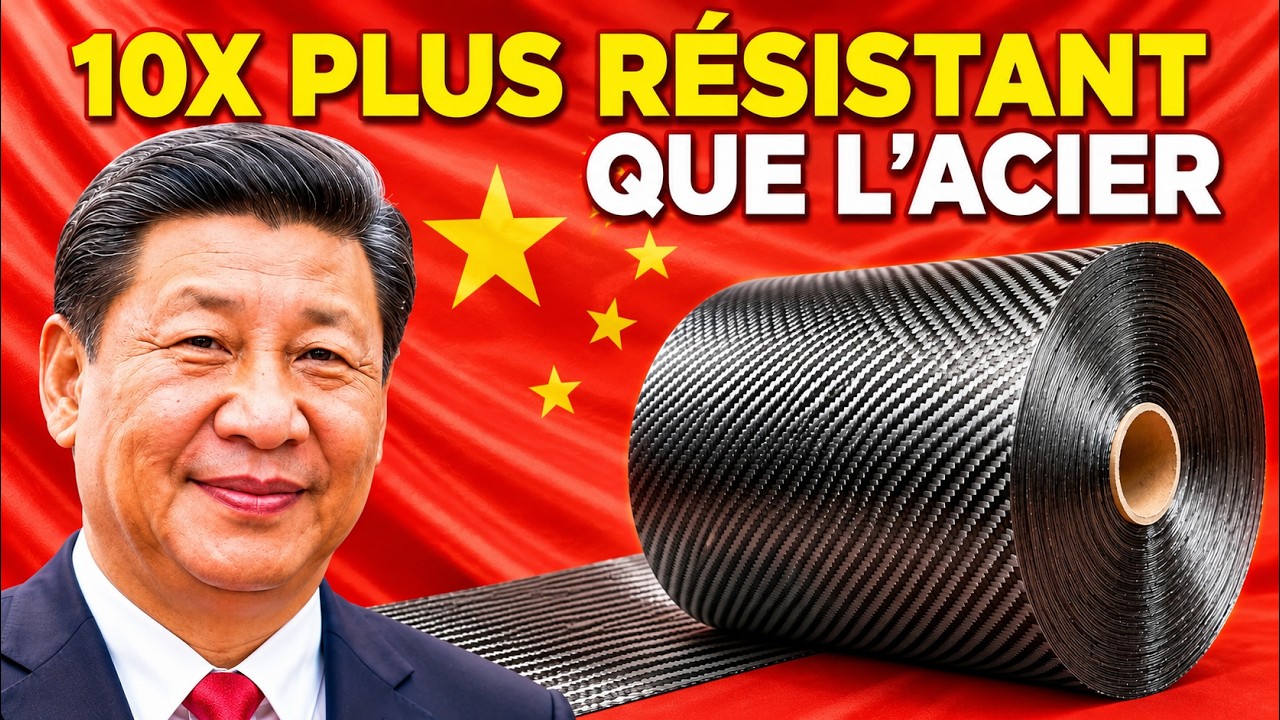
La Percée Chinoise Dans La Fibre De Carbone Vient de Rendre L'Aluminium Obsolète
The Chinese Carbon Fiber Breakthrough Just Made Aluminum Obsolete
Title history
- La Percée Chinoise Dans La Fibre De Carbone Vient de Rendre L'Aluminium Obsolète — observed on 20261101-0112 UTC (YouTube)
Keywords
Summary
187 words
Critical Evaluation
Value of the Information & Strength of the Argument
The video offers significant value by aggregating industrial data from public sources, such as production capacities, price comparisons, and qualification timelines, into a coherent narrative about technological sovereignty. The argumentation is logical and structurally sound, moving from historical context to technical specifics, then to economic and geopolitical consequences. It effectively uses concrete examples (787, F-35, J-20) and quantifiable figures (cost per kilogram, production tonnage) to support its thesis. However, the argumentation occasionally overstates certainty—for instance, claiming China’s T800 quality matches aerospace standards without mentioning potential certification differences. The video also asserts that export controls were ineffective without thoroughly discussing counterfactuals. Overall, it presents a persuasive but not fully academically rigorous case, relying heavily on inferred trends rather than directly verifiable statistics.
Scientific Rigor, Source Quality, Title Accuracy
The video demonstrates a fairly rigorous approach by referencing specific companies, programs, and reported figures, but it does not provide direct links to primary sources in the description. The narrative mentions organizations like the Japan Carbon Fiber Manufacturers Association and DoD reports, yet these are not cited with verifiable URLs. The title accurately reflects the content’s focus, though ‘aluminum obsolete’ is hyperbolic since aluminum remains widely used; the video actually argues carbon fiber is replacing aluminum in certain structural applications. The inadequacy of external citations limits the ability to cross-check claims, and some numbers (e.g., exact price ranges) may be approximations. Overall, the content is methodically structured but falls short of stringent scientific sourcing standards.
251 words
Title / Content Match
The title is somewhat sensational but accurately reflects the core claim about Chinese carbon fiber replacing aluminum in aerospace and defense applications.
Quality & Reliability
7/10
The video provides a comprehensive industrial analysis with specific figures and examples, but lacks direct citations to primary sources and relies on uncorroborated claims about costs and production capacities.
Key Moments
Markers derived by PSI from the transcript: the creator did not define chapters.
- Introduction: carbon fiber as the defining material of modern aviation.
- History: Boeing-Toray partnership and the 787's 50% composite structure.
- Explanation of carbon fiber properties and grade classifications (T300 to T1000).
- China's rise: production capacity surpassing 100,000 tonnes and cost advantages.
- Geopolitical impact: dependence of F-35 and 787, export controls, and Western vulnerabilities.
- Future outlook: COMAC C929 targets and the question of Western rebuilding capacity.
Contribution & Novelties
The video provides an original synthesis of publicly available industrial data, connecting technical material properties with strategic industrial policy in a compelling narrative. It highlights the underappreciated role of automated fiber placement and RTM processes in the competitive dynamics, and frames the issue as a completed structural shift rather than an ongoing race. The contribution lies in making the stakes of carbon fiber supply chains accessible to a broad audience.
Pour aller plus loin :
- Carbon fiber (Wikipedia) — Overview of carbon fiber composition, production, and applications.
- Carbon fiber reinforced polymer (Wikipedia) — Detailed look at composite materials used in aerospace.
- COMAC C929 (Wikipedia) — Information on China’s wide-body aircraft program and its composite targets.
115 words
Radar Profile
The radar scores suggest a well-rounded but not exceptionally rigorous video: high information quantity (8) and decent quality (7), but moderate technical depth (6) and lower global reliability (6). This profile indicates a video that is informative and accessible, yet may rely on unverified assertions, making it suitable for general understanding but not for detailed technical or academic purposes.