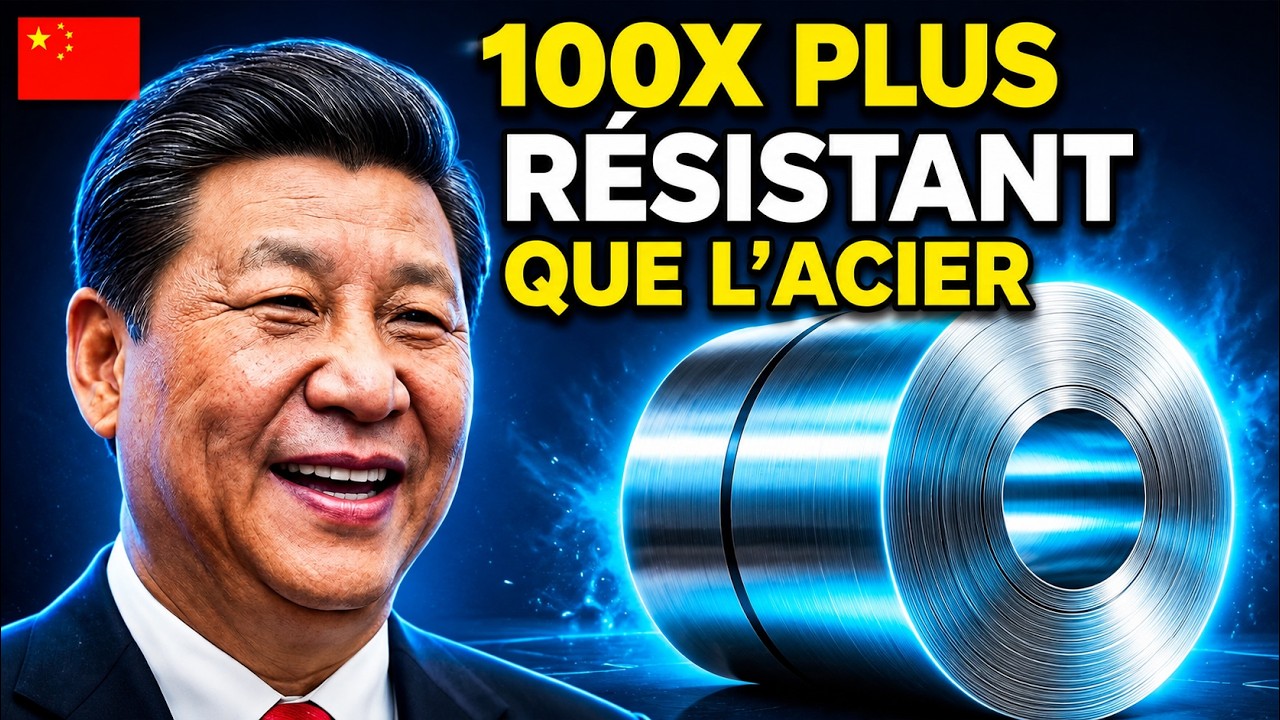
L’Incroyable Découverte Chinoise Qui Vient De Remplacer L’Acier
The Incredible Chinese Discovery That Just Replaced Steel
Title history
- L’Incroyable Découverte Chinoise Qui Vient De Remplacer L’Acier — observed on 20261101-0107 UTC (YouTube)
Keywords
Summary
170 words
Critical Evaluation
Value of the Information & Strength of the Argument
The video provides a dense set of concrete facts, figures, and examples (e.g., 960.8 million tonnes steel output, T1200 carbon fiber, 27% weight reduction, 300 million USD per production line, 15–20% price gap) that make the arguments appear compelling. The argumentation follows a logical sequence, layering technological breakthroughs with supply chain control and patent walls to build a cumulative case. However, the reasoning is largely one-sided: it presents the Chinese strategy as coherent and foresighted while depicting Western producers as passive and structurally disadvantaged, without addressing potential weaknesses in China’s approach (e.g., capital intensity, technology diffusion, or overcapacity). The absence of counterarguments or acknowledgment of Western mitigation efforts reduces the persuasive strength from an analytical standpoint, but the factual density and strategic framing are effective.
Scientific Rigor, Source Quality, Title Accuracy
The scientific rigor is moderate at best. The video cites named companies and sectoral numbers, but does not reference peer-reviewed studies, official reports, or primary data sources. The T1200 carbon fiber grade is described with physical characteristics (molecular alignment, gradient control) but no technical specifications are given. The advanced steel claims are illustrated with automotive examples but lack metallurgical details or comparative analyses. The hydrogen steel section mentions Baowu’s Zhangjiagang line and a million-tonne capacity, but no independent verification is provided. The patent strategy is asserted without citing specific patent numbers or families. The title/content match is acceptable: the video discusses materials that could substitute for steel in various applications, but the ‘replacing steel’ wording is hyperbolic. No contradictory evidence or expert opinions are presented, and the narrative is consistent but uncorroborated.
272 words
Title / Content Match
The title is slightly sensationalist, as the content covers advances in carbon fiber, advanced steel, and hydrogen-based steelmaking that could substitute for traditional applications, but not literally replace steel entirely. The title overstates the direct replacement while the video remains largely relevant.
Quality & Reliability
6/10
The video presents specific technical claims and numerical data without providing verifiable citations or primary sources. It adopts a one-sided, persuasive tone with no counterarguments or expert validation, reducing confidence in the accuracy and completeness of the information.
Key Moments
Markers derived by PSI from the transcript: the creator did not define chapters.
- Introduction: China produces 960.8 million tonnes of steel, more than the rest of the world combined.
- Discussion of T1200 carbon fiber production by CNBM's Zhongfu Shenying (March 2026) and its significance over T700-T800.
- Comparison of T700 and T1200 carbon fiber as structurally different, impacting aerospace, wind turbines, and vehicles.
- Introduction of third-generation advanced high-strength steel, explaining its simultaneous strength and flexibility.
- Examples: Volkswagen car body weight -27%, Hyundai floor weight -30% due to Chinese advanced steel.
- Launch of Baowu Steel's million-tonne hydrogen-based direct reduced iron line at Zhangjiagang (end 2025).
- Analysis of carbon border tariffs (CBAM) potentially favoring Chinese green steel while penalizing Western steelmakers.
- Supply chain chokehold: China dominates refining of vanadium, manganese, and niobium, essential for advanced steel.
- Patent strategy: China files aggressive patents on methods, processes, and compositions in green steel and carbon fiber, creating barriers.
- Long-term planning: China's 30-year investments in carbon fiber and materials strategy, contrasting with Western short-termism.
- Conclusion: The West may not have noticed the start of the materials war; China controls inputs, methods, prices, and timelines.
Cited Sources
- CNBM Group — Cited as the parent company of Zhongfu Shenying, which announced stable industrial production of T1200 carbon fiber (grade S8T80).
- Zhongfu Shenying — Named as the unit of CNBM responsible for the T1200 carbon fiber production breakthrough.
- Baowu Steel Group — Cited for completing a one-million-tonne hydrogen direct reduction line at Zhangjiagang, producing steel with water emission instead of CO2.
- Toray and Teijin — Mentioned as dominant Japanese carbon fiber producers operating at T800 grade, contrasting with China's T1200.
Contribution & Novelties
The video synthesizes public information into a critical narrative about China’s strategic positioning in advanced materials. It highlights the interplay between technological leaps, supply chain control, and patent clustering—a perspective often fragmented in mainstream coverage. The emphasis on vanadium/manganese/niobium processing as a choke point is a valuable angle, as is the analysis of CBAM’s unintended consequences. The metaphor of ‘patent walls’ and the long-term planning vs. quarterly returns dichotomy succinctly capture structural differences.
Pour aller plus loin :
- Carbon fiber — Overview of carbon fiber grades, production methods, and applications, providing a technical basis for understanding T1200.
- Direct reduction — Explains the principles of direct reduced iron (DRI) and the role of hydrogen in green steelmaking.
- Vanadium — Details on vanadium as a critical alloying element and its industrial processing, relevant to the supply chain discussion.
- Advanced high-strength steel — References 3rd-generation AHSS characteristics, aligning with the video’s description of simultaneous strength and ductility.
154 words
Radar Profile
The radar profile shows a pronounced peak in quantity of information, with moderate quality and technical level, but noticeably lower reliability. This suggests a content-rich video that presents many facts and technical details without solid sourcing, resulting in an informative yet unverified narrative.