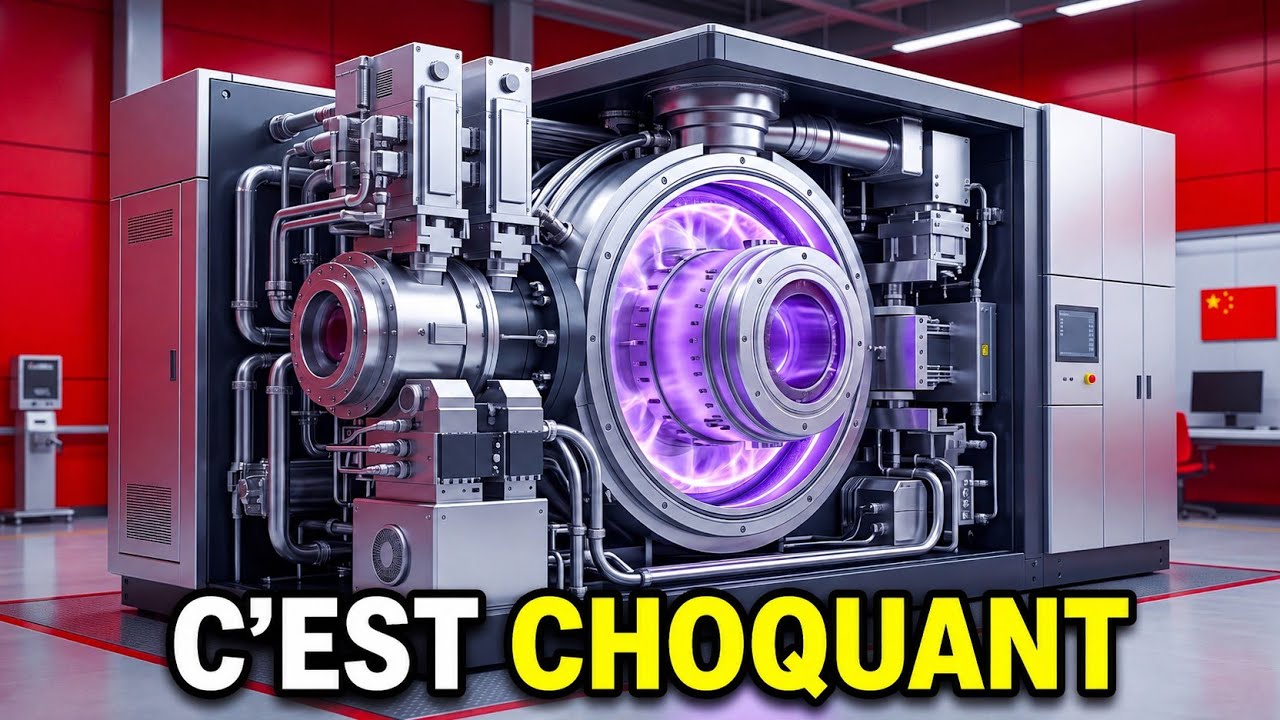
La Chine A Créé La Machine Qui Fait Trembler ASML
China Created the Machine That Makes ASML Tremble
Title history
- La Chine A Créé La Machine Qui Fait Trembler ASML — observed on 20261101-0051 UTC (YouTube)
Keywords
Summary
175 words
Critical Evaluation
Value of the Information & Strength of the Argument
The video’s primary value lies in its thorough explanation of EUV lithography mechanics and supply chain dependencies, going beyond simple news recap. It clearly distinguishes between ASML’s proven method and China’s alternative, and correctly points out that the prototype is far from commercial viability. The argumentation is solid: it supports claims with specific technical details and multiple cited sources, while avoiding exaggerated conclusions. It also presents the parallel development efforts as a sign of strategic resilience, adding nuance to the common ‘one engineer saves China’ narrative. The reasoning is well-structured, moving from technology to geopolitics to economics, and it effectively underscores the helium supply as a underreported but critical factor.
Scientific Rigor, Source Quality, Title Accuracy
The video demonstrates strong scientific rigor by referencing reliable outlets such as Reuters, Power Electronics News, TechPowerUp, eTimes, South China Morning Post, and the journal China Laser. It does not overstate the prototype’s capabilities and clearly labels it as unverified beyond the lab. The title, while attention-grabbing, is not misleading as the content directly addresses why ASML might be concerned. The sourcing is mostly adequate, though some claims such as the helium export ban are cited without direct links; nevertheless, the dependency on tritium and TrendForce is plausible. The video also corrects a common media over-simplification about a single transfuge, which enhances its credibility. Overall, the title-contenu alignment is good and the sources appear reliable enough for a general audience.
245 words
Title / Content Match
The title is somewhat sensational but the content matches: it discusses China's EUV machine prototype and its implications for ASML.
Quality & Reliability
8/10
The video provides a detailed and well-structured analysis of ASML's EUV monopoly, China's prototype, and the technical and geopolitical challenges. It cites multiple sources and avoids sensationalism, presenting a nuanced view.
Key Moments
Markers derived by PSI from the transcript: the creator did not define chapters.
- Introduction: China's EUV prototype and what the video will clarify.
- Explanation of ASML's monopoly and why China cannot legally buy EUV machines.
- Details on the Chinese prototype: assembled from retro-engineered parts, two approaches (Shanghai and Harbin).
- Comparison of light generation: ASML's laser-driven tin droplets vs. China's rotating electrodes method.
- Challenges with mirrors, vacuum, and the critical role of helium supply.
- Impact on SMIC: current quadruple patterning workaround, cost and yield effects.
- Conclusion: realistic timelines (2028-2030) and the ongoing uncertainty of the program.
Cited Sources
- Reuters — Cited as reporting on the completion of the prototype in December 2025.
- Power Electronics News — Mentioned for describing the prototype's size and SMIC's quadruple patterning in February 2026.
- TechPowerUp — Listed as one of the media outlets covering the prototype.
- eTimes — Cited for detailing the rotating electrode method (discharge-induced plasma).
- South China Morning Post — Covered the research from Shanghai Institute of Optics in May 2025.
- China Laser (journal) — Published the solid-state laser approach in March 2025.
- Trivium China — Referenced for helium import statistics.
- TrendForce — Also cited for helium import data.
Contribution & Novelties
The video adds value by debunking the oversimplified narrative that one former ASML engineer solved China’s lithography problem. It reveals that China is funding two independent approaches (Shanghai’s solid-state laser and Harbin’s rotating electrodes), illustrating a portfolio strategy. It also highlights the helium supply chain as an under-appreciated bottleneck, which is rarely covered in mainstream tech media. By comparing the technological intricacies and dependencies, it provides a comprehensive, realistic assessment of China’s progress and challenges.
Pour aller plus loin :
- ASML — Background on the company and its EUV dominance.
- Extreme ultraviolet lithography — Technical details on EUV technology.
- Helium — Properties and supply issues.
- Multiple patterning — The technique SMIC uses as a stopgap.
115 words
Radar Profile
The radar profile shows a balanced distribution across quantity, quality, technical level, and reliability, indicating a well-rounded and informative video that excels in all dimensions with no significant weaknesses.