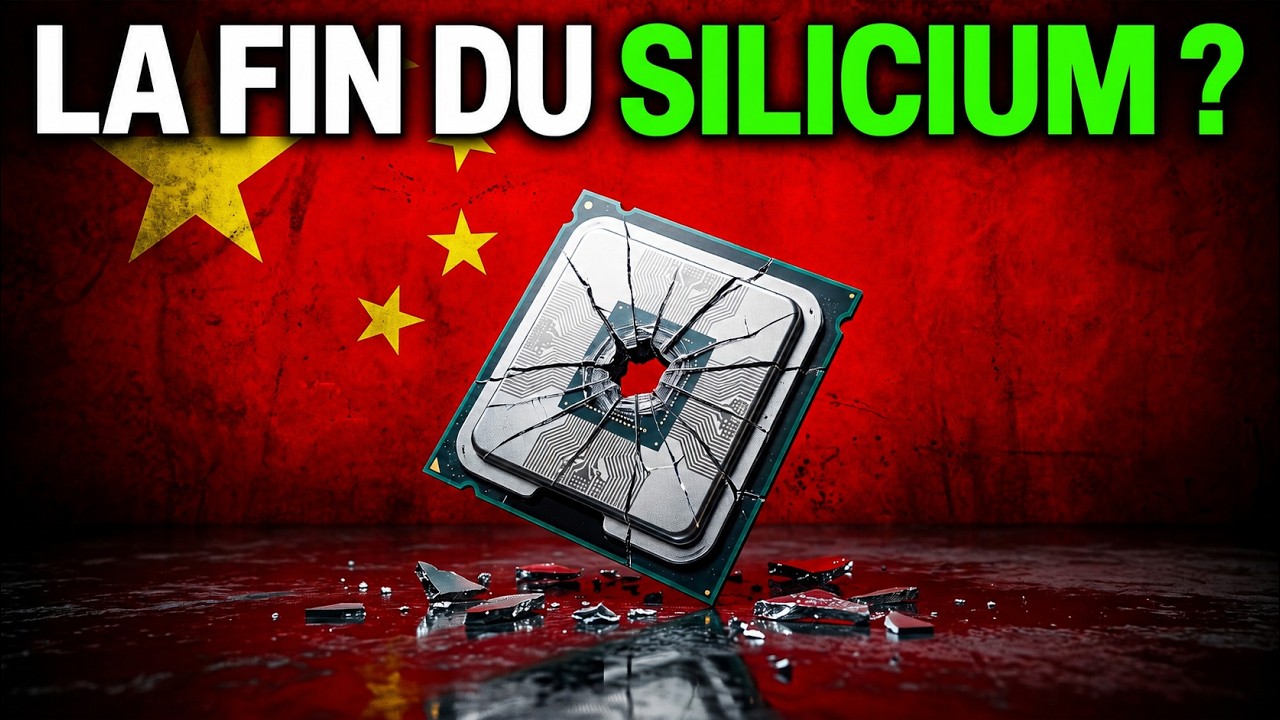
Le Silicium Est Mort — La Chine Vient De Construire Son Remplaçant
Silicon Is Dead — China Just Built Its Replacement
Title history
- Le Silicium Est Mort — La Chine Vient De Construire Son Remplaçant — observed on 20261101-0040 UTC (YouTube)
Keywords
Summary
139 words
Critical Evaluation
Value of the Information & Strength of the Argument
The video provides significant value by correcting widespread misinformation about the Wuji and Mengqi chips. It distinguishes between laboratory demonstrations and industrial viability, using concrete data such as yield percentages and transistor densities. The argumentation is solid, systematically addressing each misconception and explaining the underlying physics and engineering. The explanation of RISC-V’s role in China’s technological autonomy is compelling and well-contextualized. The video avoids sensationalism and presents a nuanced view of the global semiconductor landscape, acknowledging both Chinese academic progress and Western industrial leadership. The logic is coherent, with each correction supported by references to published research.
Scientific Rigor, Source Quality, Title Accuracy
The video demonstrates strong scientific rigor by citing primary publications in Nature and Nature Electronics, and by involving detailed technical metrics. It accurately describes the work of IMEC, ASML, TSMC, and others, based on public roadmap statements. The sources are credible, though no direct links are provided in the description; however, the references to specific papers and institutions are identifiable. The title is somewhat hyperbolic, but the content immediately tempers it, with the presenter stating that the story is more complex. The adéquation is acceptable because the video deconstructs the title’s claim, making the sensationalist phrasing a hook rather than a misrepresentation.
214 words
Title / Content Match
The title is sensational but the video thoroughly qualifies the claim, providing a balanced and accurate overview.
Quality & Reliability
8/10
The video is well-researched, references original papers, corrects common misconceptions, and demonstrates a clear understanding of the subject matter.
Key Moments
Markers derived by PSI from the transcript: the creator did not define chapters.
- Introduction: a 32-bit processor on a grain of rice, and the claim that most coverage is wrong.
- Presentation of Wuji chip: 5900 transistors, RISC-V 32-bit, from Fudan University, published in Nature.
- Yield analysis: 99% for simple circuits, drops to 7% for 64-bit registers, highlighting scalability challenges.
- Importance of RISC-V for China's semiconductor independence, avoiding licenses from Intel and ARM.
- Correction of SiDimension as an American spin-off from MIT, not Chinese, focused on quantum computing.
- Introduction of Mengqi-1000: first parallel multi-bit 2D processor, 1433 transistors, higher density, from Nanjing and Huawei.
- Debunking the 0.6 nm myth: that number is material thickness, not fabrication node; actual process is 0.5 µm.
- Industrial perspective: IMEC, ASML, TSMC demonstrate 2D transistors on 300mm wafers, with CFET roadmap towards 2041.
Contribution & Novelties
This video brings a crucial corrective perspective to the coverage of Chinese 2D semiconductor research. It clarifies the actual technical achievements and limitations of Wuji and Mengqi-1000, corrects the national misattribution of SiDimension, and exposes the factual errors in viral headlines. It also situates these advances within the broader global race, noting the parallel industrial progress in the West. The synthesis of academic and industrial efforts is a valuable contribution to public understanding.
Pour aller plus loin :
- RISC-V architecture — This open instruction set is central to the video’s discussion on China’s strategic independence.
- Molybdenum disulfide — The 2D material used in the chips; understanding its properties is key to grasping the breakthrough.
- 2D materials — General background on atomic-thickness materials and their potential.
- Complementary FET (CFET) — The stacked-transistor architecture mentioned in the industrial roadmap, relevant to future scaling.
141 words
Radar Profile
The radar profile shows a balanced video with strong scores in information quality and reliability, slightly lower in technical depth and quantity. This suggests a well-informed presentation that prioritizes accuracy over exhaustive detail, appropriate for a general audience interested in semiconductor breakthroughs.