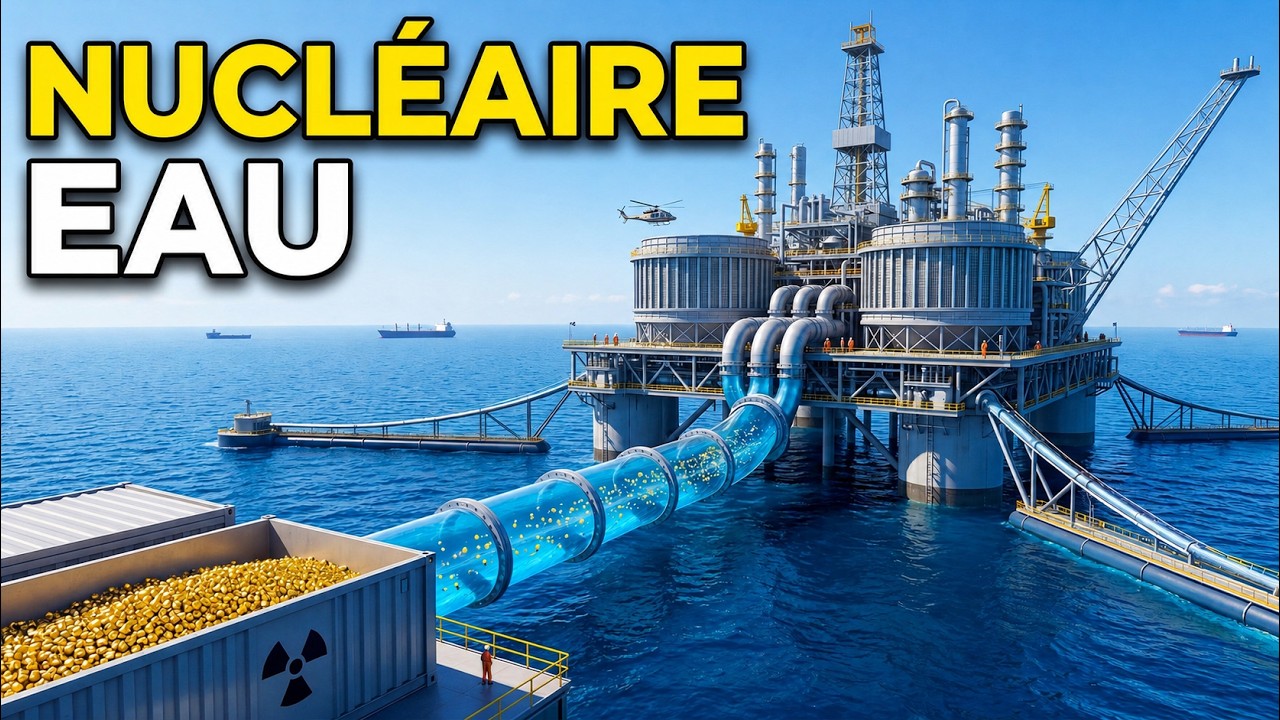
La Chine A Trouvé Comment Transformer L’Eau De Mer En Combustible Nucléaire
China Has Figured Out How to Turn Seawater Into Nuclear Fuel
Title history
- La Chine A Trouvé Comment Transformer L’Eau De Mer En Combustible Nucléaire — observed on 20261101-0104 UTC (YouTube)
Keywords
Summary
169 words
Critical Evaluation
Value of the Information & Strength of the Argument
The video provides a valuable overview of a niche but important topic, explaining complex scientific concepts in an accessible manner. Its argumentation is logical, presenting the problem of deuterium extraction, the historical limitations, and the proposed solution step by step. It effectively uses analogies and comparisons to make the case that this development is significant, such as linking the energy cost of extraction to the viability of fusion. However, the value is tempered by an over-reliance on unsupported claims about the Chinese program’s results, with no direct evidence or links provided. The argumentation is persuasive but lacks critical scrutiny, potentially overstating the technology’s readiness. The inclusion of specific numbers and institutional names adds apparent authority, but the absence of direct citations weakens the overall robustness.
Scientific Rigor, Source Quality, Title Accuracy
The video references real institutions and publications, including the International Atomic Energy Agency (AIEA), Silex Systems, GE Hitachi Nuclear Energy, the Chinese Academy of Sciences, and academic journals like Physical Review Letters and Physical Review Applied. These references contribute to its perceived scientific rigor. However, the video does not provide direct links or explicit citations, making it difficult for viewers to verify the claims independently. The title is essentially accurate, as it focuses on China’s role in developing a method to transform seawater into nuclear fuel, but it carries a sensational tone. The content aligns with the title, though the title undersells the broader historical and technical context. Overall, the sources are credible but underutilized, and the presentation could benefit from more transparent sourcing.
264 words
Title / Content Match
The title accurately reflects the main topic: China's advancement in deuterium extraction from seawater for nuclear fusion fuel. It is slightly sensational but the content matches.
Quality & Reliability
7/10
The video presents plausible scientific developments with references to real institutions and publications, but it simplifies complex details and may overstate the maturity of the technology. The core claims about laser isotope separation are credible, but the specific energy numbers and the readiness of the Chinese program are not independently verified in the video.
Key Moments
Markers derived by PSI from the transcript: the creator did not define chapters.
- Introduction to the Girdler Sulfide process and its energy cost for deuterium extraction.
- Explanation of laser isotope separation and Silex Systems' early demonstration.
- Description of the membrane cascade and how it pre-concentrates HDO molecules.
- Discussion of the integrated system and verification of energy consumption below Girdler threshold.
- Implications of the breakthrough for future fusion reactors and the energy paradigm.
Cited Sources
- International Atomic Energy Agency (AIEA) — Mentioned as a source for the concentration of deuterium in seawater (33 mg/L).
- Silex Systems — Australian company that demonstrated laser isotope separation in 1994.
- GE Hitachi Nuclear Energy — Licensed Silex technology for uranium enrichment.
- Chinese Academy of Sciences — Published pilot program results on laser separation of deuterium between 2019 and 2023.
- Physical Review Letters — Journal where some of the Chinese results appeared.
- Physical Review Applied — Documented the independent verification of the combined laser-membrane cascade.
Contribution & Novelties
This video brings attention to a relatively underreported development in nuclear fuel extraction: the combination of laser isotope separation and membrane pre-concentration for deuterium extraction from seawater. It explains the physical mechanisms and presents the Chinese program as evidence of feasibility, offering a potential paradigm shift in fusion fuel supply. The video’s contribution lies in making this complex topic understandable to a general audience while highlighting its strategic importance.
Pour aller plus loin :
- Laser isotope separation — Provides a general overview of the technique and its applications.
- Deuterium — Detailed information about the hydrogen isotope, its properties, and uses.
- Girdler sulfide process — Background on the traditional industrial method for heavy water production.
114 words
Radar Profile
The radar profile shows high scores in information quantity and quality, indicating a content-rich video with substantial detail. The technical level is moderately high, reflecting the complexity of the subject. Reliability is respectable but with room for improvement, as the video relies on unverified claims. Overall, the profile suggests a well-produced educational piece with some caveats regarding source transparency.