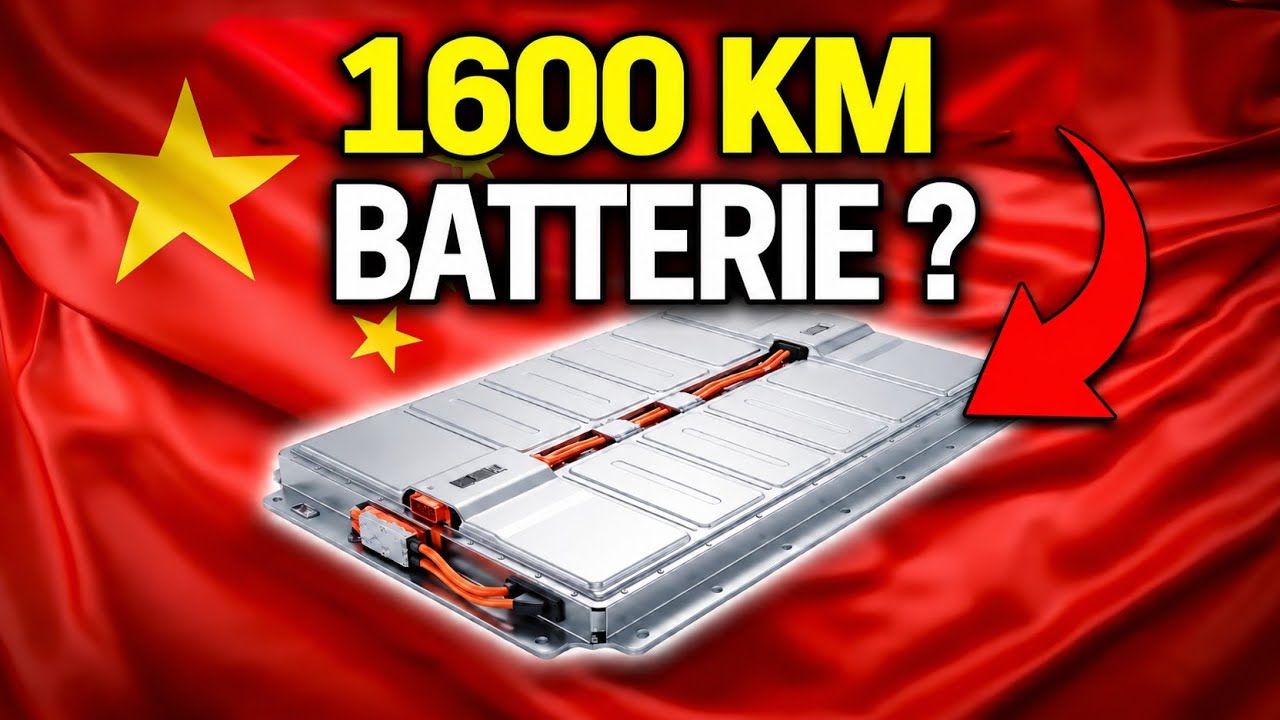
Pourquoi La Chine Mise Tout Sur Les Batteries Lithium-Air
Why China Is Betting Everything on Lithium-Air Batteries
Title history
- Pourquoi La Chine Mise Tout Sur Les Batteries Lithium-Air — observed on 20261031-2331 UTC (YouTube)
Keywords
Summary
245 words
Critical Evaluation
Value of the Information & Strength of the Argument
The video excels at breaking down complex electrochemistry into accessible analogies while maintaining scientific accuracy. It presents a well-structured argument: from the basic principle, to historical setbacks, to recent breakthroughs, and finally to a critical analysis of exaggerated media claims. The distinction between theoretical and practical energy density is particularly valuable, as it corrects a common misconception. However, the argumentation sometimes relies on rhetorical flourishes (e.g., ’the battery breathes’) that, while engaging, could mislead if not carefully anchored to technical facts. The sourcing of specific figures (311 Wh/lb, 1000 cycles) is credible, but direct references to the original papers or official reports would strengthen the argument. The debunking of the 12,000 Wh/kg figure is convincingly explained, yet it would benefit from citing a specific publication that used this number.
Scientific Rigor, Source Quality, Title Accuracy
The video demonstrates a strong commitment to scientific rigor by tracing the technology’s lineage to specific institutions and researchers (Argonne, IIT) and by calling out unreliable reporting. It mentions funding from the Department of Energy with concrete amounts, which lends credibility. However, it does not provide direct links to the studies, and some claims (e.g., ‘CATL has not produced such a battery’) are stated without verification. The title is accurate and attention-grabbing, but it slightly exaggerates China’s role, as the core research was conducted in the US, not China; CATL’s involvement is more of an endorsement. The video’s own narrative acknowledges this, but the title could be seen as misleading. Overall, the content aligns well with the title and demonstrates a high level of critical thinking.
270 words
Title / Content Match
The title perfectly matches the content, which explains why China (through CATL) is focusing on lithium-air batteries and assesses the technology's real potential.
Quality & Reliability
8/10
The video provides a rigorous and critical analysis of lithium-air battery technology, accurately distinguishing between theoretical promises and real achievements. It cites primary sources (Argonne National Laboratory, Illinois Institute of Technology, CATL, Department of Energy) and debunks exaggerated figures, though it lacks direct citations to peer-reviewed papers.
Key Moments
Markers derived by PSI from the transcript: the creator did not define chapters.
- Introduction to lithium-air batteries and CATL's announcement.
- Explanation of how a lithium-air battery works, with metal cathode replaced by open air.
- Discussion of historical challenges: early prototypes required pure oxygen, real air causes degradation.
- 2018 breakthrough by Illinois Institute of Technology: battery operates on unfiltered air for 600 cycles.
- Chemical details: catalyst (molybdenum phosphide) and composite electrolyte enable higher energy reaction.
- 2023 results: cell achieves 311 Wh/lb and shows 1000 cycles, surpassing lithium-ion and solid-state pack promises.
- Debunking the 12,000 Wh/kg figure as theoretical and misleading; real pack-level number is ~318 Wh/lb.
- DOE funding and Air Energy startup launch; target of pilot production by 2027.
- Remaining engineering challenges: cathode thickness vs air flow, manufacturing scale-up, CATL's timeline beyond 2030.
- Conclusion: potential of the technology for electric aviation and drones, call for comments.
Cited Sources
- CATL — World's largest battery maker, announced lithium-air as a new frontier.
- Argonne National Laboratory — Co-developed a working lithium-air battery with 1000-cycle stability in 2023.
- Illinois Institute of Technology — Partner institution that achieved the 2018 breakthrough with unfiltered air.
- Department of Energy (DOE) — Provided $1.5M and $3.2M grants to fund the research and development.
- Air Energy — Startup founded by the researchers to commercialize the technology, targeting drones.
Contribution & Novelties
The video adds value by correcting widespread misinformation about lithium-air batteries, specifically the misrepresented 12,000 Wh/kg figure. It provides a clear timeline of actual achievements and legitimate benchmarks, helping viewers distinguish hype from substance. It also highlights the overlooked role of US laboratories in a narrative often attributed to China, and explains the engineering barriers that remain before commercialization.
Pour aller plus loin :
- Lithium–air battery - Wikipedia — Comprehensive overview of technologies, challenges, and history.
- Solid-state battery - Wikipedia — Context on competing next-generation battery chemistry.
- Energy density - Wikipedia — Explains the different metrics and why theoretical vs practical values differ.
103 words
Radar Profile
Le profil radar montre une vidéo de vulgarisation équilibrée, avec une quantité d'information élevée, une bonne qualité, un niveau technique modéré et une fiabilité notable. La fiabilité est légèrement inférieure à la quantité, indiquant une bonne base mais un besoin de vérifications supplémentaires.