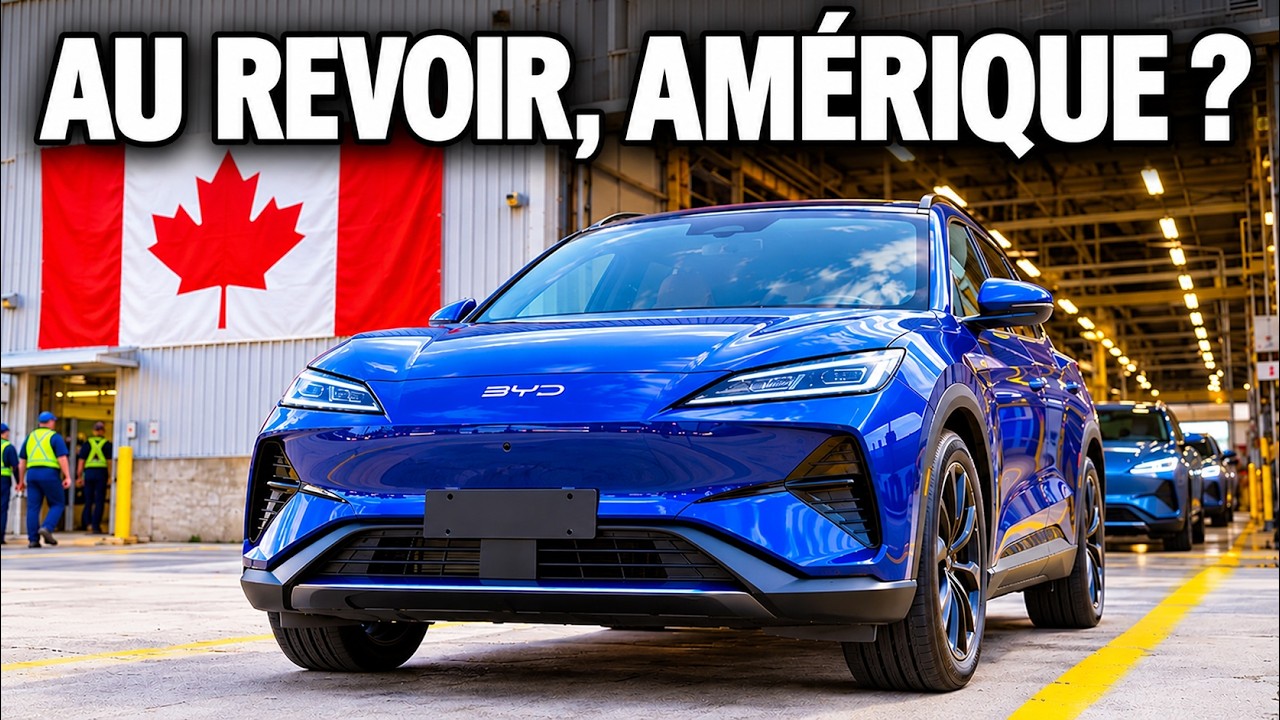
Comment La Chine Pourrait Sauver L'Industrie Automobile En Difficulté Du Canada
How China Could Save Canada's Struggling Auto Industry
Keywords
Summary
163 words
Critical Evaluation
Value of the Information & Strength of the Argument
The video values information by providing concrete data points, such as quota limits (49,000 vehicles) and production figures, sourced from credible institutions like Desrosiers and the IEA. It argues persuasively that China’s advantages are structural (supply chain, vertical integration) rather than merely subsidized. The argumentation is balanced, acknowledging real benefits (job creation in Brazil, Belgium) and risks (supplier payment delays, loss of Canadian ownership). It handles complexity well, contrasting different investment models and their implications. The reasoning is logical, moving from specific cases to general conclusions, and it does not oversimplify the geopolitical context, presenting both opportunities and constraints.
Scientific Rigor, Source Quality, Title Accuracy
The video adheres to scientific rigor by citing reputable outlets and research firms, including Bloomberg, The Canadian Press, Rhodium Group, and the International Energy Agency. It distinguishes between established facts and allegations (e.g., Brazilian labor conditions). The title accurately reflects the content, though it slightly overstates the ‘rescue’ possibility, as the video emphasizes uncertainty. Sources are mostly secondary but adequately support the claims. The production is professional, with clear narration and data visualizations, enhancing credibility. No major factual errors were spotted, and the video does not dismiss alternative views, such as labor union objections.
208 words
Title / Content Match
The title accurately reflects the content, which explores the potential for Chinese automakers to rescue Canada's ailing auto industry while weighing realistic obstacles.
Quality & Reliability
8/10
The video presents a well-structured analysis with numerous data points and references to reputable sources such as Bloomberg, Rhodium Group, and the IEA. It balances perspectives and includes specific figures, though some claims rely on reporting rather than primary data.
Key Moments
Markers derived by PSI from the transcript: the creator did not define chapters.
- Introduction to the Brampton Stellantis plant crisis and the Leapmotor rumor.
- Detailed look at Brampton layoffs and Unifor's response.
- Statistics on Canada's declining vehicle production since 2000.
- Overview of the Canada-China trade agreement and its quota for Chinese EVs.
- Analysis of BYD's cost advantage using Rhodium Group data.
- Four models of Chinese investment illustrated by Brazil, Spain, Korea, and Belgium.
- Risks: US software ban, data security, and potential import surge.
- Current prices and availability of Chinese-made vehicles in Canada.
- Comparison with UK, Australia, and Europe, then concluding verdict.
Cited Sources
- Le Décrochage De L’occident (ebook) — Promoted in video description as additional resource on China's technological lead.
- Bloomberg — Reported on Stellantis-Leapmotor talks and BYD's stance on ownership.
- The Canadian Press — Reported on layoffs at Brampton plant.
- Desrosiers Automotive Consultants — Provided Canadian vehicle production statistics.
- Rhodium Group — Cost comparison between BYD and Tesla.
- International Energy Agency — Data on battery production costs in China vs EU.
- NATO Association of Canada — Commentary on Canada's lack of automotive data security controls.
- CleanTechnica — Reported on Volvo EX30 production transfer to Belgium.
- Electrive — Details on Ford-CATL battery license arrangement.
- AutoData — Brazilian publication reporting BYD's plant output in Camacari.
- The Logic — Coverage of minister Joly's meetings with Chinese automakers.
Contribution & Novelties
The video’s original contribution is its synthesis of the Canada-China auto trade deal, focusing on concrete investment models and real-world examples from Brazil, Spain, Korea, and Belgium. It brings fresh perspectives by linking Rhodium Group’s cost analysis to Canadian parts suppliers’ concerns, and by comparing various national responses to Chinese EVs. It fills a gap by detailing the ownership conflict between BYD and Ottawa, which is often underexplored.
Pour aller plus loin :
- BYD Auto - Wikipedia — Overview of BYD’s global operations and business model.
- CATL - Wikipedia — Details on the world’s largest battery manufacturer and its international plants.
- Lithium iron phosphate battery - Wikipedia — Explains the battery chemistry central to China’s cost advantage.
117 words
Radar Profile
The radar profile shows strong scores in information quantity, quality, and reliability, with a slightly lower technical level. This indicates a comprehensive, well-referenced analysis accessible to a general audience but grounded in solid data.