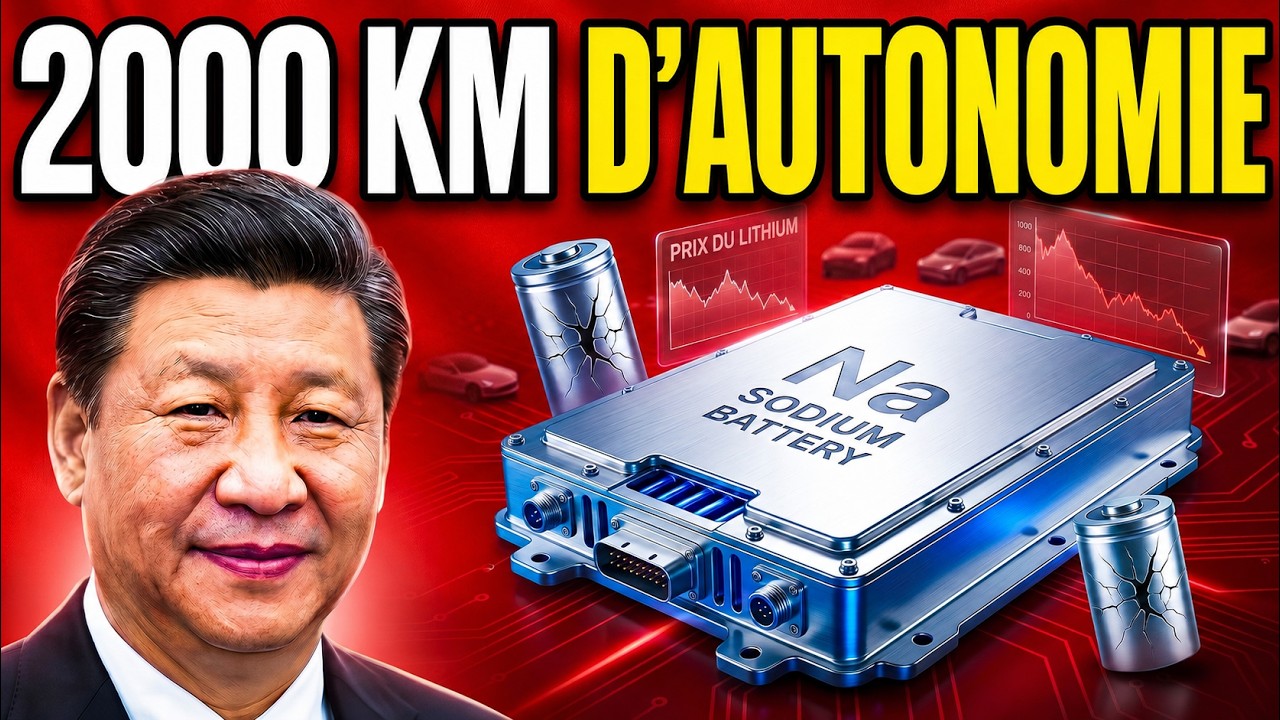
La Batterie Sodium Chinoise Qui Fait Paniquer Toute L’Industrie Des Voitures Électriques
The Chinese Sodium Battery Sending the Entire Electric Vehicle Industry into a Panic
Title history
- La Batterie Sodium Chinoise Qui Fait Paniquer Toute L’Industrie Des Voitures Électriques — observed on 20261101-0101 UTC (YouTube)
Keywords
Summary
145 words
Critical Evaluation
Value of the Information & Strength of the Argument
The video provides a strong, coherent argument supported by quantitative data (cost figures, energy densities, cycle life). It explains technical concepts clearly and uses analogies to make them accessible. The discussion of CATL’s manufacturing innovations (humidity control, dry room design) adds practical depth. The argumentation is mostly balanced, acknowledging the energy density disadvantage while emphasizing cost and cold-weather advantages. However, the claim that $39/kWh is ‘certified’ relies on secondary confirmation by analysts, and the video sometimes overstates the immediacy of disruption without fully addressing scaling challenges.
Scientific Rigor, Source Quality, Title Accuracy
The video maintains scientific rigor by referencing reputable sources: BloombergNEF, Wood Mackenzie, Faraday Institution, and IEA reports. Specific studies and figures are presented without direct links, but the mentions align with known public data. The historical parallels (lead-acid to lithium) are relevant and well-argued. The title is appropriate, though slightly sensational with ‘Panicking’; the content is factually grounded. The video does not include comments for analysis, so no public sentiment can be assessed.
174 words
Title / Content Match
The title accurately reflects the content: the video focuses on the disruptive potential of CATL's sodium-ion battery in the EV industry.
Quality & Reliability
7/10
The video cites recognized institutions (BloombergNEF, Wood Mackenzie, Faraday Institution, IEA) and provides specific technical figures, but as a YouTube explainer it lacks peer review and direct access to primary sources. The cost figure of $39/kWh is presented as certified and confirmed by analysts, yet independent verification is not detailed.
Key Moments
Markers derived by PSI from the transcript: the creator did not define chapters.
- Introduction of the $39/kWh cost from CATL's Yichang plant and its significance.
- Historical comparison of sodium-ion and lithium-ion chemistries, size difference of ions.
- Explanation of why sodium was abandoned: energy density gap and intercalation stress.
- CATL's 2021 announcement and initial skepticism from analysts.
- Technical breakthroughs: Prussian blue cathode with reduced crystalline water and hard carbon anode.
- Manufacturing innovations: dedicated dry room design, 20 GWh production capacity.
- AB battery concept and performance at -40°C.
- Market impact: Chinese EVs under $15,000, grid storage deployments.
Cited Sources
- BloombergNEF analysis of battery costs — Mentioned as confirming the $39/kWh cost and pointing out energy density deficit.
- Wood Mackenzie analysis — Independently confirmed CATL's production cost at Yichang.
- Faraday Institution 2023 study — Cited for the reduction in mining footprint per kWh compared to NMC lithium.
- International Energy Agency (IEA) 2023 report — Projected global battery demand of 4 TWh/year by 2030.
- Argonne National Laboratory — Mentioned as having directed research budgets towards lithium chemistries in the 1990s-2000s.
Concurring Sources
- BloombergNEF cost data — The video references BNEF's confirmation of the $39/kWh figure.
- Wood Mackenzie report on sodium-ion — Mentioned as independently verifying production costs.
Dissenting Sources
- Panasonic research note — Panasonic noted that its own sodium research, abandoned in 2004, achieved similar energy density but concluded intercalation could not be solved at acceptable cost.
Contribution & Novelties
This video synthesizes publicly known but scattered information about CATL’s sodium-ion battery, presenting a clear narrative of the technological and economic challenges overcome. It emphasizes the role of material engineering (Prussian blue cathode, hard carbon anode) and manufacturing innovations (humidity control) in achieving a cost breakthrough. The AB battery concept and cold-weather performance are highlighted as strategic advantages.
Pour aller plus loin :
- Sodium-ion battery - Wikipedia — Provides a comprehensive overview of chemistry, history, and applications.
- Prussian blue - Wikipedia — Background on the pigment’s crystal structure and electrode applications.
- Hard carbon - Wikipedia — Explains the disordered carbon material used as an anode in sodium-ion batteries.
108 words
Radar Profile
The radar profile shows high scores in quantity and quality of information, moderate technical depth, and slightly lower reliability due to reliance on secondary sources. The balance suggests a well-informed but not fully peer-reviewed presentation.