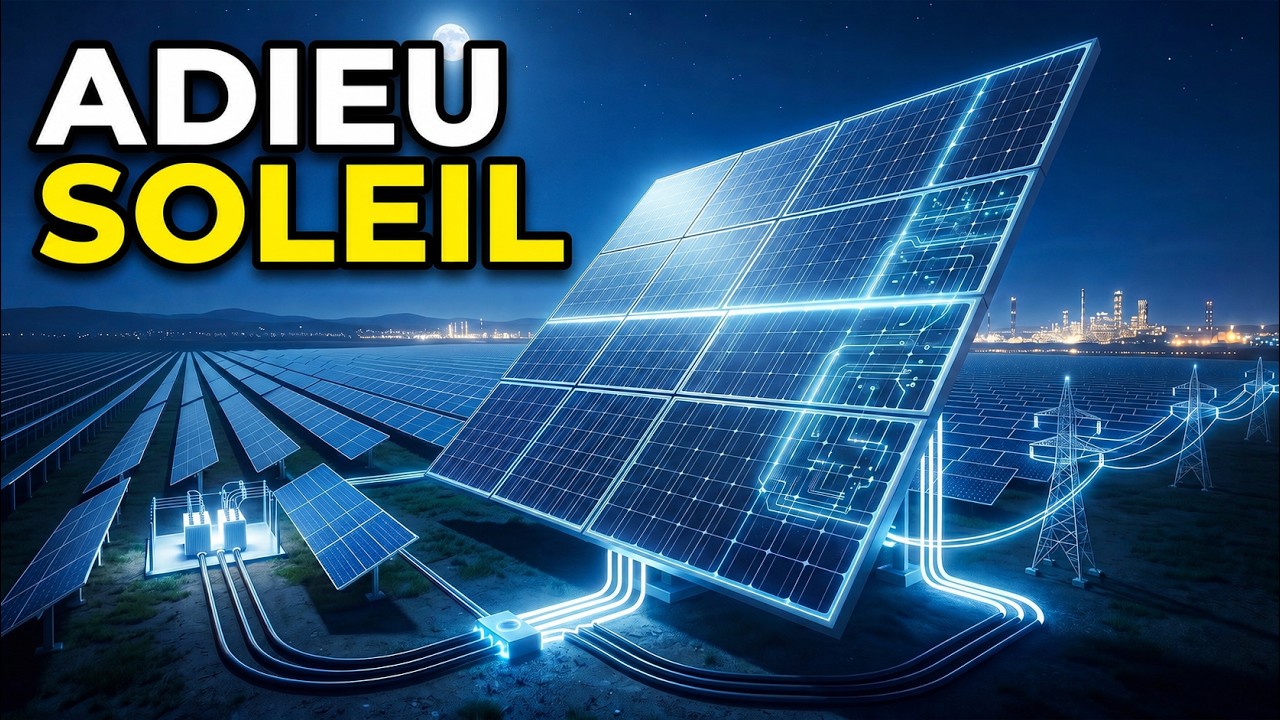
La Chine Vient De Créer Un Panneau Solaire Qui Fonctionne La Nuit
China Just Created a Solar Panel That Works at Night
Title history
- La Chine Vient De Créer Un Panneau Solaire Qui Fonctionne La Nuit — observed on 20261101-0101 UTC (YouTube)
Keywords
Summary
152 words
Critical Evaluation
Value of the Information & Strength of the Argument
The video provides valuable information about a novel concept in solar energy, clearly explaining the thermodynamic principles and separating the innovation from simple battery storage. The argumentation is structured and builds a logical case for why this technology matters, using historical analogies and quantitative data from the research. However, it tends to repeat key points for emphasis, which can dilute the impact, and it sometimes inflates the significance by framing the night production as ‘breaking a rule’ when the actual output is negligible compared to daytime generation. The reasoning is scientifically sound, but the presentation occasionally overstates the immediate relevance.
Scientific Rigor, Source Quality, Title Accuracy
The sources cited are credible and include well-known research institutions and international energy agencies. The video accurately attributes the 2022 diode demonstration to UNSW and the hybrid design to Jiangnan University, and it correctly references the California ISO’s duck curve and IEA investment figures. However, it does not provide direct links to peer-reviewed papers, which limits verification. The title is accurate but uses a sensationalist wording (‘Just Created’) that might exaggerate the novelty, as similar concepts have been explored for decades. The content aligns well with the title, but the scientific rigor would benefit from more precise citations and less repetitive language.
217 words
Title / Content Match
The title accurately reflects the main topic: a solar panel capable of generating electricity at night.
Quality & Reliability
7/10
The video provides a coherent explanation of a real scientific development, corrects the underlying physics, and cites reputable institutions. However, it uses sensationalized language and repetition that slightly dilute the scientific rigor.
Key Moments
Markers derived by PSI from the transcript: the creator did not define chapters.
- Introduction: The concept of a solar panel that continues generating electricity after sunset.
- Explanation of the duck curve problem and the massive investment in batteries to compensate.
- 2022 University of New South Wales demonstration of a thermoradiative diode producing a real current from nighttime heat radiation.
- Description of radiative cooling and thermoelectric generation, including the temperature difference between panel and cold sky.
- Hybrid panel architecture from Jiangnan University with thermally decoupled layers and the challenge of combining day and night functions.
- Measured results: about 800 mW/m² day and tens of mW/m² night, continuous 24-hour production.
- Potential applications for isolated sensors, telecom relays, and emergency infrastructure.
- Limitations: low night output, high cost of thermoelectric materials, and need for further development.
Cited Sources
- Jiangnan University — Research institution behind the hybrid solar panel with day-night capability.
- University of New South Wales — 2022 laboratory demonstration of a thermoradiative diode that generated current from night sky radiation.
- California Independent System Operator — Source of the 'duck curve' concept describing the evening drop in solar production.
- International Energy Agency — Cited for data on battery investment exceeding $40 billion annually.
- International Renewable Energy Agency (IRENA) — Mentioned as tracking thermoradiative and hybrid solar research as a new category.
Contribution & Novelties
The video’s original contribution lies in its clear synthesis of how a solar panel can be engineered to produce a continuous, albeit small, electrical current throughout the night by leveraging radiative cooling and thermoelectric conversion. It explains the hybrid architecture proposed by Jiangnan University, which separates the photovoltaic and thermal layers, and contextualizes this within earlier milestones such as the UNSW diode. The video also translates the technical results into practical applications for off-grid sensors and emergency systems, while honestly discussing the scale and cost limitations.
Pour aller plus loin :
- Radiative cooling — A comprehensive overview of the physical principle behind nighttime heat emission.
- Thermoelectric effect — Explains how temperature differences can generate voltage, the core mechanism of the nighttime module.
- Photovoltaic effect — The foundational physics of solar cells, contrasting with the radiative emission approach.
137 words
Radar Profile
The profile shows a balanced distribution across information quantity, quality, technical level, and reliability, indicating that the video is informative and moderately rigorous but not without flaws. The reliability score is slightly lower due to some sensationalism and lack of explicit citations, while technical level remains moderate, making it accessible to a broad audience.
💬 Balanced: The 30 comments are mixed, with some viewers praising the topic and clarity while others criticize the excessive repetition and lack of new information, and a few question the originality of the technology.