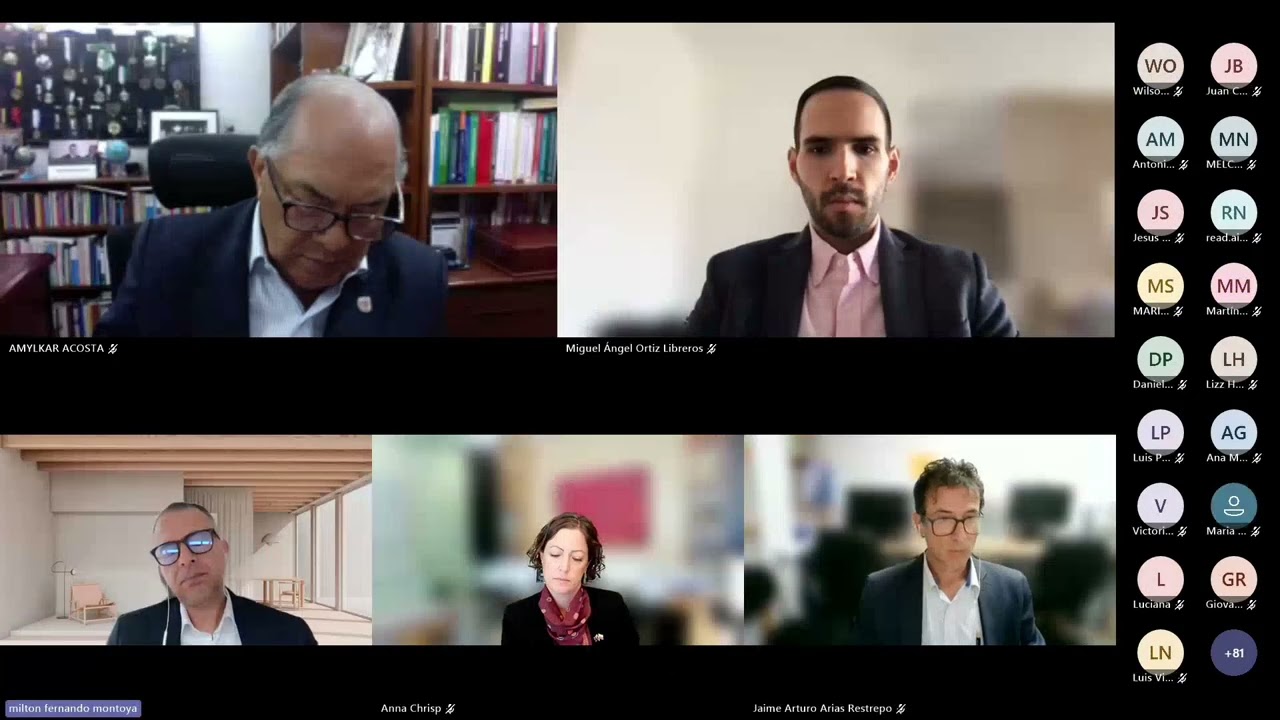
LANZAMIENTO DDHH, minería y competitividad territorial (GDIAM/ECOS)
LAUNCH DDHH, mining and territorial competitiveness (GDIAM/ECOS)
Keywords
Summary
207 words
Critical Evaluation
Value of the Information & Strength of the Argument
The information value of this video lies primarily in its role as a launch event for a policy document, offering a synthesis of the GDIAM/ECOS perspective on the intersection of human rights, mining, and territorial competitiveness in Colombia. The speakers provide contextual framing: the urgency of developing mining and energy projects, the need for territorial and social dialogue, and the importance of legal and physical security. However, the transcript captures only the opening remarks and the beginning of the document presentation; the substantive panel discussion is not included. The argumentation is largely normative and rhetorical, drawing on quotes from Serrat, Pope Francis, and Antonio Machado to emphasize pluralism and careful action. While the speakers reference concrete issues—such as the 1,885 social leaders killed since 2016, the ratification of ILO Convention 169, and the National Action Plan on Business and Human Rights—these are mentioned without detailed evidence or data analysis in the transcript. The reasoning is coherent but remains at the level of expert opinion and policy advocacy rather than rigorous empirical demonstration. The document itself is presented as a starting point for dialogue, not as a definitive study, which limits the argumentative depth available in this recording.
Scientific Rigor, Source Quality, Title Accuracy
The event is organized by a reputable academic institution and features recognized experts, which lends credibility to the discussion. However, the transcript does not include citations to specific studies, data sources, or peer-reviewed literature; the only source referenced is the document being launched, available via a link in the description. The speakers mention international instruments (ILO Convention 169, the National Action Plan on Business and Human Rights) and a statistic on social leaders (1,885 since 2016) attributed to INDEPAZ, but without direct citation in the transcript. The title accurately reflects the content: the event is indeed the launch of the document ‘Human Rights, Mining and Territorial Competitiveness’ and the discussion remains focused on that theme. No comments were provided for analysis.
333 words
Title / Content Match
The title accurately reflects the content: the event is the launch of the document 'Human Rights, Mining and Territorial Competitiveness' and the discussion stays on that topic.
Quality & Reliability
6/10
The event is hosted by a recognized academic institution (Universidad Externado de Colombia) and features credentialed experts (a former Minister of Mines and Energy, a department director, the executive director of ECOS). The content is a launch presentation of a policy document, not a peer-reviewed study; claims are largely normative and contextual, with limited verifiable data in the transcript. The single link in the description points to the document itself, which is a primary source. No independent verification of the document's methodology is possible from the transcript alone.
Key Moments
Markers derived by PSI from the transcript: the creator did not define chapters.
- Welcome and introduction by the moderator, acknowledging the organizing institutions: Universidad Externado, Instituto ECOS, and GDIAM.
- Dr. Milton Montoya, director of the Department of Mining and Energy Law, gives opening remarks on the urgency of mining and energy development in Colombia and the need for territorial and social dialogue.
- Miguel Ángel Ortiz, executive director of ECOS, presents the institutional transition from GDIAM to ECOS and frames the document's purpose: to open a plural conversation on human rights in mining.
- Dr. Amilcar Acosta begins his presentation of the document, quoting Serrat, Pope Francis, and Antonio Machado to emphasize pluralism and careful action.
- Acosta outlines the document's structure: starting point, normative framework, territorial situation, human rights and competitiveness, and conclusions.
- Acosta highlights the lack of physical and legal security in mining territories and mentions the killing of 1,885 social leaders since 2016.
- Acosta notes Colombia's ratification of ILO Convention 169 and the adoption of the National Action Plan on Business and Human Rights, while pointing to implementation gaps.
Cited Sources
- DDHH, minería y competitividad territorial (GDIAM-ECOS) — The document being launched, available for download via the link in the video description.
Contribution & Novelties
The video’s original contribution is the public launch of a policy document that synthesizes the GDIAM/ECOS perspective on human rights, mining, and territorial competitiveness in Colombia. It brings together academic, governmental, private sector, and civil society voices to frame human rights protection as a condition for, rather than an obstacle to, territorial competitiveness. The document proposes a corresponsibility approach involving multiple actors—State, companies, communities, ethnic authorities, and academia—and emphasizes the need to close gaps between norms and implementation. It also highlights the urgency of addressing physical and legal security in mining territories and the importance of formalization, gender guarantees, and ethnic recognition.
Pour aller plus loin :
- ILO Convention 169 — International legal instrument on indigenous and tribal peoples’ rights, referenced in the presentation.
- UN Guiding Principles on Business and Human Rights — Framework mentioned indirectly through the National Action Plan.
- INDEPAZ — Colombian NGO that reports on social leader killings, cited for the figure of 1,885 since 2016.
- Instituto ECOS — Organization that now hosts GDIAM and published the document.
171 words
Radar Profile
The radar profile shows moderate information quantity and quality, with a technical level appropriate for a policy-oriented audience. Reliability is above average due to the institutional backing and expert participation, but the lack of empirical data and peer-reviewed sources in the transcript limits the depth. Overall, the content is credible for a policy discussion but not a rigorous scientific study.