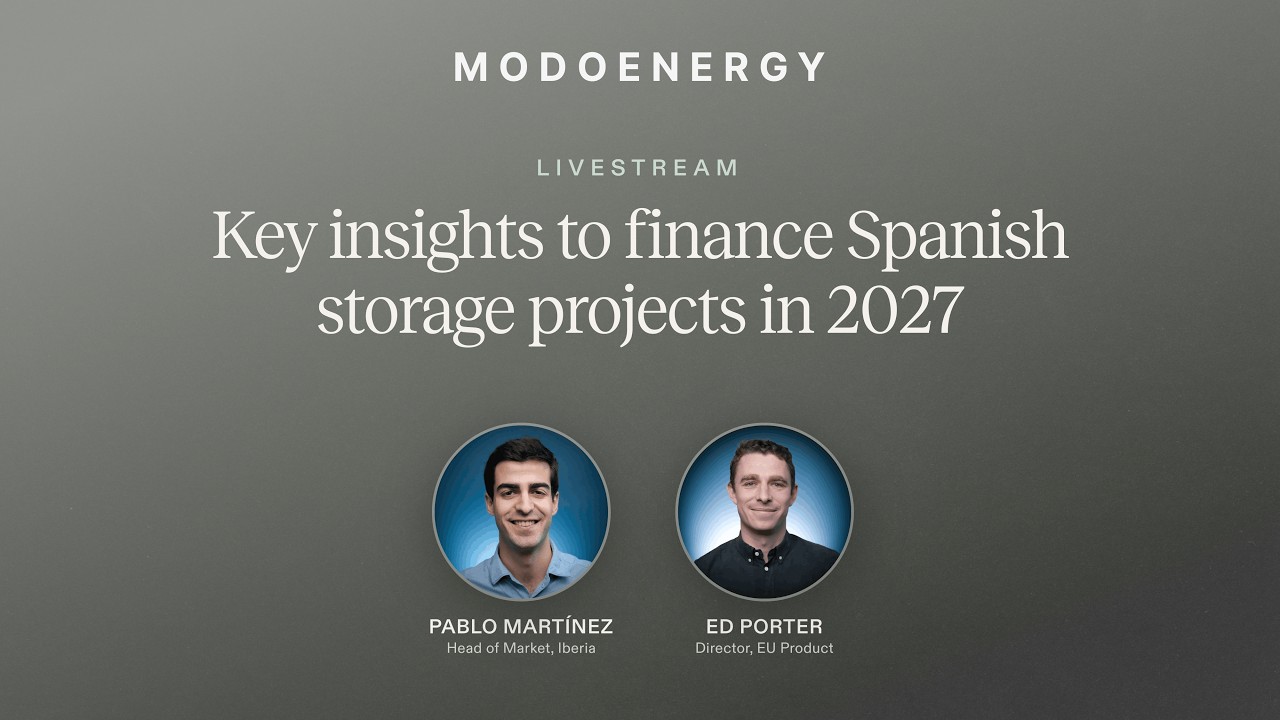
Key Insights to Finance Spanish Storage Projects in 2027 | Livestream
Title history
- Key Insights to Finance Spanish Storage Projects in 2027 | Livestream — observed on 20261118-1418 UTC (YouTube)
Keywords
Summary
258 words
Critical Evaluation
Value of the Information & Strength of the Argument
The information presented is highly valuable for investors and developers in the Spanish storage market, offering specific revenue forecasts, saturation thresholds, and financing mechanisms. The argumentation is solid, built on Modo Energy’s proprietary models (CEM and PCM) and supported by data on gas prices, hydro inflows, and battery costs. The speakers clearly articulate cause-and-effect relationships, such as how gas prices influence hydro opportunity costs and how battery deployment compresses spreads. They also address counterarguments like the risk of dry years and nuclear policy changes, making the analysis balanced and credible.
Scientific Rigor, Source Quality, Title Accuracy
The scientific rigor is high within the scope of proprietary market analysis, with clear methodology for the stress tests and sensitivity scenarios. However, the sources are mostly internal to Modo Energy, and the only external link provided is to their Ko product, limiting independent verification. The title accurately reflects the content, focusing on financing Spanish storage projects, and the discussion covers key financial elements like offtake structures and indices. No community comments were provided for analysis.
181 words
Title / Content Match
The title accurately reflects the content, which focuses on insights for financing Spanish storage projects, including market analysis, revenue potential, and offtake structures.
Quality & Reliability
8/10
The presentation relies on proprietary data and models from Modo Energy, with detailed analysis of Spanish power market, battery buildout, and financing mechanisms. The experts demonstrate a strong grasp of market dynamics, and the analysis is well-structured. However, the lack of publicly verifiable sources reduces absolute reliability.
Chapters
- Welcome and introductions
- Launching a forecast with Ko
- Agenda
- Spain's battery buildout
- Spain vs GB, Australia, ERCOT and CAISO
- Spanish power prices in 2026
- Gas prices and the Hormuz crisis
- How often does gas set the price?
- Hydro price setting
- Hydro, inflows and dry-year risk
- How Modo models Spain to 2060
- Day-ahead saturation in 2030
- Breakeven: 9 to 12 GW of batteries
- Election and nuclear scenarios
- Ko results: co-located forecast
- Benchmarks and indices
- The SSE and Statkraft index swap
- Offtake options and basis risk
- Spain's virtual battery
- Real asset indices and virtual assets
- Q&A: project sizes in Spain vs GB
- Q&A: who operates a swapped BESS?
- Q&A: hydro environmental constraints
- Q&A: flexible grid access in Spain
- Q&A: ancillary service saturation
- Q&A: should new investors still enter?
- Wrap-up
Cited Sources
- Ko - Modo Energy's AI market analyst — Product mentioned for launching forecasts and accessing market data.
External References
Contribution & Novelties
The webinar contributes original insights into the saturation of the Spanish day-ahead market under different battery capacity scenarios, providing a breakeven range of 9-12 GW that is not commonly discussed. It also introduces the concept of using indices like the GB BESS index for fixed-for-floating swaps to reduce basis risk in storage financing, a novel approach in the European market. The virtual battery modeling offers a practical tool for assessing site-specific revenues.
Pour aller plus loin :
- Battery energy storage system — Background on battery technologies and applications.
- Day-ahead market — Explanation of the wholesale electricity market structure.
- Ancillary services — Details on grid services like frequency response, relevant to saturation discussion.
112 words
Radar Profile
The radar profile shows high scores in information quantity and technical level, reflecting the dense and specialized content. The fiability and quality are slightly lower, due to the use of proprietary data and lack of external references, but still strong overall.